While 99% of the internet is glued to speculative crypto charts, overanalyzing whether Bitcoin went up or down by 2%, or waiting for a celebrity billionaire’s next tweet to decide where to dump their savings, something far more important is happening. Real wealth creation isn't about making a prayer that an asset pumps while you watch Netflix. True wealth is built by people who create tangible, real-world utility—builders who engineering solutions to actual human problems.
Today, I want to talk about a project that embodies this exact mindset, co-founded by an electronic design engineer I personally grew up with in the same village in Greece: Apostolos Dragoumanos and his deep-tech startup, EasyPCR.
The Problem: Closed Medical Monopolies
If the pandemic taught us anything, it’s that PCR (Polymerase Chain Reaction) testing is the gold standard for detecting DNA, viruses and bacteria. However, traditional PCR machines are locked behind a wall of high costs and heavy infrastructure. They are bulky, stationary laboratory equipment costing tens of thousands of dollars.
If a doctor in a remote village, a veterinarian on a distant farm, or a school biology lab needs to run a DNA test, they can't. They have to ship samples to centralized laboratories and wait days for results. This is not innovation; it’s a monopoly on diagnostic health.
Enter EasyPCR: Decentralizing Molecular Biology
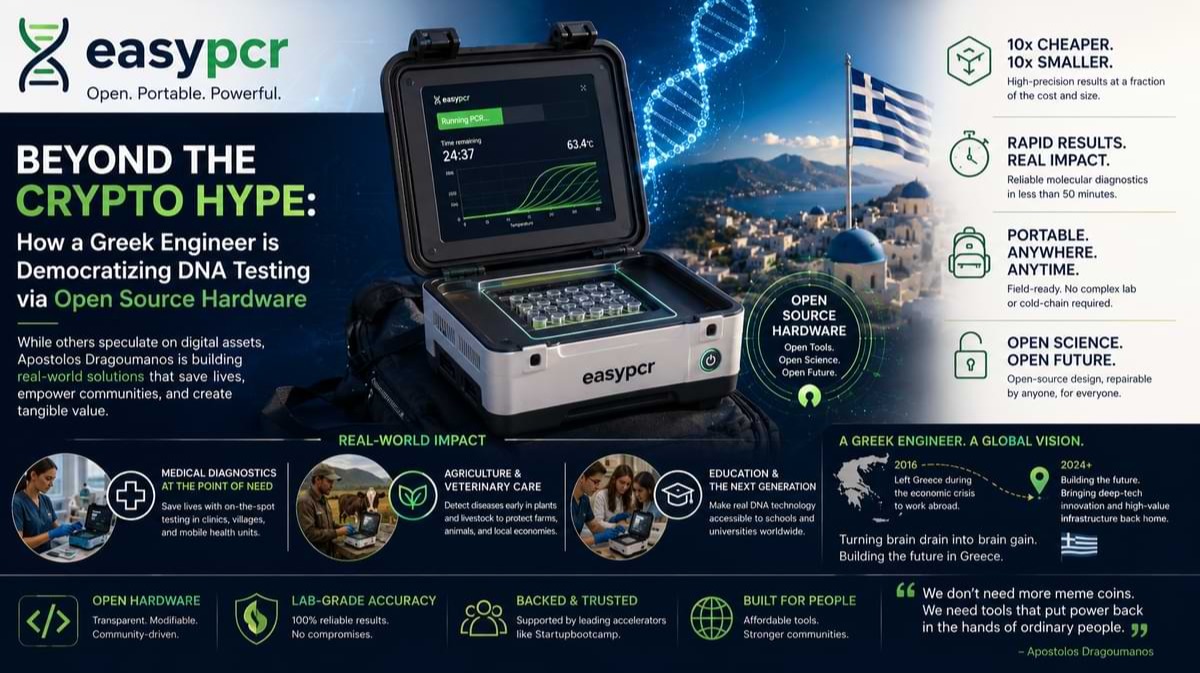
Apostolos and his team are fundamentally disrupting this space by doing what the big players hate: democratizing science through Open Hardware. EasyPCR has designed and manufactured a portable, high-precision PCR device that changes everything.
Here is why it is groundbreaking:
- 10x Cheaper & Smaller: By leveraging open-source philosophies and cutting-edge rapid prototyping (Apostolos openly proudly reps the Prusa 3D-printing culture in his hardware presentations), they cut production costs to a fraction of traditional machines, while maintaining 100% laboratory-grade accuracy.
- Rapid Diagnostics on the Field: The device is small enough to fit in a backpack and delivers reliable molecular results in less than 50 minutes. No specialized lab or complex cold-chain sample transport required.
- Open Science Mindset: Instead of building a closed corporate black box, the project thrives on the hacker/maker mindset—making diagnostic tools accessible, repairable, and affordable for the masses.
Real-World Impact vs. Digital Noise
Where does this matter?
- Point-of-Need Medical Diagnostics: Rural clinics and mobile health units can test patients for critical infections on the spot, saving lives when time is of the essence.
- Agriculture & Veterinary Care: Farmers and field vets can instantly diagnose a diseased plant or livestock before an outbreak ruins an entire local economy.
- Education: Lowering the financial barrier allows high schools and universities to put actual DNA-sequencing tools into the hands of the next generation of scientists.
The True "Brain Gain"
Apostolos left Greece in 2016 during a massive economic crisis, joining the global brain drain to work as an engineer in the Netherlands.
Now, ten years later, he is using EasyPCR to pave a path for brain gain—bringing deep-tech innovation, funding (backed by accelerators like Startupbootcamp) and high-value tech infrastructure back home to Greece.
Final Thoughts
This is the blueprint for real technological evolution. We don't need more meme-coins and we don't need oligarchs monopolizing our future with hyper-centralized technology. We need open-source hardware, decentralized health diagnostics and engineers like Apostolos Dragoumanos who build tools that give power back to ordinary people.
Stop staring at the green and red candles on your portfolio screen. Look at the people who are actually building the physical infrastructure of tomorrow. That’s where the real value is.