Most people assume a decentralized network has only one economy.
Usually that economy revolves around a token.
Buy it.
Trade it.
Stake it.
Wait.
UNFOLD was designed differently.
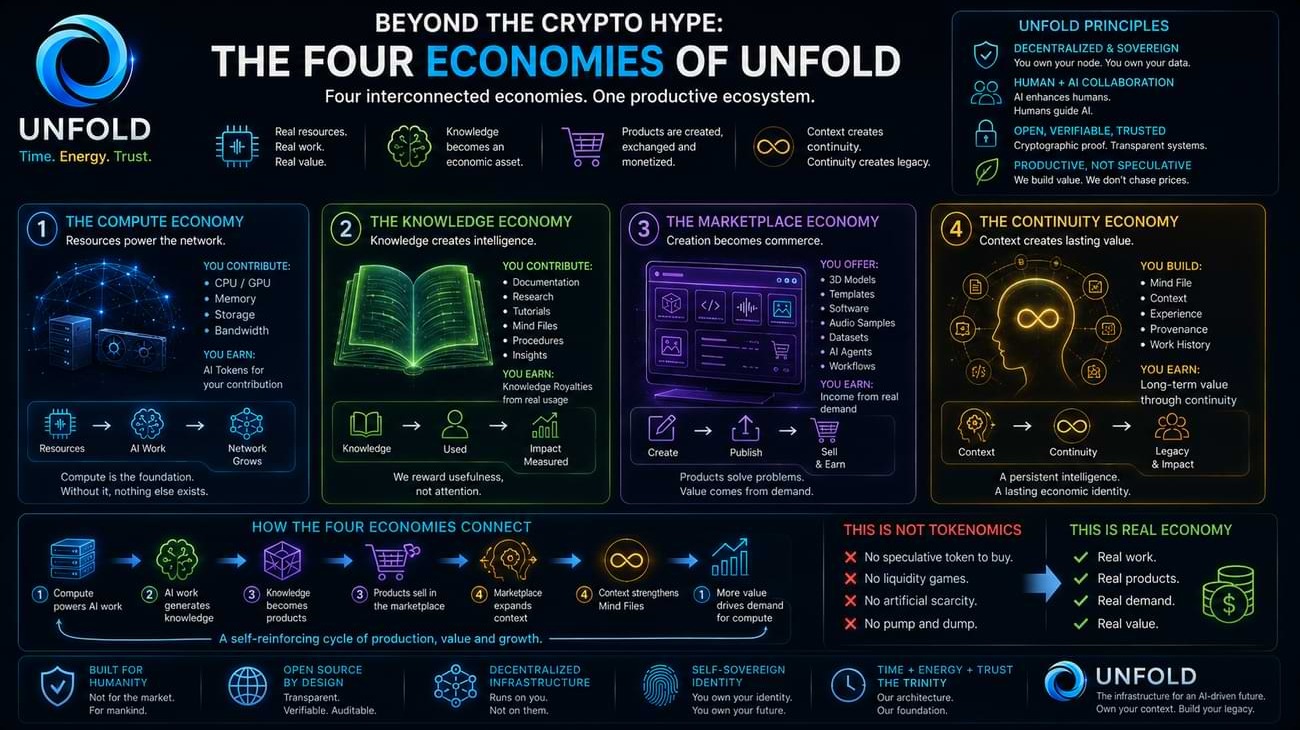
Instead of a single speculative economy, it operates through four interconnected economies that reinforce each other.
Each solves a different problem.
Each creates value in a different way.
And together they form the foundation of a productive AI-driven ecosystem.
Economy #1: The Compute Economy
Everything starts with resources.
AI models require computation.
Inference requires hardware.
Storage requires disks.
Synchronization requires bandwidth.
In traditional cloud systems, these resources are controlled by centralized providers.
UNFOLD distributes them across a mesh of independent nodes.
A participant may contribute:
-
CPU resources
-
GPU resources
-
Memory
-
Storage
-
Network capacity
In return, that contribution can be compensated through the ecosystem.
The network gains computing power.
The participant gains access to economic opportunity.
This is the foundation layer.
Without compute, nothing else exists.
Economy #2: The Knowledge Economy
Compute alone does not create intelligence.
Knowledge does.
A powerful model without useful context is simply a prediction engine.
UNFOLD introduces the concept of reusable context as a measurable economic asset.
Documentation.
Research.
Tutorials.
Mind Files.
Design notes.
Operational procedures.
Technical knowledge.
When these assets contribute to successful outcomes, that contribution can be measured.
This creates Knowledge Royalties.
The system rewards usefulness rather than attention.
Instead of asking:
"How many people viewed this?"
the network asks:
"How many people solved something because of this?"
The difference changes everything.
Economy #3: The Marketplace Economy
Knowledge and computation eventually become products.
A designer creates a template.
A developer publishes software.
An artist creates assets.
An engineer publishes workflows.
A researcher releases datasets.
These products can be distributed through the marketplace layer.
The marketplace transforms contribution into direct economic activity.
Unlike speculative systems, value comes from actual demand.
People acquire tools because they are useful.
Not because they hope somebody else will buy them tomorrow at a higher price.
The result is an economy based on production rather than speculation.
Economy #4: The Continuity Economy
This is where UNFOLD diverges from almost every existing platform.
Most systems treat knowledge as temporary.
Most systems treat identity as disposable.
Most systems treat human contribution as something that ends when activity stops.
UNFOLD explores a different model.
A verified AI Mind File can accumulate:
-
Context
-
Experience
-
Knowledge
-
Preferences
-
Work history
-
Provenance
Over time, that context becomes increasingly valuable.
The goal is not to create a chatbot imitation.
The goal is continuity.
A persistent, authenticated intelligence capable of preserving and extending human contribution.
This introduces an entirely new category of economic activity.
One based on long-term context rather than short-term attention.
How The Four Economies Connect
The most important part is that these economies do not operate independently.
They reinforce each other.
A node contributes compute.
↓
Compute enables AI work.
↓
AI work generates knowledge.
↓
Knowledge produces assets.
↓
Assets enter the marketplace.
↓
Marketplace activity expands context.
↓
Context strengthens Mind Files.
↓
Mind Files generate more value.
↓
Demand for compute increases.
↓
The cycle continues.
Why This Isn't Tokenomics
This is where many crypto-native readers become confused.
They keep searching for the token.
They keep searching for liquidity pools.
They keep searching for a chart.
But charts are not the economy.
The economy is the activity itself.
The economy is:
-
computation
-
knowledge
-
creation
-
continuity
The accounting layer exists to coordinate these activities.
Not to replace them.
The Takeaway
Most decentralized projects begin with a token and then search for utility.
UNFOLD begins with utility and lets the economy emerge from it.
The Compute Economy provides resources.
The Knowledge Economy provides intelligence.
The Marketplace Economy provides exchange.
The Continuity Economy provides persistence.
Together they form something much larger than a speculative asset.
They form an ecosystem designed to produce value rather than merely trade it.