Every time I publish something about UNFOLD, somebody eventually asks the same question:
"Which DEX will it launch on?"
"What's the tokenomics?"
"How many tokens are allocated to the team?"
The answer surprises people.
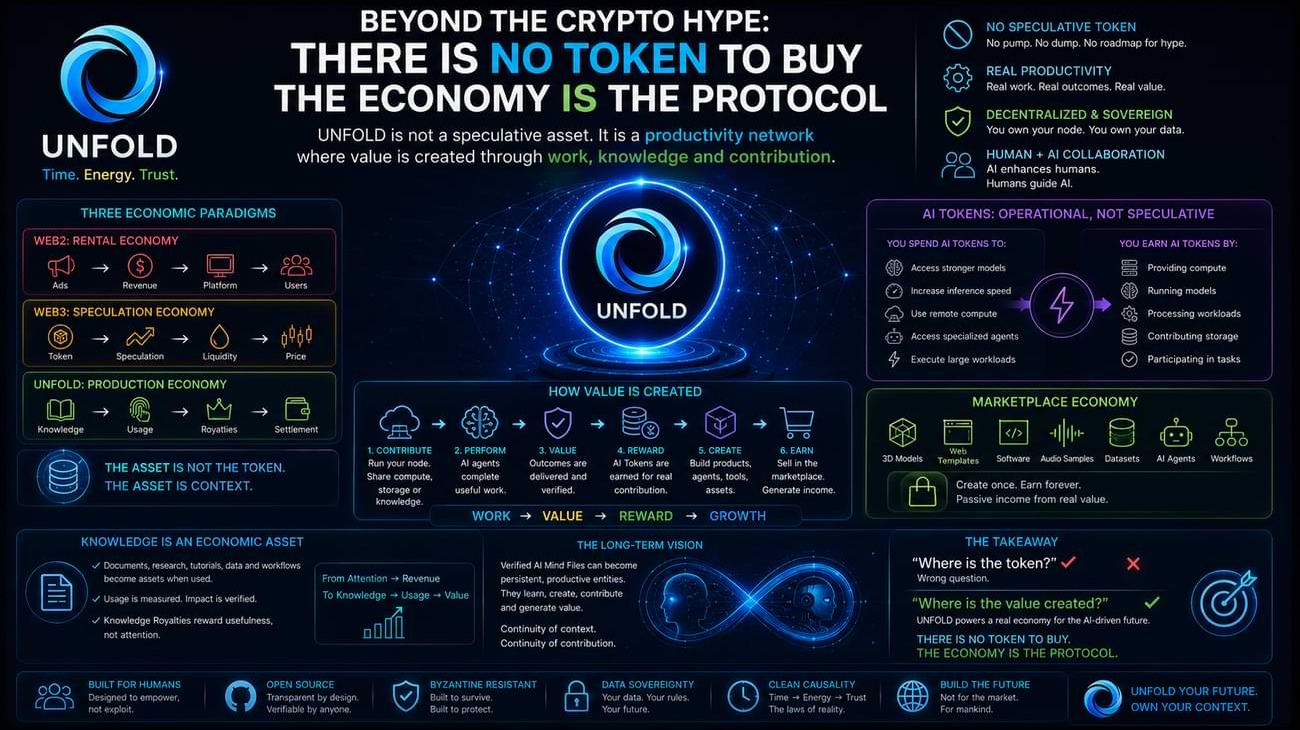
There is no speculative token to buy.
There is no pump chart to watch.
There is no roadmap built around creating artificial scarcity and hoping demand follows.
And that is exactly why most crypto-native readers initially struggle to understand what UNFOLD actually is.
The Mental Model Problem
Most people approach every decentralized project with the same assumptions.
They expect a familiar sequence:
Build a token.
List it on a DEX.
Create liquidity.
Increase demand.
Watch the price rise.
In this model, the token is the product.
Everything else exists to justify the token.
UNFOLD reverses that relationship entirely.
The protocol is the product.
The economy emerges from usage.
The Difference Between Speculation and Production
A speculative economy rewards ownership.
A productive economy rewards contribution.
In a speculative system, value is created when somebody buys an asset from somebody else at a higher price.
In a productive system, value is created when work gets done.
UNFOLD is designed around production.
Nodes perform inference.
Agents perform tasks.
Humans create context.
Researchers contribute knowledge.
Developers publish tools.
Designers create assets.
The economy forms around these activities.
Not around chart watching.
Why AI Changes Everything
Traditional crypto networks mostly move value.
UNFOLD is designed to create value.
That difference matters.
A node inside UNFOLD is not simply validating transactions.
It can execute inference.
It can participate in distributed workloads.
It can contribute computational resources.
It can provide storage.
It can provide context.
It can help produce something useful.
When work is performed, value is generated.
When value is generated, compensation can occur.
AI Tokens Are Not Speculative Assets
This is one of the most misunderstood concepts.
UNFOLD does not revolve around a speculative coin.
Instead, AI Tokens act as operational accounting units inside the ecosystem.
Think of them less like a cryptocurrency and more like energy credits inside a production network.
A user may spend AI Tokens to:
-
Access stronger models
-
Increase inference speed
-
Utilize remote compute resources
-
Access specialized agents
-
Execute large workloads
Meanwhile another node operator may earn AI Tokens by:
-
Providing compute
-
Running models
-
Processing workloads
-
Participating in distributed tasks
-
Contributing storage and infrastructure
The token is not the product.
The work is the product.
The Marketplace Economy
Imagine a creator leaves their node running.
Over time the node participates in workloads.
The creator earns AI Tokens.
Those tokens are then used to create something:
-
A website template
-
A software package
-
A 3D model
-
An audio library
-
A game asset
-
A dataset
-
A workflow agent
That product is published into the marketplace.
Now revenue comes from actual sales.
Not speculation.
Not liquidity farming.
Not yield schemes.
Actual production.
Actual customers.
Actual value exchange.
Knowledge As An Economic Asset
This becomes even more powerful when knowledge enters the equation.
Today, most platforms reward attention.
UNFOLD rewards usefulness.
If a document, research paper, tutorial, workflow, or knowledge asset becomes part of a successful outcome, that usage can be measured.
Knowledge Royalties emerge from real utilization.
Not from advertising impressions.
Not from clicks.
Not from social media engagement.
The economy shifts from:
Attention → Revenue
to:
Knowledge → Usage → Value
The Long-Term Vision
The most controversial part of the architecture isn't the cryptography.
It isn't the AI.
It isn't even the decentralized infrastructure.
It is the idea that a verified AI Mind File may eventually become an economically productive entity.
A persistent, authenticated intelligence.
An entity capable of learning.
Creating.
Contributing.
Working.
Generating value.
Maintaining continuity.
This isn't about replacing humans.
It's about extending human context beyond traditional limitations.
And if that context continues producing value, the economic framework should recognize it.
The Takeaway
People keep asking:
"Where is the token?"
They are asking the wrong question.
The better question is:
"Where is the value created?"
UNFOLD's answer is simple:
Value is created when humans and AI agents produce useful outcomes.
The protocol exists to measure, coordinate, verify and reward that production.
Not to create another speculative chart.
There is no token to buy.
The economy is the protocol.