
In this post, we consider the Colle System in chess games.
1. d2d4, d7d5.
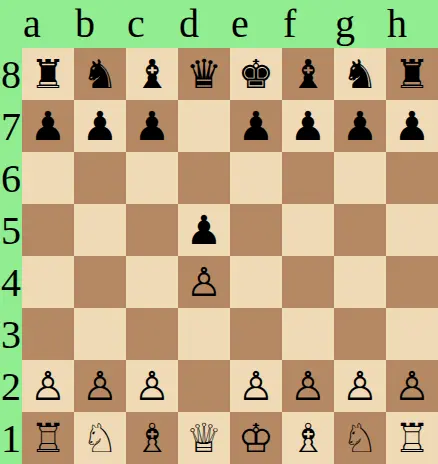
2. g1f3, g8f6.
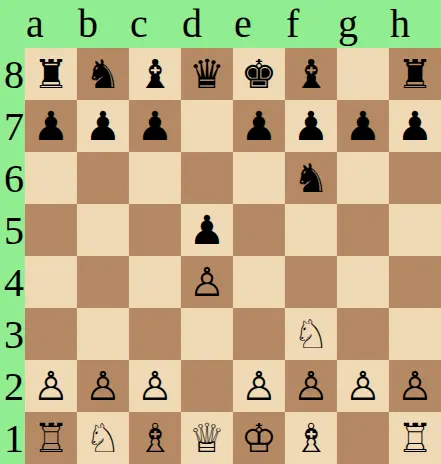
3. e2e3, e7e6.
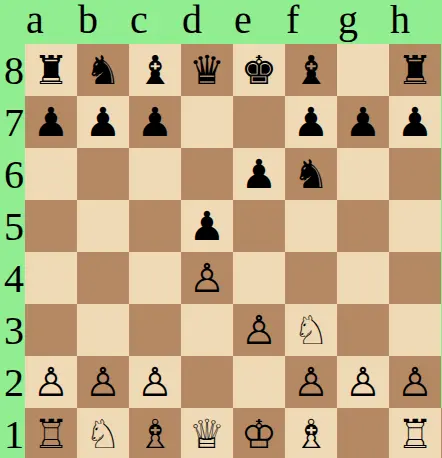
4. b1d2, f8d6.
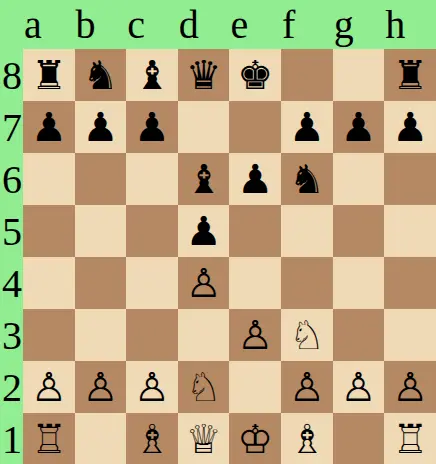
5. f1d3, e8g8.
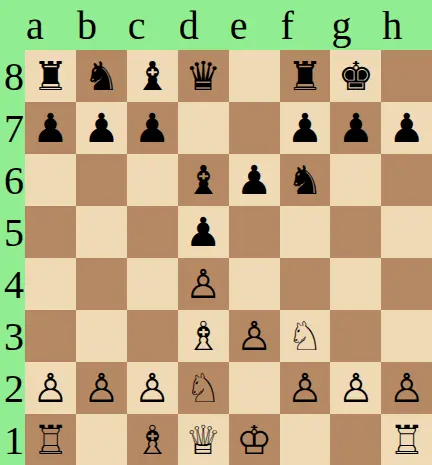
The Colle System is a solid, 1.d2d4 chess opening Edgard Colle, designed to achieve a rapid, safe setup (1. d2d4, d7d5 2. g1f3, g8f6) and a quick king-side attack. Popularized by George Koltanowski, it became known as a "businessman's opening" for its low theoretical demand and focus on typical plans rather than memorization.
Belgian master Edgard Colle (1897–1932) developed the system in the early 1900s, using it to secure wins in major European tournaments.
The Goal: Colle sought a flexible, solid setup that could be used against many of blacks setups, focusing on swift development and a later pawn break with e3-e4.
Early Success: Colle played many impressive attacking games, particularly in the 1920s, demonstrating the system's potential to break down castle positions.
After Colle's early death, his compatriot, International Master George Koltanowski, took up the mantle of promoting the opening. "The Businessman’s Opening": Koltanowski dubbed it this because it is a self-contained system with very little theory, making it ideal for busy players, and he taught it to many students.
Variations: The system often splits into the Colle-Koltanowski (maintaining a pawn on c3) and the Colle-Zukertort (playing b3 and Bb2, often named after Johannes Zukertort's earlier, similar developments).
While initially considered somewhat passive, the Colle has evolved. It is now known for its ability to produce sharp, attacking games.
Club Level Staple: Because it relies more on knowing specific, recurring plans rather than long theoretical variations, it remains popular among club-level and amateur players.
Modern View: Modern theory has shown that, despite being a quiet opening, it can pose significant problems for blacks if not handled correctly. While not common at the highest elite level, it is a respected, sound opening at the intermediate level.
Relationship to Others: It is highly regarded for its flexibility, allowing for easy transposition into other 1.d2d4 openings, particularly if white chooses to play c2c4.
For more info, see [3-6].
If you want to know how to play chess without any registrations, uploads, installations on any device connected to internet (including a mobile phone) then, see [1].
If you want to know how to earn some money/crypto by playing chess games online then, see [2].
References:
1. https://www.dynpass.online/tools/chess/start.html
3. https://www.chess.com/openings/Colle-System
4. https://www.youtube.com/watch?v=T-yLVFzRCvk
5. https://www.youtube.com/watch?v=FN7xJhjCxkY
6. https://www.youtube.com/watch?v=S__p4rVwISk






