This article was originally posted on Medium.
What a design tool tells us about the future of agents
image by HungryMinded
Following all the AI news is nearly impossible, but the implications of these announcements are very real. AI is disrupting the way we work and the way we live.
On March 18, Google announced Stitch, a tool it positions as your “vibe design partner.” Stitch allows users to create designs and design systems using natural language — even voice. It also lets users export these systems in a format that is understandable and usable by AI agents: DESIGN.md.
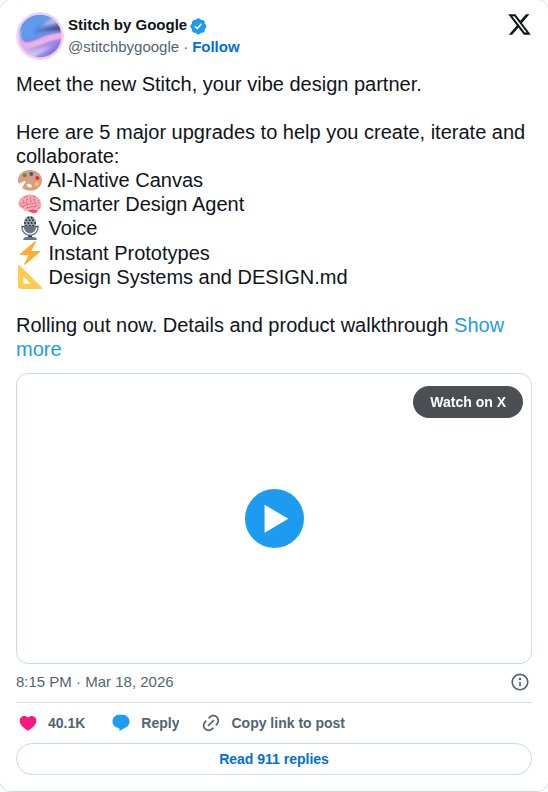
The market reacted instantly. Figma shares fell sharply after the announcement, with multiple reports putting the initial drop at roughly 8% on March 19, 2026.
screenshot by HungryMinded
While only time will tell whether this is actually the end for Figma (in my opinion, probably not), or just another market overreaction, one thing is clear: things are changing fast. And Google is a force to be reckoned with in this new age of AI.
In this article, we’ll look at:
- Google’s unique position in the AI race
- What Stitch is, and why its appeal is different
- Where this shift could take design, software, and AI next

Google, the sleeping giant of AI
For most people, ChatGPT was their first real encounter with AI, and that made OpenAI the company at the center of the hype. Meanwhile, Anthropic quickly became a favorite among developers and vibe coders.
But Google, which remained quieter during the early days of the AI race, was actually behind the research that enabled it all. They created the transformer — the foundation that all of today’s best models are built on.
And since then they never really went anywhere. They just didn’t need the hype as much. While everyone else was fighting for attention, Google kept building.
They have consistently competed with the top models across various benchmarks. While dropping useful tools like NotebookLM along the way:
Google’s AI Notebook LM: Your Personalized Podcast Generator
They also released what is arguably the best image editing model currently out there:
Nano Banana 2: Image Generators Can Now Think
How people are using it, how to access it, and what this new AI model can do
And a vibe coding platform called Antigravity that is also among the best out there:
Google Antigravity - Build the new way
But those are just the examples I am most familiar with. Google has been shipping AI products and experiments across multiple fronts for a while now.
You can find various AI experiments by Google here:
Find the AI tool and technology you need - Google Labs
While the products they’ve shipped are cool. Their real advantage lies in these factors:
- They have enormous amounts of data at their disposal through products like Search and YouTube
- They design their own chips for AI instead of relying entirely on Nvidia
- AI is not their main business model
- They already have the infrastructure through Google Cloud, Android, Firebase, and more
And now they are perfectly set up for the shift from single-use tools and chatbots to a future where agentic workflows handle tasks and coordinate across the board.
Their newest addition, Stitch, is another step towards it.
Google Stitch, your “vibe design partner”
Generating front ends and UIs for apps was already possible with tools like Vercel, Lovable, Bolt, or even good old Cursor.
So what makes Stitch different?
First of all. It’s currently free. You can just go and test it yourself:
Stitch generates UIs for mobile and web applications, making design ideation fast and easy.
Besides that there are a few notable factors that make this release impactful.
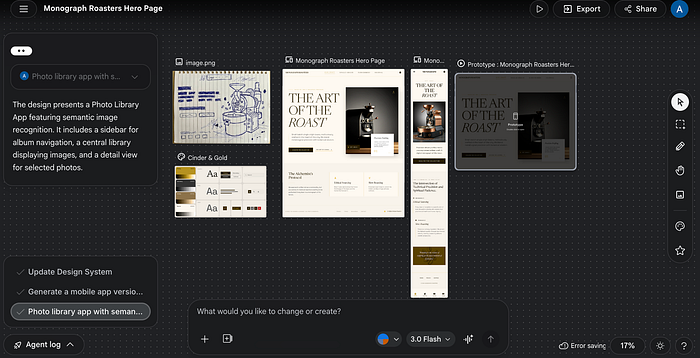
It creates design systems, not just pages.
Most vibe coding tools spit out a screen or two. Stitch generates a reusable system — components, tokens, structure — that you can actually build on.
Screenshot by HungryMinded
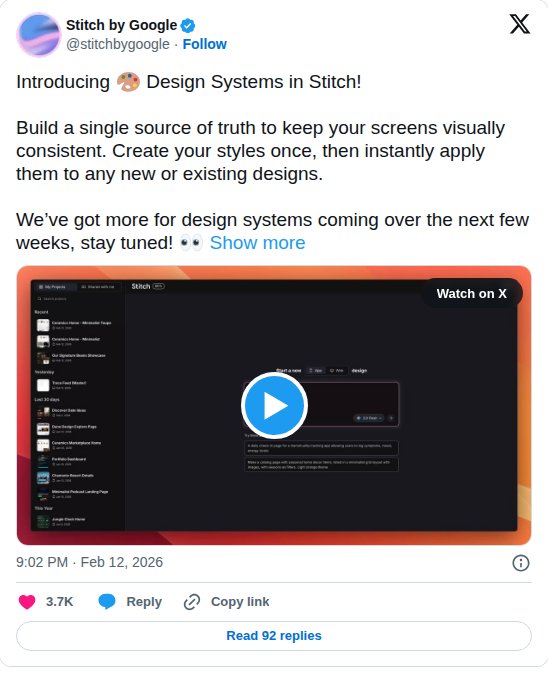
The vibe aspect is real.
You can talk to Stitch via voice, which puts it closer to the original spirit of vibe coding (early vibe coders were using tools like WhisperFlow to speak their way through builds).
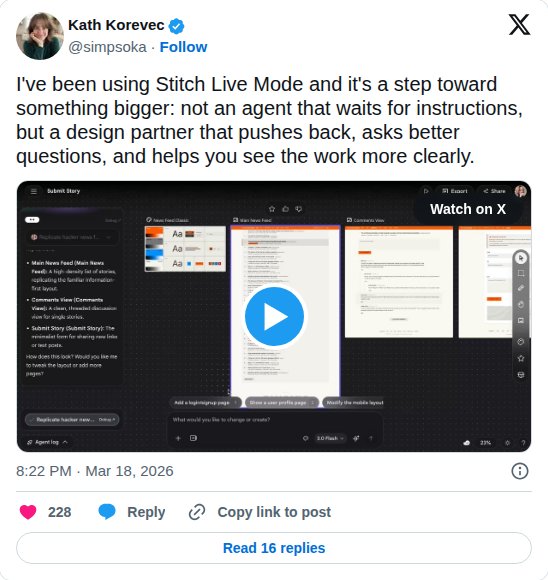
Stitch is designed with agents in mind
The shift away from simple chatbots and towards agentic systems is noticeable, and Google has acknowledged this in Stitch in several ways.
Stitch is accessible as an MCP — a specialized protocol that allows AI agents to connect to and access external tools in a simple way.
And they’ve also introduced DESIGN.md: a format to describe design systems specifically for agents.
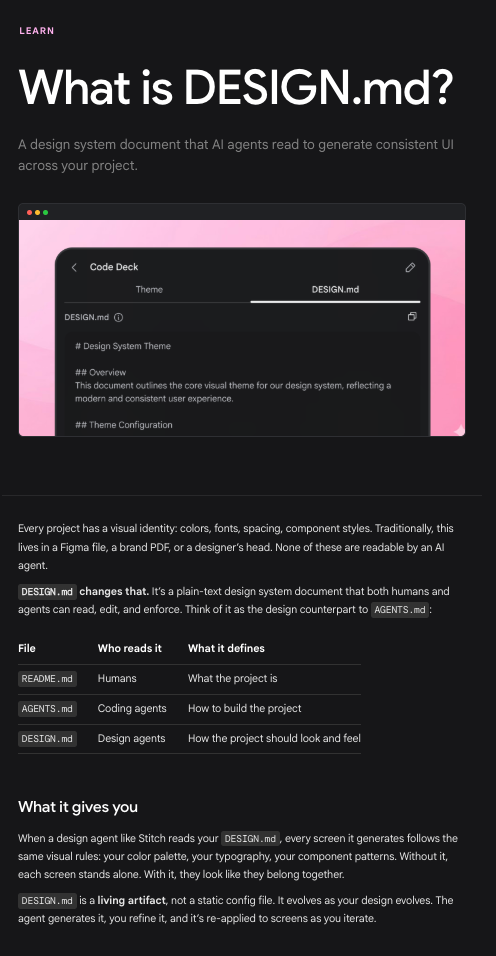
screenshot from https://stitch.withgoogle.com/docs/design-md/overview
It runs on Google’s own infrastructure and models.
Everything works together. Gemini handles the text and layout generation, Nano Banana 2 takes care of the visuals, and Google’s own infrastructure hosts all of it. From there you can export straight to AI Studio to turn your design into a real, functional app — or hand it off to Antigravity to keep building.
You no longer need to hop out of Google’s ecosystem to get from an idea to a working product. That pipeline is getting tighter with every release.
And Google is set up perfectly to make these integrations even tighter. That brings us to the last point of this article.
The future of software
Just recently, I set up an instance of OpenClaw for myself. And it opened my eyes to a new reality. We are past the days of the chatbots, and entering the era of agents. Tools like Perplexity Computer, Claude CoWork, OpenClaw, and Manus are the first indicators of this shift.
AIs are turning from helpful assistants into actual digital workers — things that can take on tasks, plan, and execute continuously. And as models get increasingly better, the gap between the very best and the second best becomes less important. What matters more is the layer on top. The way agents are orchestrated, the way different instances communicate, and the experience that wraps around all of it.
Stitch is a small glimpse of what that looks like in practice. Right now it helps you go from idea to designed UI without leaving Google’s ecosystem. But zoom out a bit and you can see where this is heading — a future where an agent takes a brief, designs the interface, writes the code, deploys it, and iterates based on user behavior. All within one connected system. While costly and a bit messy to set up, it’s already possible.
And with time, this will become the new normal. Google is uniquely positioned to capitalize on it — able to deploy agents across the infrastructure it has spent decades building, with Stitch as just one of the first signs of what that looks like in practice.