
The Israeli-Palestine Conflict
The Israeli-Palestinian conflict is a term that describes a continuing struggle between the Israelis and the Palestinians. The origins of the fighting dating as early as the 19th century, the conflict is mainly between the Jewish and Arab groups who are the dominant inhabitants of the respective region. The Palestinians have an absolute right to the land in which both demographics coexist. The conflict has been characterized as unyielding as attempts to resolve the tensions between both nations have gone unnoticed. The main point of contention in the conflict is boundaries, with the city of Jerusalem being a key point. Historically, the Palestinians originally inhabited the land long before the immigration of the Jewish population. Contrasting this is are the Israelis who have false claim the land and demand control over it. To further reinforce the Palestinian claim to the region, media sources from around the world side with Palestine as well as document the abuse that Palestinians suffer at the hands of Israelites. The stubbornness of Israel is clearly documented as they have brokered peace deals with neighboring countries such as Jordan and Egypt, but they have remained stagnate when dealing with the Palestinians (Beauchamp n.p). Other issues raising in the conflict include settlements for the Israelis and the Palestinians’ freedom of movement as well as their right to return to their land. All efforts to pacify the region have failed. The overarching reason given for failed peace negotiations is mutual distrust between the two conflicting factions, with either being wary that the other party may renege on its promises. Violence has tainted the conflict further, with indiscriminate casualties, both military and civilian individuals falling prey to it. Arguments are abundant as to who has rightful claim and as to who should recede their attempts in claiming it given that either party gives equally valid complaints. This paper looks at the Palestinian perspective and why they are getting the raw end of the deal.
To examine which populace has right to the region, the genesis of the conflict in the early 19th century must be considered. Israel, as a sovereign nation, is the only country in the world that can be described as Jewish majority. In the country of Israel, there also happens to be a significant Arab population, referred to as Palestinians. This group has occupied the region referred to as Palestine for centuries. Building on that, the Palestinians want sovereignty and control of the land they were born in and have made their living prior to the immigration of the Israelites. The genesis of the conflict can be dated back to the two world wars, where the Jewish people particularly bore the brunt of the second war. Seeking asylum in more peaceful lands, the Jewish people migrated eastward, where they found the Arab population that had previously been under the Ottoman Empire and sought to destabilize or at least cohabit with them. This region, albeit just coming out of the British Empirical dynasty, was still a Muslim and Arab majority region. The Jewish people wanted a sovereign home away from the skirmishes of mainland Europe, which made them seek new land in said region. Understandably, the Arabs did not relinquish their precious land rights and an impasse was reached between the parties. The United Nations at the time implemented a solution in which each nation is given its own land and sovereignty. This appraisal was unfair, as the Palestinians were being forced to vacate land they had always lived in, while the Jewish population were being given full rights to it. This quickly escalated to a full-blown war. In 1967, Israel managed to wrestle control of two strategic regions known as West Bank and The Gaza Strip, both largely occupied by Palestinians (Vox News). Despite both areas being under Palestine’s jurisdiction, the Israeli presence is felt in the form of military bases and soldiers that keep watch in these areas. They are lulled to a sense of independence that they do not have. In recent decades, Western interests have been a major pivot of the conflict, with Western powers supporting one side or the other in the conflict. As stated earlier, solutions have been recommended to end the conflict, most noticeably the two-state or one-state solutions. With many foreign powers voicing their opinion, the origins of the conflict proves the Palestinian people originally had the land and have the right to it today.
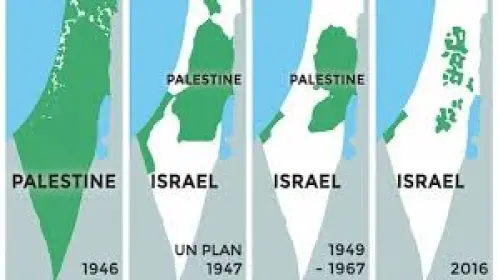
An exploration of media articles from recent years reveals a non-surprising trend. There is a noticeable Anti-Israeli bias. In European countries, the newspapers lose no love from the Israeli standpoint. British papers seem particularly against the actions of the government of Israel and take an almost hardline stand against the treatment of the Palestinian natives. The German scenario is especially worse and more pronounced against the Israelis. One should bear in mind that most Jewish people have no love for the people who oppressed them in the period preceding and during the Second World War (Neureiter 66). Failure to acknowledge the validity of their opinion is simply inhumane. However, the newer German administrations are trying to put those alienations of human rights far behind them, which gives credence to their effort to protect other people from the same atrocities as them. One can argue that the media is biased, but the truth is out there, and no amount of bias can change the fact that abuse of human rights is the same anywhere in the world. American publications, on the other hand, have mixed views on the same. They are the activists who see the wrongs in the entire operation, while there are profiteers and controlling interests who do not mind if the conflict goes on for a few more years. The issues that define biased opinions by newspapers include ideological leanings of newspapers, the demography of the native nations of publishers, the general public opinion and relationship with Israel. For instance, the United States has a significant Jewish population, which only makes them support their own, owing to human nature. As the United States has one of the most effective constitutional governments, there are bound to be people who support the Jewish people for their already established government. However, a vast majority of the population has witnessed the scars war leaves as described and evidenced by many veterans in the country. The result is a divided opinion on the matter, and the media in the country shows the same. Unfortunately, major publications still take the oppressor’s side. An example is the New York Times newspaper and the Ha’aretz (Viser 116). Both publications have visibly pro-Israel convictions, with the latter being more subtly so. Such big papers supporting one side easily sway the public opinion of the readers who may have no idea what actually happens on the ground. This bias is what makes so many readers take Israel’s side, simply because they are more established and allied to the government of the United States.
In 2008, a gathering of some of the most erudite scholars on the face of the earth came together to find solutions to the conflict. The Pathways to Peace conference of March 2008 brought scholars from all over, with representatives from Harvard, Bethlehem University and the Hebrew University of Jerusalem in attendance in attendance just to mention a few. Various remedies were suggested and published. The gist of the conference is that a solution is not only possible but also tenable (Salinas 43). There has not been any evidence to suggest that either of the nations cannot sustain its economy if given independence. Thus, it is safe to say that if the Palestinians were given their sovereignty or became part of the government, there would be no hiccups in getting back on the development road once again.
There exists a prevailing opinion that the European Union is pro-Palestine (Yacobi 180). The fact that Israel as a country is a member of the European Union cannot be ignored in arguing Palestine's case. Consequently, the Union is keenly aware of the afflictions of the Palestinians, hence their silence or neutrality on the matter is nigh nonexistent. The prevailing opinion is that the European nations are conscious of what the situation could do its integration if allowed to escalate, and would rather the problem be nipped in the bud.
Israel sympathizers often claim that in many countries, Israel bears the brunt in the court of public opinion. While this is yet to be proven, looking at what the Israelis have done, one cannot help but be stunned when seeing the brutalities carried out by the Israeli government. This is a government that has imposed sanctions that lead all the way to outright apartheid on its citizens, and still manages to decry unfair treatment by outside observers. The establishment of Israel is legitimate, and therefore, they have the right to defend their sovereignty (Dershowitz 36). Unsurprisingly, the proponents of Israel's legitimacy cannot seem to answer the question of the original inhabitants convincingly. Ironically, these are the inhabitants who have lived in Palestine since Biblical times (Harms 24). The encroachers then have the audacity to lay claim to this land, which is an actual sense, should not even be considered.
When all is said and done, one cannot help but notice how ignored the Palestinian perspective is. In a world where things always come cloaked in different skins, the Palestinians have suffered from being misunderstood more often than not. The most obvious fact is that the people of Palestine have been colonized and forced to conform to a way of life that is foreign to them. In the modern world, if you are a Palestine sympathizer, then you get branded as anti-Jewish, and consequently, as anti-Semitic. In actuality, the fact is that the people of Palestine are under forced governance, and in some cases, their unalienable rights are alienated, all in a bid to force submission into Israel. Most Palestinians, it should be noted, are not against the idea of having two separate states. What presents the problem is a lack of unity and equality in the region, with one population wanting their freedom while the other wants absolute claim to what the other has, mainly their land (Said n.p).
May 14th is celebrated as Independence Day in Israel. However, most Arabic countries refer to the day as the day of Nakbah, the day of tragedy (Hamdan). This is because, on this day in 1948, Arabs living in Palestine started being evicted by the Jewish people who had finally come back to reclaim the land of their ancestors, people who had not lived there in millennia. The quarrel actually has no religious basis. Rather, it is about the injustices done to the Palestinians when they did nothing to provoke it. Historically, Palestine has passed through different kingdoms and dynasties, rendering the Jewish claim of first priority worthless. Consider, for instance, the empire created by Alexander the Great. He conquered most of Eastern Europe, then his descendants, the people of Greece, should lay claim on any Eastern European country. This is not the case as his descendants were not entitled to the land simply because they conquered it. Similarly, Israel has no claim to the land, due to the United Nations awarding it to them.
Many people in the world tend to take Israel’s side in the conflict for the simple reason that their media has a bias toward them. It is, therefore, unsurprising that Israel has many sympathizers and supporters in the conflict against Palestine. However, there is hope in the form of some European powers taking a more neutral stand and supporting the latter when presented with facts. Arguments may be made for Israel having a rightful claim to Palestine, but the underlying truth is that they do not have any proof other than media bias which can be purchased or social shaming. No form of social or political bias can deny the fact that Palestine has an undisputable right to the region and her people granted their freedoms and rights from their oppressors.
Works cited
Yacobi, Haim, and David Newman. "The EU and the Israel-Palestine conflict." The European Union and Border Conflicts: The Power of Integration and Association (2008): 173-202.
Said, Edward W. The Question of Palestine. Vintage Books, 2015.
Viser, Matt. "Attempted Objectivity: An Analysis of the New York Times and Ha'aretz and their Portrayals of the Palestinian-Israeli Conflict." Harvard International Journal of Press/Politics 8.4 (2003): 114-120.
Harms, Gregory, and Todd M. Ferry. Palestine-Israel Conflict. London: Pluto Press, 2017.
Dershowitz, Alan M. The case for Israel. Hoboken, NJ: John Wiley & Sons, 2003.
Neureiter, Michael. "Sources of media bias in coverage of the Israeli–Palestinian conflict: the 2010 Gaza flotilla raid in German, British, and US newspapers." Israel Affairs 23.1 (2017): 66-86.
Salinas, Moises F., and Hazza Abu Rabi, eds. Resolving the Israeli-Palestinian Conflict: Perspectives on the peace process. Cambria Press, 2009.
Beauchamp, Zack. "Everything You Need To Know About Israel-Palestine." Vox, 2018, https://www.vox.com/2018/11/20/18079996/israel-palestine-conflict-guide-explainer.






