
Thanks to Folks Finance's cross-chain capabilities and collaboration with Avalanche, I finally had the opportunity to learn how the Liquidity Book works. With boosted rewards from Folks Finance and BENQi, it was a no-brainer to test. The significant revelation for most of us has been learning what it means to add liquidity to an advanced clAMM — Concentrated Liquidity Automated Market Maker. After a couple of weeks, here is my first experience managing liquidity for my sAvax/xAlgo pool.
The two available poles for adding xAlgo are: xAlgo/Avax and xAlgo/sAvax. In both pools, you receive the same amount of xAlgo in rewards. However, if you add liquidity to the sAvax/xAlgo pool, you also earn QI rewards and stake rewards for sAvax. The current APR for staking AVAX is 5.8%.
Concentrated liquidity refers to allocating liquidity within specific price bands, enhancing the capital efficiency of the system. Concentrated Liquidity is important because it allows liquidity providers to optimize their capital efficiency. By concentrating my assets in specific price ranges where trading is likely to occur, I can earn more fees compared to spreading my capital across all price ranges.
To optimize, you need to have a view of the expected trading range for the specific pair. I prefer using Dexscreener and the Analytic tab at Trader Joe.
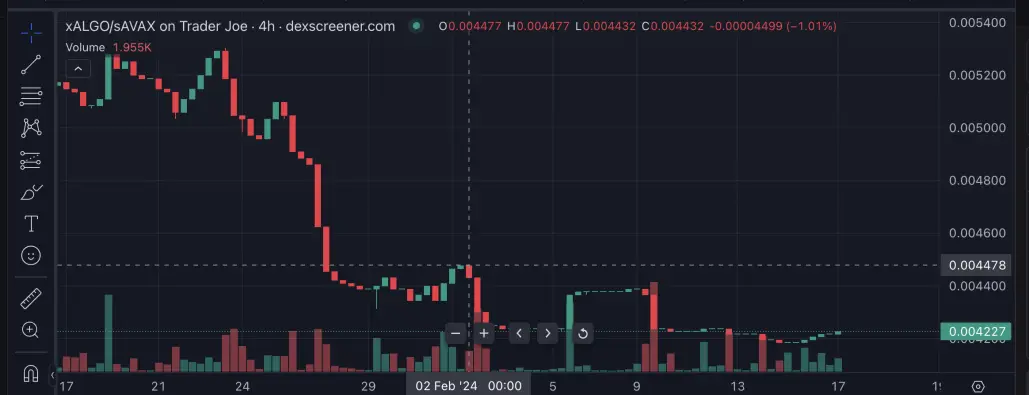
From the graph above, we can see that the trading range for the last few weeks has been between 0.004182 and 0.004478.

On the graph in the Analytic tab, there is a section called "Bin Traded". We can observe that trading has taken place in 20 bins, ranging from 0.004185 to 0.004388, over the last 14 days. The 'active bin,' highlighted in purple, is situated at 0.004227. I found both graphs very useful for planning my strategy.

The Liquidity Book allows liquidity to be distributed across discrete bins with a fixed width. Liquidity can be exchanged at a fixed price within each bin. Each bin represents a single price point, and the difference between two consecutive bins is the bin step. From the image above, we can see that the bin step for xAlgo/sAvax is 25 basis points or 0.0025%. For example, the price for the 'active bin' in the above image is 0.0042271994 sAvax, and the price for the bin to the right is calculated as 0.0042271994 * 1.0025 = 0.0042377674 sAvax.
If we examine the current pool distribution, which can also be found in the Analytic tab, we can observe that the price range spans from 0.0040414189 to 0.0046828728, covering 59 bins.

The number of bins can be calculated by determining the min, max, and bin steps for the pool:
LOG(0.0046828728 / 0.0040414189) / LOG(1.0025) = 59.
Therefore, over the last 2 weeks, there were at least 39 (59-20) bins that did not generate any fees.
One of my conclusions is that I now spread my funds over fewer bins. If you are a whale, you probably find it easier to use a flat distribution over, say, 50 bins.
This concludes Part I. Here is a link to Part II






