
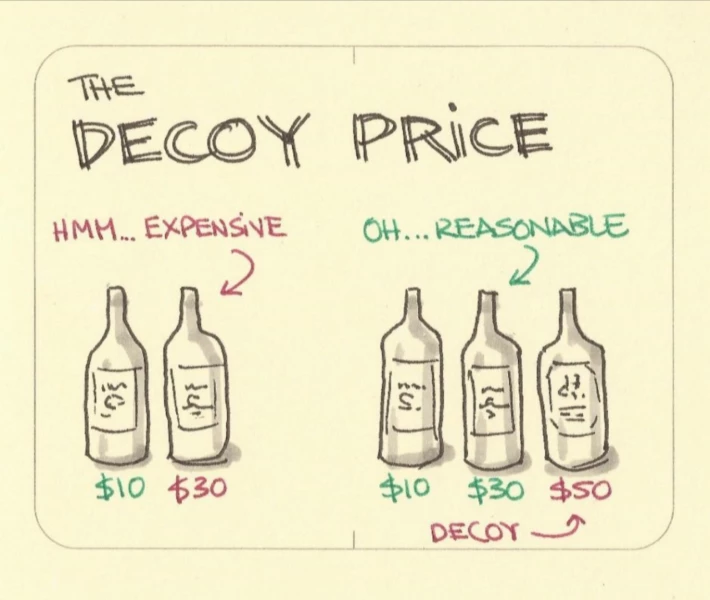
It happens when consumers change their preference between two options when presented with a third option, or decoy.
The decoy is priced to make one of the other options much more attractive. The decoy is not intended to sell, just to nudge consumers away from the competitor and towards the target.
How Decoys Work
When consumers are faced with many alternatives, they often experience choice overload that increases anxiety and hinders decision-making.
Consumers try to reduce this anxiety by selecting only a couple of criteria (say price and quantity) to determine the best value for money.
A decoy steers you in a particular direction while giving you the impression that you are making a rational, informed choice.
Decoy Example in the Market
Consider the price of drinks at a well-known juice bar: a small (350 ml) size costs $6.10; the medium (450 ml) $7.10; and the large (610 ml) $7.50.The medium is a slightly better value than the small, and the large better still. The medium is designed to be the decoy, steering you to see the biggest drink as the best value for money.
If you buy the biggest, was it because you made a sensible choice, or have you been manipulated to opt for bigger than intended?






