
Introduction
The site coin.dance gathers a collection of information and statistical data about bitcoin, from this, I noticed some patterns that show socially fragile countries having their trading volume growing steadily and gradually, this article aims to study a little why these events are occurring, the geopolitical events that permeate the reality of each location, and how in the future these people might become the biggest bitcoin holders.
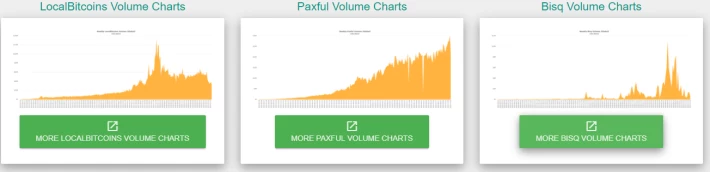
Here we have the volume information of the main decentralized exchanges, for this article I will use data from LocalBitcoins, because it is the exchange that brings more data relevant to the study I want to raise here.
In order not to go into such complex and exhausting details, I will briefly summarize what happened from 2015 to 2019 to clarify the point I want to reach.
Argentina - fiduciary currency: Argentine Peso
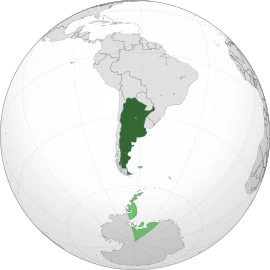
Formed by Spanish and Italian immigrants, Argentina is the second largest country in extension in South America, in terms of population it is the third largest and its economy is the second most influential in the region (behind only Brazil), it is even part at the G20 (forum that brings together the 20 most economically influential countries in the world). Industry is the largest economic sector and tourism is one of the main activities in the country.
From 2015 until now (December 2019) the country was governed by Mauricio Macri, at that time the economy was stagnant, government accounts in the red and there was a crisis of mistrust of the public and investors. To address this issue, Macri used so-called liberal measures to regain control of the economy. What matters for this study is that he took steps to stabilize the currency, allowing Argentines to buy foreign currencies more easily and with little control until then. There were many difficulties in the purchase of foreign currency, Argentines had a restriction on the purchase of the dollar that could reach a maximum of $ 10,000.00.
In the end, the Argentine economy continued to grow slowly and the recovery was below expectations. Inflation remained high and wages did not rise, with international investors remaining pessimistic. In December 2018, it was confirmed that Argentine GDP shrank by 3.5%, putting the country back in a technical recession which caused unrest in the population.
From this, already in 2019 we have the rise to power of Alberto Fernándes who has already put in place a measure aimed at stabilizing the currency, which is to lower the purchase price of dollars from $ 10,000.00 to $ 200.00. This, coupled with the fact that in 2001 the Argentine government forced people with dollars in bank accounts to migrate to the Argentine peso becomes a strong ally in the process of migrating to bitcoin.
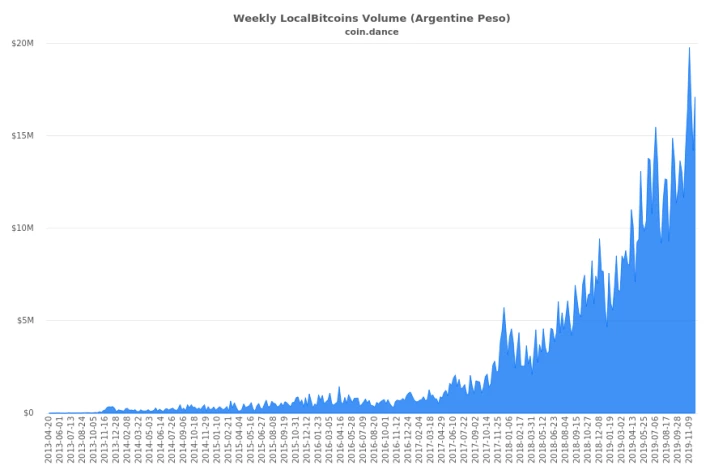
With this we have that people who sought to get out of the devaluation of the Argentine peso buying dollar, will have no alternative if they do not find another store of value. This may be the bitcoin that has numerous advantages over the dollar, including being out of state control, although there is still the possibility that the state will tax brokers that trade bitcoins, there is no way for it to have information about their equity stored in their wallet. or track funds traded in a decentralized broker (this is one of the key points proving the need for decentralized technologies, I wrote about this in this post). This also reflects the significant increase in bitcoin trading volume in Argentina that we see on the LocalBitcoins chart.
Venezuela - fiduciary currency: Petro, Bolívar venezuelano
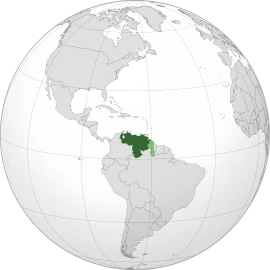
The Venezuelan territory is located in northern South America formed by descendants of Spanish and natives of the region. Recognized worldwide for its diversity of natural resources as well as its huge oil reserves that has caused in recent years numerous international conflicts.
Historically, Venezuela has experienced numerous political crises and some attempted coups. Currently, the country is experiencing an intense scenario of political crisis, in which the position of president, held by Nicolás Maduro (representative who calls himself socialist), is questioned by the international community, since the last presidential elections that took place in 2018 showed numerous irregularities during the process. Maduro took office in 2013 with the death of his predecessor Hugo Chavez, during this period of transition between governments, had high rates of inflation, exceeding 800% per year. Oil barrel prices were well above average. Markets began to sell basic products at exorbitant prices, and the population went through nightmarish days (remember that venezuela has a mixed economy based on the oil market). The discontent of the population, the lack of basic inputs for survival, the high number of unemployed people and the misery brought about made Venezuela collapse socioeconomically. In 2018 during the electoral process Venezuelan inflation reached 1,000,000% causing the population to get into a situation of misery.
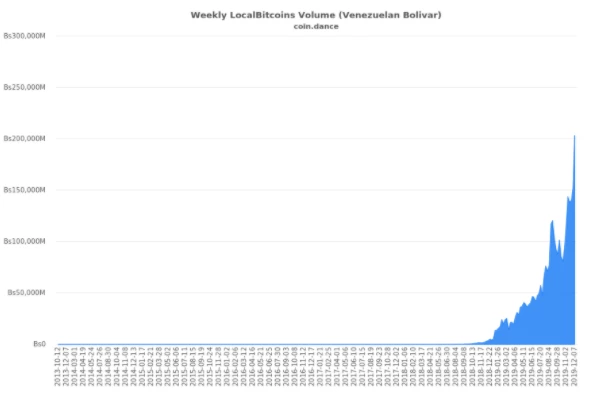
All this chaotic scenario has made the inhabitants of venezuela who still had internet access look for alternatives not to lose their assets at the expense of the absurd devaluation of the local currency, the most viable alternative in this scenario would be to migrate to cryptocurrencies. LocalBitcoins's capital inflow came long after the 2017 bull run and is at its historical peak right now. Remember that bitcoin is not the only refuge for this escape from the local currency, for example there is the NANO (or raiblocks at the time) that was being distributed through faucets throughout this chaotic scenario, at that time you could get around with faucets. of 70 NANO per day which was equivalent to about 1 US dollar, the people who needed it were exactly who was in a situation of vulnerability caused by this political and economic instability, this is one of the factors that make NANO very strong in places like this (I can only make an article with promising projects if you wish).
I talk a little bit about how the NANO community helped part of the Venezuelan community in times of crisis in this article.
South Africa - Fiduciary currency: Rand (ZAR)
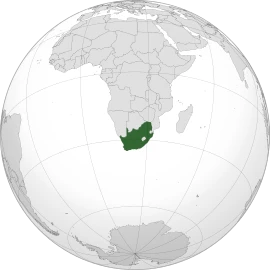
South Africa is the largest economy in sub-Saharan Africa, followed by Nigeria (which is also another country with rates similar to those studied here). Even though it is the most industrialized country on the African continent, it is possible to observe the extreme poverty having data revealing that its population lives on average with approximately US $ 1.5 per day. Even in crisis, its economy is diversified, having in industry, services, industry, agriculture and extractivism, its main economic bases.
Corruption scandals have permeated the South African reality in recent years, the African National Congress (ANC) party has ruled the country since the end of apartheid, recently from 2014 until then President Jacob Zuma has had several legal problems and has a clear a history of abuse of power for its own benefit and the unresolved structural problems that the country has were aggravated during this period. In 2018, when Zuma resigns from power, he takes over his vice-president Cyril Ramaphosa, who seems to be changing the economic reality of the country, but this has not been enough to reverse the current situation of misery.
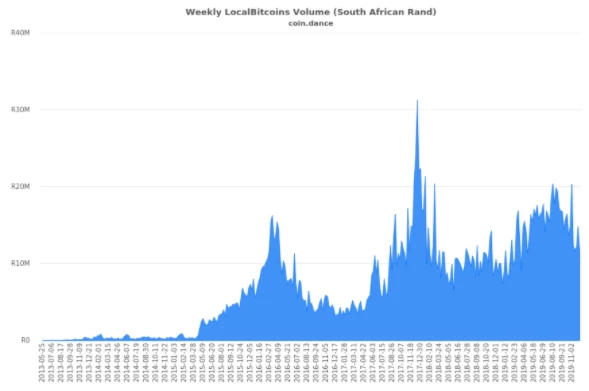
Here we can see that the trading volume tended to be large even before the 2017 bull run and is still at very high levels, so we see that with the scenario of corruption, unemployment and constant inflation people saw bitcoin as an alternative to escape and To protect its assets, in countries such as South Africa which, as we have seen above, have a large part of their population surviving on the equivalent of $ 1.5 a day, it is essential to have not only bitcoin but affordable projects as well. In the case of electroneum (etn), mining is known to be a process that requires a lot of computational power (which we should not be accessible in regions where the population lives in misery). above works with a cloud mining system on the mobile phone where you get the cryptocurrency just for having the app installed.
Conclusion
Now we see more and more people migrating from their fiat currencies to decentralized technology due to the scenario of internal instability this can be seen as a good thing or a terrible thing, this accumulation is a very important step towards mass adoption as more and more people start To know the technology through these processes, if these sites continue to accumulate cryptocurrencies, we can see in the not so distant future those people who are in a position of vulnerability becoming the next "billionaires of bitcoin" and increasingly contributing to their development.
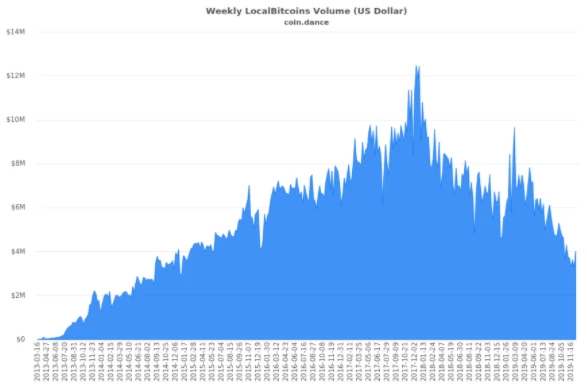
It is very important to highlight the presence of USA in bitcoin trading, of course the largest trading volumes have been concentrated there since the launch of the platform, the big point I wanted to share in this article is that these countries are waking up and constantly increasing their volume of trading. negotiations and, consequently, increasing their assets while seeing casualties in the pioneer countries.
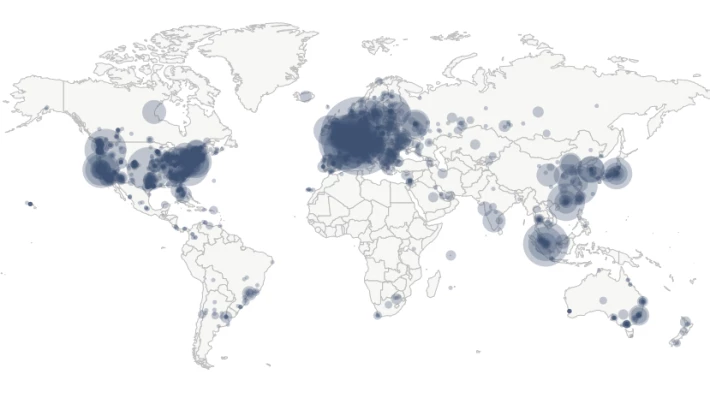
The bitcoin node map also shows that this concentration occurs mainly in the central countries and that there is a very long delay in the periphery, but this growing negotiation is telling us that this concentration can dissipate in order to make it more homogeneous, for example. while it's just an optimistic remark, but only the future will tell us.
Other countries that can also be read like the ones studied above: Chile, Colombia, Egypt
Thank you for reading :D






