
This article consists of a series of studies where I analyze the participation of institutional investors in the cryptocurrency market (mainly in bitcoin), the participation of mining pools in the centralization of bitcoin and the possible relationship that this will have with the price of bitcoin and currency centralization.
Institutional investors
Institutional investors are the largest companies, hedge funds, investment funds, pension funds, and banks in the world. These institutions provide liquidity to the global market, being able to handle more than 200 billion dollars daily. In the world of cryptocurrencies, this concept of institutional investors also encompasses the great oligarchy of mining pools.
Examples of companies like this are:
- JP Morgan Chase & Co
- Capital Group Companies Inc
- Barclays PLC
- Legal and General Group PLC
Institutions like these manage to operate in the market in a discreet way through "machine learning", which are artificial intelligence robots that help in negotiations, as we will see in the quote below, and also through the so-called iceberg orders, which are thousands of small orders sent separately making that they are not noticed. So they move prices the way they want, usually looking at the long term.
Domeyard, a Boston hedge fund that focuses on high-frequency trading, depends on machine learning to decipher 300 million data points in the New York Stock Exchange's opening hour of trading alone. "We rely on the help of machines to make easier and faster predictions of what will happen in the next second or minute," said Christine Qi, Domeyard's co-founder and partner.
Can you imagine these institutions operating in the cryptocurrency market? The largest stock market in the world (New York Stock Exchange - NYSE) has a market capitalization of 26 trillion dollars (it is estimated that the global capitalization reaches 100 trillion) and the cryptocurrency market has a market capitalization (according to coinmarketcap) 279 billion, which is less than 1% of the traditional market capitalization. What happens is that these institutions are already present negotiating bitcoins and - probably - manipulating them. We started trading bitcoin on traditional exchanges (CME and CBOE) in 2018 at the historic top and from that point on the market just fell - there are some theories saying that they were responsible for this drop, but I won't go into details - and last year we had the creation of the exchange BAKKT (I'm sure you forgot it) which is nothing more than another way for institutional markets to trade cryptocurrencies. Bakkt, which on its first day had 15 bitcoins traded, today has a higher daily trade than many major bitcoin exchanges.
Along with this we also have investment funds and hedges in cryptocurrencies that have very high amounts allocated, as we can see below:
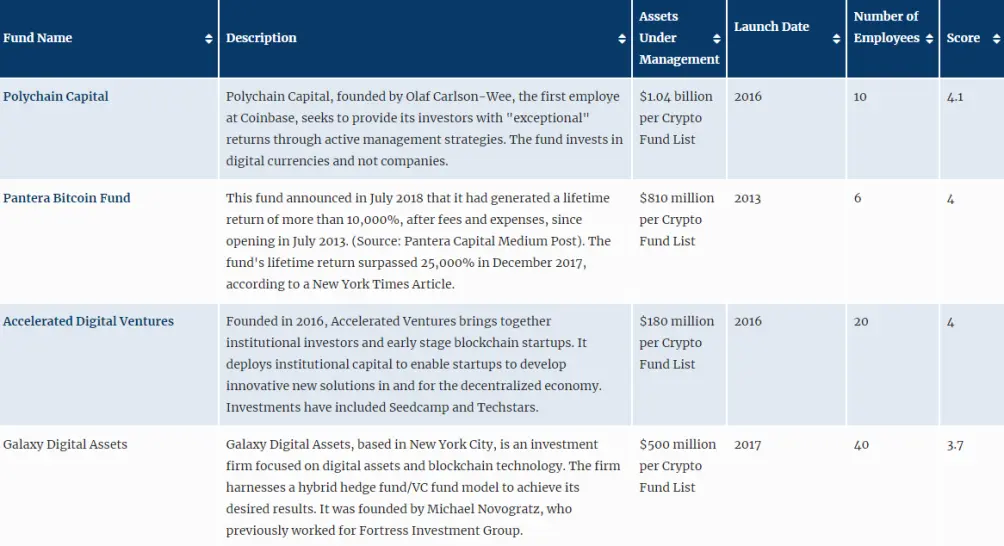
source: bitcoin market journal
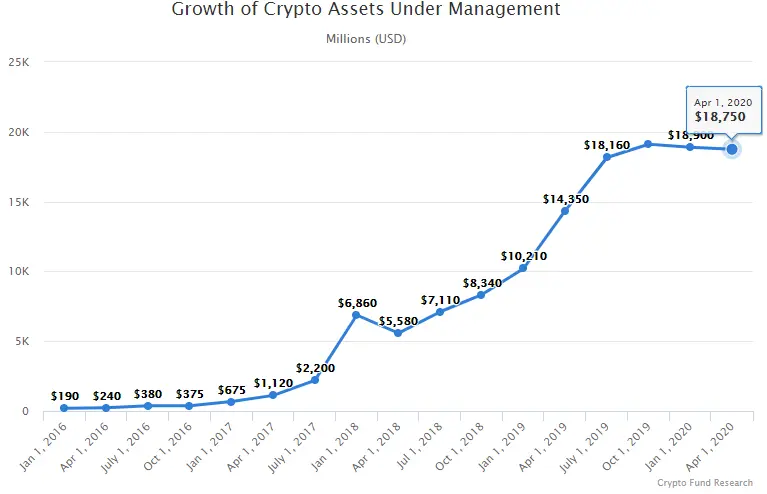
source: crypto fund research
We have a total of 18.75 billion dollars being managed by funds in cryptocurrencies, this (disregarding the diversity of assets in the fund) of around 7% of the total market capitalization.
Mining pools
Bitcoin mining can be divided into two distinct phases: the pre-asics phase and the post-asics phase. The pre-asic phase can be described in a similar way to the California gold rush history.
In the 19th century when the news of the discovery of gold spread, about 300 000 people from all over the world rushed to California, in the beginning, gold prospectors obtained gold from watercourses using simple techniques, such as batim mining, and later developed more sophisticated gold extraction methods that were adopted worldwide.
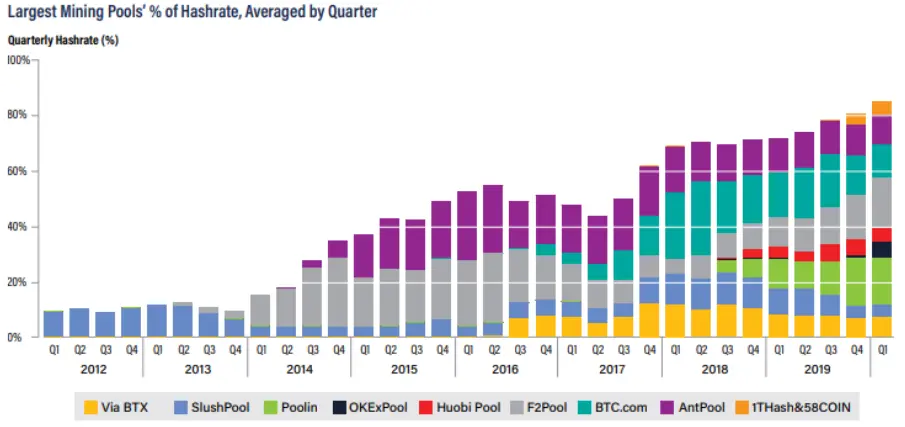
Source: Coindesk
Initially we saw mining in a very decentralized way, composed mainly of independent miners with their homemade machines, then with the arrival of mining ASICS we still had a period when home computers lost space to mining pools and now in 2020 more than 90% of the Bitcoin network is controlled by large mining pools that function as large institutions, the high investment that these institutions have made in ASICS have made mining so profitable that they are not so dependent on price, this creates an exponential growth of Hashrate with the constant evolution of the equipment and the decrease in the consumption of electric energy.
The characteristic of the hashrate seems to be changing its configuration with time, the dominance of China despite being very high, shows a weakness with the passage of time
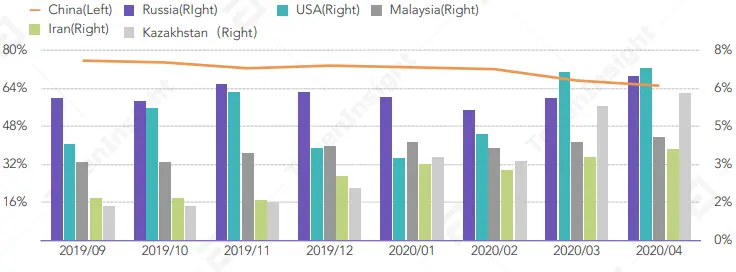
since September 2019, China's estimated hash rate has shown a slow downward trend, which has now dropped from 75.63% to 65.08%; while the United States has begun to increase from 4.06% to 7.24%, up by 78.33%;
Unexpectedly, Kazakhstan's current hash rate accounted for 6.17%, up 334.51% from 1.42% in September 2019.
Miners are mostly dependent on the mined blocks for their revenue, when there are no more blocks to be mined what will be paid to the miners will be the transaction fees, with the passing of halvings it is natural that the transaction fees increase in order to "cover "the damage that miners have with decreasing the reward.
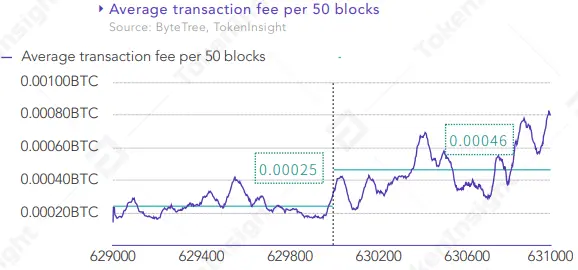
The graph above shows just that. It is to be expected that at some point (possibly when the blocks run out) bitcoin mining will no longer become so attractive to these large pools that run the mining market, which will no longer actually be a mining, become again decentralized, the issue will be that the dominance of most of the existing bitcoins will still be in the hands of those few people who run the pools.
Conclusion
From what was mentioned above you can reach two conclusions:
That the market has "matured" and is becoming more and more efficient with the entry of this new capital and bitcoin has ceased to be a revolutionary piece to become another asset of the global financial market such as gold is today besides that this can bring mass adoption more quickly
Or what I think: that bitcoin itself is and will always be decentralized, although the variables that surround it are not. The entry of institutions like these in the cryptocurrency market shakes the structures making, in a certain level there is a similarity with the traditional market (although more volatile), we have as an example the global liquidity crisis caused by the corona virus, fundamentally speaking of what caused the price of bitcoin to fall back to the $ 4,000 mark was the use of cryptocurrencies as a "hedge" of traditional market operations. There is a study done since the first bitcoin bull run showing that there is a continuity pattern based on fibonacci retractions and extensions, it repeats from the first bitcoin breath, going over the top at $ 20,000 (I can bring a post about it if you want) and now it shows signs that it could be repeated, but with the advent of manipulation coming from our whales (those who accumulated bitcoin in the beginning) and sharks (which besides being more dangerous bring the experience of manipulation of the traditional market) it may not come to come true.
Thank you for reading :D






