
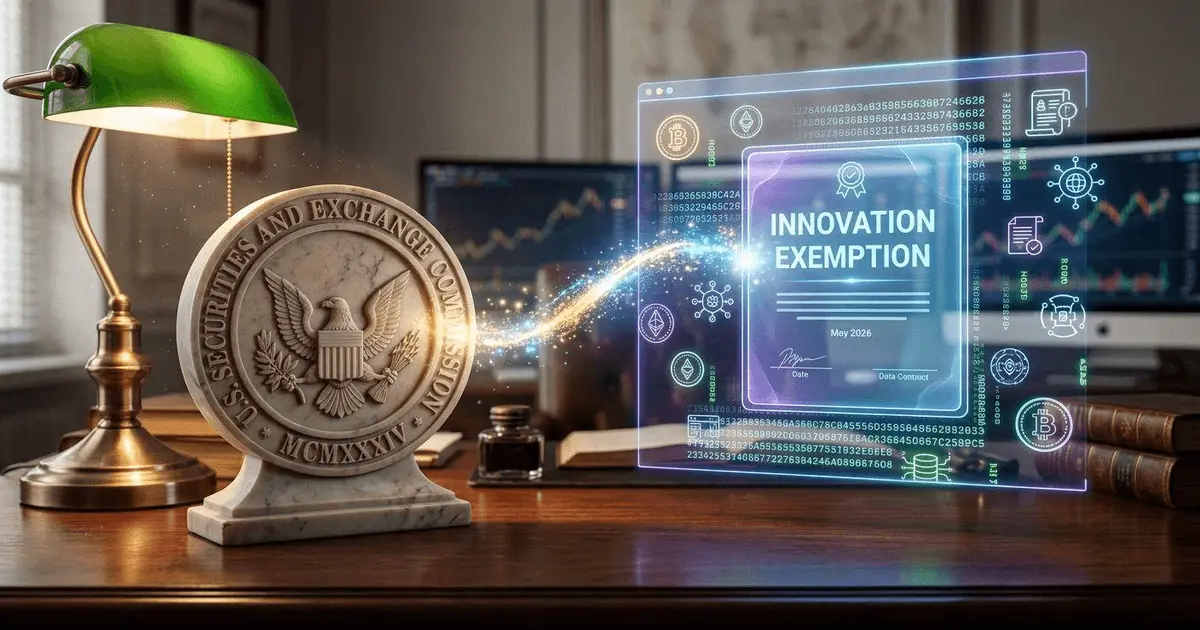
Bridging Legacy Compliance and DeFi: The SEC's upcoming 'Innovation Exemption' is set to redefine how traditional equities interact with public blockchains.
For years, Wall Street and Decentralized Finance (DeFi) existed in parallel universes. Traditional finance relied on centralized transfer agents, strict market hours, and T+1 settlement cycles. DeFi operated 24/7 on global, permissionless code, but lacked access to the world’s most lucrative asset class: U.S. public equities.
That structural divide is about to vanish. Reports indicate that the U.S. Securities and Exchange Commission (SEC), under the Trump administration and spearheaded by Chairman Paul Atkins and Commissioner Hester Peirce, is poised to unveil a historic regulatory framework: the "Innovation Exemption" for tokenized stock trading.
This is not a standard regulatory sandbox or a minor amendment. This framework introduces a mechanism that allows decentralized protocols to list and trade tokenized versions of blue-chip stocks (like NVIDIA, Apple, and Tesla) without requiring the explicit consent or backing of the issuing corporation.
The implications for Real-World Asset (RWA) protocols, liquidity layer dynamics, and the broader DeFi ecosystem are profound.
1. Deconstructing the "Innovation Exemption" Framework
Historically, if a financial platform wanted to issue a digital security tracking a public company, it faced an insurmountable wall of legacy compliance. Under the SEC's landmark Token Taxonomy Interpretation issued earlier in March 2026, tokenized traditional securities are treated strictly as digital representations of underlying equities.
The upcoming Innovation Exemption alters the execution of this policy through a dual-category system:
Structural Metric Issuer-Backed Tokenization Third-Party Tokenization (The Exemption) Origin / Minting Source Issued directly by or on behalf of the public corporation (e.g., Apple minting its own equity on-chain). Minted by decentralized protocols or synthetic asset providers (e.g., Ondo Finance, Hyperliquid). Issuer Consent Mandatory Not Required Corporate Action Mechanics Directly synchronized with the master securityholder file via native smart contracts. Must replicate corporate actions synthetically or face immediate delisting by the regulatory framework. Core Regulatory Risk High corporate governance overhead; low systemic structural risk. High structural risk (liquidity fragmentation, tracking errors, synthetic peg vulnerabilities).
The "No-Consent" Mechanics: How Synthetic Replication Meets Legal Compliance
The most debated element of this framework is the authorization of unauthorized, third-party tokenized equities. If a DeFi protocol wraps an asset tracking the value of Microsoft (MSFT) without Microsoft's permission, how does it stay compliant?
The SEC's draft approach hinges on a strict enforceability clause: Benefit Parity. To qualify for the innovation exemption, the third-party token must mirror the economic realities of the underlying asset. If the tokenized wrapper fails to provide token holders with equivalent economic benefits specifically synthetic dividend distribution and verified exposure to corporate voting rights via decentralized proxies the platform immediately loses its exemptive relief.
2. Institutional Macro Trends Driving the Shift
This regulatory pivot does not occur in isolation. It is driven by systemic structural upgrades across capital markets and legislative momentum in Washington.
The CLARITY Act Integration
The timing of the SEC’s exemption aligns with legislative developments on Capitol Hill. The Senate Banking Committee recently advanced the CLARITY Act, sending it to a full Senate floor vote. The CLARITY Act positions the Commodity Futures Trading Commission (CFTC) as the primary regulator for digital commodities, while cementing the SEC’s authority over digital securities. The Innovation Exemption serves as the SEC’s proactive framework to manage this newly affirmed jurisdiction over on-chain traditional equities.
Legacy Infrastructure Migration
Traditional financial heavyweights are already positioning themselves for a 24/7, tokenized market structure.
-
The New York Stock Exchange (NYSE): Intercontinental Exchange (ICE) announced the development of an institutional tokenization platform utilizing a blockchain-based post-trade system for around-the-clock stock and ETF trading.
-
Strategic Mergers & Acquisitions: Crypto exchange Bullish executed a $4.2 billion acquisition of Equiniti, a premier transfer agent platform. Transfer agents are the ultimate record-keepers of traditional corporate equity files. Merging a crypto-native matching engine with a legacy transfer agent establishes the foundation for real-time atomic settlement of tokenized securities on public ledger rails.

24/7 Capital Markets: The transition from legacy clearinghouses to instant, global atomic settlement on public ledger infrastructure.
3. Microstructural Impacts on the DeFi Ecosystem
The activation of the Innovation Exemption will alter tokenomics, protocol revenue models, and liquidity flows across decentralized finance.
The RWA Sector and Tokenization Protocols
Real-World Asset protocols are the immediate beneficiaries of this framework. Following the initial policy leaks, institutional RWA issuers experienced significant market momentum. Projects like Ondo Finance (ONDO), which specialize in bringing institutional-grade financial products on-chain, see this as an official validation of their core business model. By removing the requirement for corporate approval, RWA protocols can rapidly expand their product offerings from short-term Treasury bills to full-scale global equity index tokens.
Decentralized Derivatives and Perpetual Exchanges
The ability to list unauthorized, compliant stock wrappers provides a massive advantage to high-throughput decentralized perpetual platforms (such as Hyperliquid). These protocols can transition from purely crypto-native derivatives to hybrid platforms offering cross-margining between crypto assets, tokenized commodities, and U.S. equities. This creates a highly competitive environment for traditional retail brokerages by offering instant atomic settlement without intermediary clearinghouse delays.
[Traditional Settlement: Trade Execution -> Clearinghouse (NSCC) -> Central Depository (DTCC) -> Settlement T+1]
[Atomic DeFi Settlement: Smart Contract Matching Engine -> On-Chain Liquidity Pool -> Instant Settlement T+0]
4. Systemic Risks and Market Vulnerabilities
While the capital efficiency gains of 24/7 atomic settlement are clear, the framework introduces several technical and structural risks that market participants must evaluate.
1. Liquidity Fragmentation and Arbitrage Multiplicity
Former Director of the SEC’s Trading and Markets division and current President of Securitize, Brett Redfearn, has raised concerns regarding structural fragmentation. If multiple third-party protocols tokenize the same underlying equity asset (e.g., independent Apple token wrappers on Ethereum, Solana, and Base), market liquidity risks split across distinct, non-interoperable smart contracts. Without standardized market interconnectivity, tracking errors could emerge, creating systemic arbitrage inefficiencies and price discrepancies during high-volatility events.
2. Smart Contract Vulnerabilities and Oracle De-Pegging
Traditional equities rely on legal frameworks to resolve operational errors. In DeFi, security is dictated by code execution. Integrating multi-billion dollar traditional asset classes onto public ledger infrastructure exposes institutional capital to smart contract exploits, flash loan attacks, and oracle feed manipulation. If a synthetic stock wrapper suffers an exploit or an oracle failure, maintaining the collateral peg to the underlying equity asset becomes a critical risk.
Conclusion:
The SEC’s impending Innovation Exemption represents a fundamental shift in the relationship between traditional capital and decentralized rails.By legalizing third-party tokenization without corporate permission, the regulatory framework acknowledges a new financial reality: public company shares are no longer bound to traditional, siloed market exchanges. For DeFi, this marks the transition from speculative digital assets to an open-architecture, global financial utility capable of hosting the world's primary equity markets.
Research & Sources
-
U.S. Securities and Exchange Commission (SEC): Statement on Tokenized Securities & Token Taxonomy Interpretation, published March 17, 2026. This official guidance defined the legal classification of tokenized securities and established the parameters for digital representation of traditional financial instruments under federal securities laws.
-
Bloomberg Regulatory Report (May 18, 2026): Investigative brief tracking the SEC’s internal deliberations, led by Commissioner Hester Peirce, regarding the specific rules governing "Innovation Exemptions" for unauthorized third-party equity tokenization.
-
U.S. Senate Banking Committee Legislative Record: The CLARITY Act (Comprehensive Legal Accountability and Regulatory Information Act), advanced via committee vote on May 14, 2026.
-
Corporate Financial Disclosures: Intercontinental Exchange (ICE) strategic roadmap for blockchain-based post-trade settlement infrastructure; Bullish LLC regulatory filings regarding the $4.2 billion acquisition of Equiniti Transfer Agent services.
Disclaimer: This post is for educational and research purposes only and does not constitute financial advice. Always do your own research (DYOR).






