Bitcoin holds above $80K, stablecoins are becoming payment rails, and real-world assets are flooding onto blockchains. Here's what every investor needs to know right now.
📊 Key Stats
- BTC Price: $82K+
- Total Market Cap: $2.74T
- Spot ETF AUM: $115B+
The market has changed fundamentally
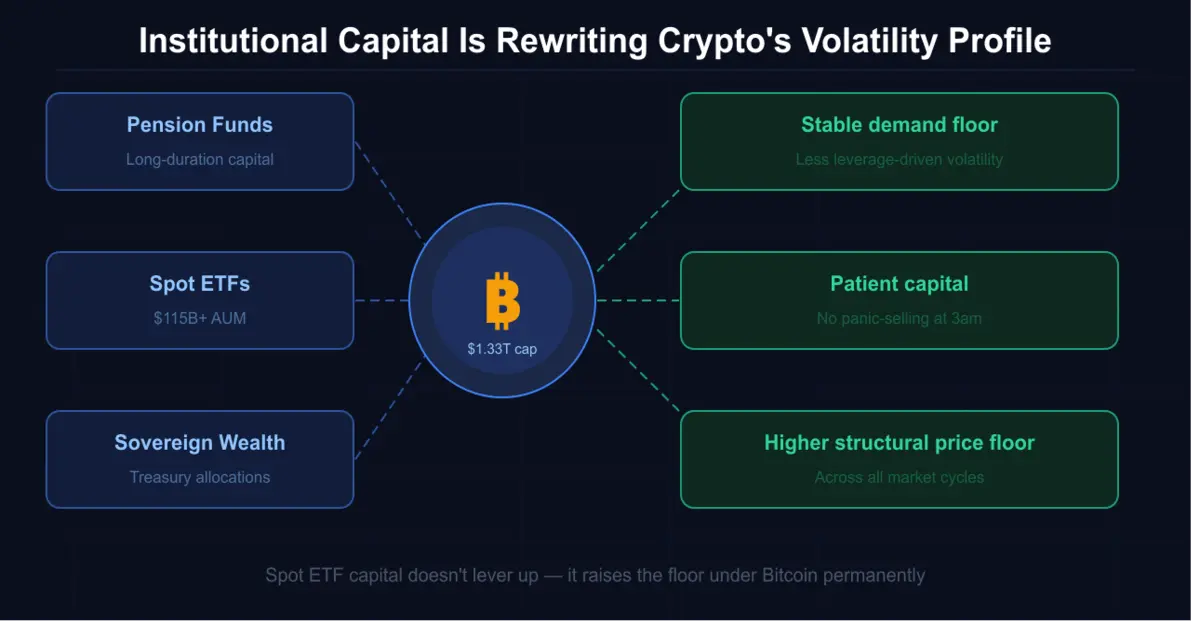
If you've been in crypto long enough, you remember the old playbook: a halving happens, retail floods in, altcoins go parabolic, and then everything crashes 80%. That cycle isn't dead, but it's being overlaid by something entirely new patient institutional capital that doesn't panic-sell at 3am.
As of May 2026, Bitcoin is hovering around $82,320 with a market capitalization of roughly $1.33 trillion and 58% dominance over a total crypto market worth $2.74 trillion. More importantly, combined spot Bitcoin and Ethereum ETF assets have already crossed $115 billion. That's not speculative money. That's pension-adjacent, wealth-management capital and it behaves differently.
Why this matters for you: The volatility that wrecked portfolios in 2018 and 2022 was largely driven by leveraged speculation unwinding all at once. Spot ETF capital doesn't lever up the same way. The structural floor under Bitcoin is higher than it's ever been even during drawdowns.
The 5 biggest narratives dominating 2026
1. Tokenized real-world assets (RWAs) BlackRock and other major asset managers have filed paperwork to expand tokenized fund offerings, with the RWA market growing 200% year over year. Stocks, bonds, and commodities are moving on-chain fast.
2. Stablecoins as payment rails Stablecoins have cemented themselves as the #1 use case in crypto. Market cap projections point toward $1.2 trillion by 2028, and legislation like the GENIUS Act could let banks hold them on balance sheet.
3. AI × crypto convergence AI agents need wallets, payments, and programmable money. PayPal and Google reps at Consensus Miami confirmed agentic commerce will run on crypto rails a structural demand driver that barely existed 18 months ago.
4. Privacy infrastructure As institutions join public blockchains, robust privacy tooling becomes essential. Projects like Aztec (Ethereum L2) and Railgun are gaining serious traction, and Ethereum's ERC-7984 brings confidential transactions natively on-chain.
5. DeFi as institutional-grade infrastructure Perpetual futures are now core DeFi primitives integrated with lending, collateral, and hedging. The wild west era is giving way to regulated, composable financial tooling.
Bitcoin vs Ethereum: two completely different bets
One of the most common portfolio mistakes in 2026 is treating Bitcoin and Ethereum as competing versions of the same thing. They're not. They serve fundamentally different investment theses.
₿ Bitcoin The scarcity play Hard-capped supply, zero governance risk, commodity classification under U.S. law. Corporate treasuries and sovereign wealth funds use it as a non-sovereign monetary anchor. Ideal for longer holds where the supply-shock thesis plays out over years. No yield but no protocol upgrade surprises either.
Ξ Ethereum The productivity play The economic foundation for DeFi, stablecoins, and tokenized assets. Commands $55B+ in total value locked and roughly 60% of all DeFi activity. ETH can be staked for 2.8-3.5% annually within regulated ETF structures. More moving parts, more return vectors and more complexity to manage.
Over the decade ending April 2026, Ethereum's cumulative return has slightly edged Bitcoin in raw percentage terms but that comparison misses the different risk profiles entirely. A cleaner framework: Bitcoin for scarcity, Ethereum for productivity, and an allocation to both for most portfolios.
DeFi is no longer a wild west
Remember 2021 DeFi summer? Triple-digit APYs, rug pulls every week, anonymous teams disappearing with millions? That era is mostly over. In 2026, DeFi has transitioned into institutional-grade financial infrastructure, with a global market size forecast to reach $37.27 billion.
Perpetual futures once isolated leverage tools are now becoming core DeFi primitives integrated with lending, collateral management, and hedging. Prediction markets are expanding after U.S. tax changes, and staking through regulated ETPs is now the default structure for yield-seeking institutional positions in Proof-of-Stake tokens.
The Ethereum TVL signal: $55 billion locked in Ethereum-based DeFi protocols, representing 58-68% of all DeFi TVL across every blockchain. That's not a speculative metric. It's a measure of real capital choosing Ethereum as its settlement layer for financial activity.
What could go wrong risks you must price in
Don't ignore these: Quantum computing now poses a documented threat to crypto security, with a May 2026 report warning of up to $3 trillion in at-risk digital assets. The LayerZero $292M Kelp exploit shows smart contract risk is not eliminated. Regulatory shifts particularly around stablecoin yield remain unresolved. And altcoins, outside a handful of narrative-driven plays, continue underperforming Bitcoin significantly in this cycle.
The bottom line
2026 is not a year for reckless speculation, but it's also not a year to be on the sidelines. The infrastructure is stronger than it has ever been. Regulation is clarifying. Institutional capital is patient and persistent. The biggest narratives RWAs, stablecoins, AI agents on crypto rails are all pointing toward greater adoption, not away from it.
The question is no longer "will crypto survive?" It's "are you positioned for the specific parts of it that are growing?" Bitcoin for scarcity. Ethereum for the productivity stack. A watchful eye on privacy infrastructure and the AI-crypto overlap. And a hard stop-loss on leverage, because even in the institutional era, crypto can still move fast in both directions.
Did this article help you think about 2026 differently? Drop a tip and share your take in the comments. What's your highest-conviction position this cycle?
Disclaimer: This post is for educational and research purposes only and does not constitute financial advice. Always do your own research (DYOR).