
Before the arrival of ETH2.0, Ethereum faced two major problems: one was network congestion, and the other was excessive gas fees.
In the past year, the popularity of DeFi and NFT projects has once again caused gas fees to rise, and transaction performance cannot match the demand. Finding new outlets has become the top priority of current trading platforms.
Starting in 2020, first-class platforms represented by Binance and Huobi took the lead in proposing public chain construction, and then ZT trading platform caught up and became the third platform to propose smart chains. BSC, HCEO, and ZSC are public chains initiated by Binance, Huobi, and ZT respectively, and have become the main competitors of Ethereum today.
At present, these public chains have effectively solved the problems faced by Ethereum. BSC and HCEO have a handling fee of less than $1, while ZSC has a lower handling fee; the transfer can be completed in just a few seconds. Experience victory over Ethereum. It can be said that these public chains have acted as side chains of Ethereum, helping Ethereum alleviate congestion pressure, thereby gaining a position in the entire DeFi development process.
For ZT trading platform that has been launched closely following the front line, it is not easy to obtain the corresponding market share in this silent fight.
The ZT smart chain ZSC originated in February 2021. The launch of the first DEX project Tofuswap and the opening of mining are constantly stimulating the nerves of users, especially the super high annual revenue, which quickly attracts a large number of users to enter the market. Large projects have been launched one after another, and with the launch of the first NFT platform-Opengaga, the market share of the ZSC smart chain has been further increased.
At present, the ZSC smart chain ecology is gradually taking shape, and it already has a place in the current public chain structure, which is quite a trend to challenge Ethereum. Today, the ZSC smart chain ecology involves decentralized exchanges (DEX), NFTs, lending, cross-chain assets, wallets, infrastructure, insurance and other fields, with a total of more than 100 projects. For ZSC, which was born only half a year ago, the speed of development is not undesirable. Overall, the ZSC smart chain has achieved amazing growth in the past six months.
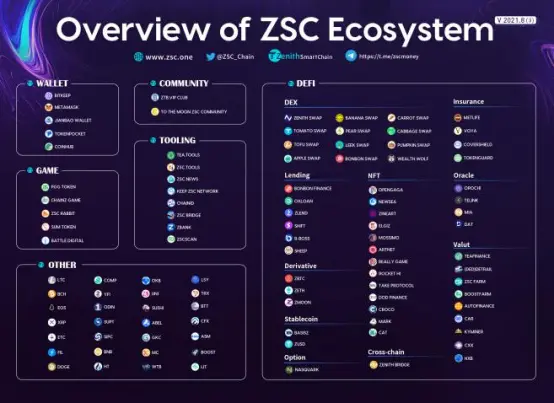
At present, the DeFi products of BSC, Heco, and ZSC are almost complete. After several months of their respective development, the ecology of the three has shown the characteristics of homogeneity. As the traffic entrance of the trading platform, these public chains take over the platform currency. With the popularity of these smart chains, the prices of BNB, OKB, and ZTB have also continued to rise, and the phenomenon of skyrocketing exceeding in just one week has overwhelmed Ethereum.
In today's cryptocurrency and blockchain world, the phrase "who gains public chain infrastructure can gain the world!" This sentence has become a consensus. To stand out among many competitors, it must be much faster than similar products in terms of innovation and iteration speed, and be highly open and transparent, making it difficult for other trading platforms to match. Under these circumstances, many people can't help but wonder, what strength does ZT have to keep up with the pace of the first-line platform? And in the future development journey, will they be left behind?
In fact, from the ecological layout above, ZT has been silently starting the ecological construction based on the public smart chain. ZT has realized the integration of multi-chain ecology, realized multi-project cross-chain and shared cross-chain ecology; in terms of DeFi ecology, it has also formed a decentralized financial ecosystem. It is worth mentioning that some exchanges will also set the platform currency as the core of the entire public chain decentralized financial ecosystem. The higher the popularity of a trading platform, the greater the transaction volume, and the better the construction of public chain infrastructure, the higher the value of the platform currency will naturally be, and vice versa. The annual growth rate of ZTB is actually an affirmation of the achievements of the ecological construction of the ZSC public smart chain by the market and the community.
We have reason to believe that as the ZSC infrastructure becomes more mature and based on the advantages of ecological development, ZT can bring developers and users a better experience and stronger confidence.






