"I am a secret so everyone can know me. First you must count every part of me, then translate those parts into signs that do not describe me. Together we are shackled, and with the sign that does not describe me you can open me up and read me as I am. People will give you their promises for me, and if wrongdoers try to take me away from you, you can find me and tell the world where I am hidden. I began as a silent speaking, a key to open every door; now that I have opened all the front doors, I am the key that locks the back doors by which wrongdoers try to escape the scene of the crime. I am the nothing that makes everything happen. You don't know me, you don't understand me; and yet still, if you want justice, I will help you find it. I am blockchain. I am encryption. I am code. Now put me to use." Chapter 43 - The Ministry for the Future; Kim Stanley Robinson (2020)
In this highly real-life, scientific-oriented work of fiction, Chapter 42 (the chapter preceding this ^riddle) describes Janus (Computer science) and Dick (economist) discussing their concept of the fictional "Carbon Coin" to Mary Murphy, the head of the "Ministry for the Future" which is based in Zurich, Switzerland.
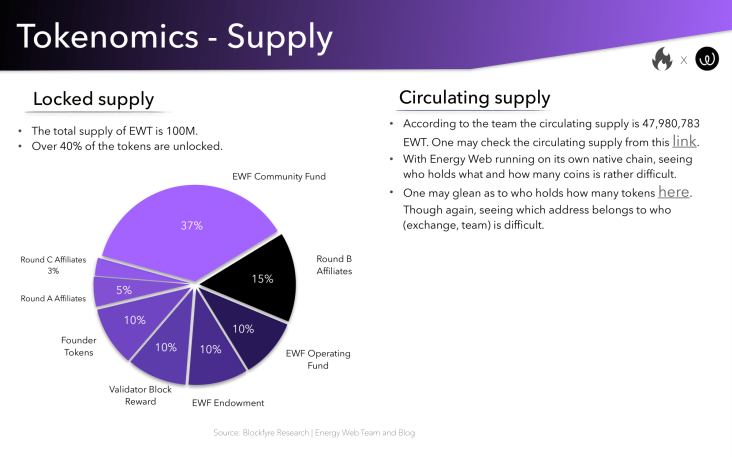
To relate it to real-world concepts - the Carbon Coin is very similar in principal to what I see as one of the most promising blockchains in the entire space - the Energy Web. (EWT). https://www.energyweb.org/. Here is the tokenomics breakdown of the EWT:
Back to the book and the fictional Carbon Coin: For every ton of carbon not burned, or sequestered for one century (benchmark time) - you are given one Carbon Coin. You can trade that coin immediately for any other currency on the currency exchanges, so one carbon coin would be worth a certain amount of other fiat currencies. The central banks would guarantee it at a certain minimum price, they would support a floor so it couldn't crash. But also, it could rise above that floor as people get a sense of its value. in the usual way of currencies in the currency exchange markets. A form of directed, targeted, quantitative easing aimed at carbon reduction. Combined with a carbon tax, the fictional Carbon Coin offers a carrot and stick incentive to address climate change for Governments, Corporations, and individuals in the form of a blockchain that is public AND permissioned that can be calculated and tied into the world economy effectively and in real-time.
How this relates to the EWT: I was actually brought to the attention of this book by Jesse Morris, the CCO of the Energy Web Chain. The "Carbon Coin" is an economic proposal very similar to what the Energy Web Token (EWT) is building the infrastructure for. The issues the Ministry for the Future has is getting the major central banks to back it - as they are bankers concerned with monetary policy, not fiscal policy.
TLDR: A highly entertaining yet scientific read during this market downturn. To me, investing in projects that support sustainability and climate change solutions are a philosophical no-brainer. However, we all know, markets do what markets do.
*On Barack Obama's list of favorite books of 2020 - I'm not affiliated in any way to the book or the Energy Web Chain.* Thanks for taking the time to read. Comment below your thoughts on the Energy Web, or other projects addressing world climate change.