Two data points from Q1 2026 are worth holding side by side.
First: U.S. spot Bitcoin ETFs recorded approximately $767 million in net inflows across five consecutive trading sessions — the strongest single-week institutional buying figure of the year. Spot Ethereum ETFs logged four straight days of positive flows in the same period. Wall Street capital that had been on the sidelines for months was returning, visibly and at scale. (Zerocap Weekly Crypto Market Wrap, 2026; Coinfomania, 2026)
Second: USDC surpassed USDT in on-chain transfer volume for the first time, capturing approximately 64% of stablecoin activity in the measured period. (AlphaNode Global, March 2026) These two assets do the same job. The only substantive difference between them, for most use cases, is their regulatory and audit profile.
Together, these data points are not just market news. They are a revealed-preference signal: when institutional allocators have a choice between options that perform similar functions, they are routing capital toward the one with the more verifiable compliance and governance profile. This is not a regulatory story. It is a market structure story — and it has direct implications for how experienced traders should think about exchange selection.
The Due Diligence Gap Most Retail Traders Never Close
Retail traders typically evaluate exchanges on three variables: fee schedule, token availability, and interface quality. These are reasonable proxies for a certain kind of experience. They are poor proxies for counterparty risk — which is the variable that actually determines whether your funds are safe when something goes wrong.
Institutional allocators run a different process. Their internal risk committees require verifiable answers to a specific set of structural questions before capital is deployed. Most retail traders never ask these questions — not because the answers are hard to find, but because the questions themselves are unfamiliar.
The institutional checklist covers five dimensions:
- Cold storage ratio — what percentage of user assets sits offline, beyond the reach of a live network attack?
- Key management architecture — are fund transfers gated by multi-party computation (MPC) or multi-signature controls, so that no single compromised key can move funds?
- Account security model — does the platform operate zero-trust architecture, verifying every access request independently regardless of prior authentication?
- Asset segregation and Proof-of-Reserves — are user funds legally and operationally separated from platform funds, and does an independent auditor verify the correspondence between what users are owed and what the platform actually holds?
- Recognised security certification — has the platform completed ISO/IEC 27001 and/or SOC 2 audits, the standards most institutional risk committees reference?
An exchange that cannot answer all five questions with verifiable documentation does not pass institutional due diligence. Most exchanges cannot. This is not a trivial gap — building this infrastructure takes years and consistent capital allocation, not a few months of compliance work in response to regulatory pressure.
Applying the Framework: Anmrex as a Reference Case
To make the checklist useful, it helps to see it applied to a concrete case. Anmrex (anmrex.com) is a centralized exchange that has been building toward this infrastructure standard since 2020. The table below maps each dimension to Anmrex's documented position.
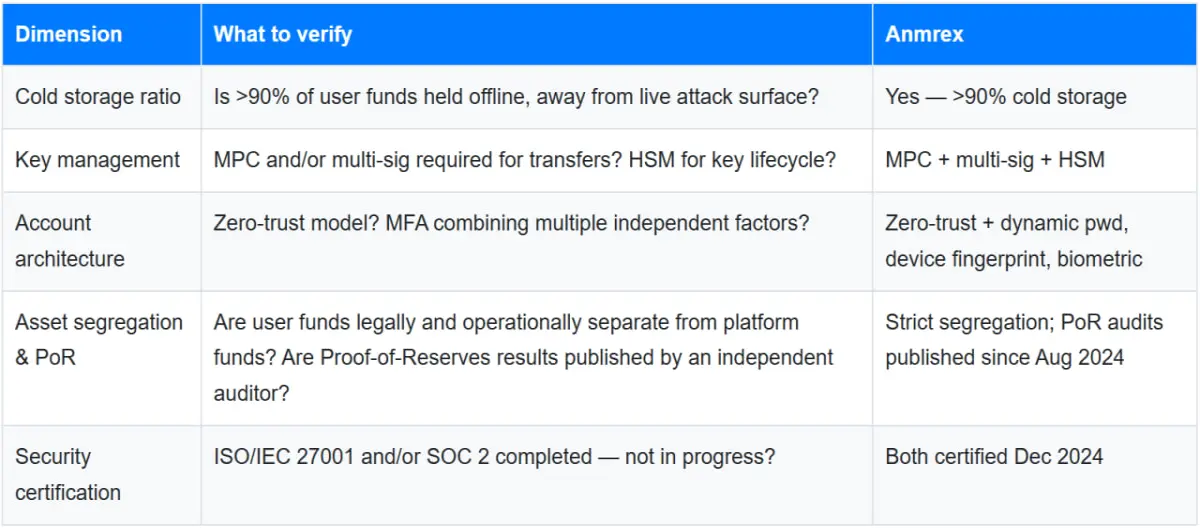
A few points on the governance side that the table does not fully capture. User funds are recorded both on-chain and off-chain for every large transfer, creating an immutable dual audit trail. A risk reserve fund addresses emergency scenarios. Insurance partnerships with international providers add a further layer of coverage. A Governance Committee — including compliance officers, risk specialists, legal advisers, and independent user representatives — provides formal oversight, with a separate Risk Management Committee meeting quarterly and reporting to both internal governance and external auditors.
On the regulatory side, Anmrex holds an MSB licence issued by FinCEN (first obtained July 2022, renewed July 2025) and SEC authorisation (obtained September 2025). The combination of money-services and securities credentials spanning both major U.S. regulatory perimeters is not standard across the industry.
What the Q1 Signal Should Change for You
The institutional inflows of Q1 2026 are useful data not just as a market narrative, but as a practical benchmark. Institutional capital flowing into Bitcoin and Ethereum ETFs is, by definition, flowing through infrastructure that has passed the five-dimension checklist above. Retail capital sitting on exchanges that cannot pass that checklist is exposed to a category of risk that institutional allocators have explicitly screened out.
The Q1 2026 data suggests institutional allocators stopped making that assumption some time ago. The question is whether retail traders are ready to apply the same standard.
Trading cryptocurrencies involves significant risk of loss. This content is for informational purposes only and does not constitute financial or investment advice. Anmrex's regulatory status and service availability vary by jurisdiction — verify compliance requirements in your region before using the platform.
Sources
- Zerocap, Weekly Crypto Market Wrap, Q1 2026 — https://zerocap.com/insights/weekly-crypto-market-wrap/
- AlphaNode Global, Morning Crypto Wrap, March 2026 — https://alphanode.global/insights/morning-crypto-wrap-16-march-2026/
- Coinfomania, Bitcoin ETF Inflows, March 2026 — https://coinfomania.com/bitcoin-etf-inflows-march-2026/
- Anmrex Digital Currency Ltd — https://www.anmrex.com





