
Games are one of the most popular hobbies in the modern world. Almost half of the world's population, around 3.6 billion people, play games and a large part of the market is driven by mobile games. People have played games since ancient times. Anthropologists believe that forms of play such as chasing, fighting and imitating hunting existed long before civilization. Some of the oldest known board games, such as Senet, the Royal Game of Ur and Go, are around 4,500–5,000 years old.
Playing is a natural human activity and an important part of our lives.
Today, there are many different types of games and in this article I want to talk about crypto games with a Play-to-Earn model.
What Is Play-to-Earn?
The Play-to-Earn concept is based on a game model where players can create real-world value in the form of cryptocurrency and NFTs by playing games. For players, this can create several advantages.
-
The most obvious advantage is that players can own part of the game's economy. In-game assets that players spent their resources on, such as time and possibly money, can become their property. They can keep them as collectibles or get in-game value from using them within the game. This can strengthen the connection between players and the game and change the way players perceive the in-game economy.
-
If they want to, players can sell these assets to other players and get value outside the game, potentially compensating for some of the resources they invested in the project. For some people, this can simply be an additional benefit, while for others it can become a source of additional income. This can also help games attract a new audience and create additional incentives for long-term players.
-
NFT ownership can provide a different kind of ownership compared to traditional in-game assets. An NFT can remain in a player's wallet even if a project stops being supported. This can be important for players who spend a lot of time collecting items or achieving goals in a game.
-
Since players can own part of the game's economy, they may also have more influence on the project and its development. Their opinions can become an important element in shaping the future of the game. This creates an opportunity for developers to use the potential of co-creation with the community. From a development perspective, such a project can gain a more independent life, which can give players a greater sense of agency.
When Playing Becomes Work
At the same time, while this concept is interesting, I would point out one critical conceptual problem that a team can face when developing a Play-to-Earn game.
When the main motivation for interacting with a product becomes making money, the fun element can disappear. It stops feeling like a game and starts feeling like work.
This is because the main value of a game exists within the game itself. We spend our time, energy, attention and sometimes money on games because they are fun and give us satisfaction. This is usually all we need from a game.
Of course, there are people who make money from games in other ways, such as streamers. But in this case, streaming is closer to work because generating income is the main purpose of the activity.
If we engage in an activity mainly because we want to earn money from it, it starts to resemble work by definition. And work is not something we usually associate with fun.
This creates a paradox for Play-to-Earn game design. If some players see earning money as their main goal, the game itself can become secondary.
This is why it is important not to lose sight of one simple idea: people play games because they want to have fun.
What Should Come First?
If a project allows players to earn cryptocurrency or mint NFTs, this should not be the priority. The priority should be the game mechanics and an enjoyable gameplay loop that are interesting on their own.
The ability to create value outside the game should be an additional feature that supports and strengthens the core experience.
There is little reason to focus too much on monetization through Play-to-Earn mechanics. If players see value in the product itself, they will want to return to it, build a community around it and spend more time in the game. This community can create demand for in-game products, which can eventually create a market for in-game items.
If the focus of game design shifts from creating fun for the player to monetization and maximizing the use of the P2E model, this can lead to unsustainable economies.
The problem is that activities inside the game may not create enough value by themselves. They only make sense because they provide financial rewards. If players are not having fun, this can lead to the destruction of the game's value and, as a result, the market around the project.
For a deeper analysis of this topic, I recommend this research by CryptoRank: https://cryptorank.io/insights/research/the-rise-and-fall-of-play-to-earn-games
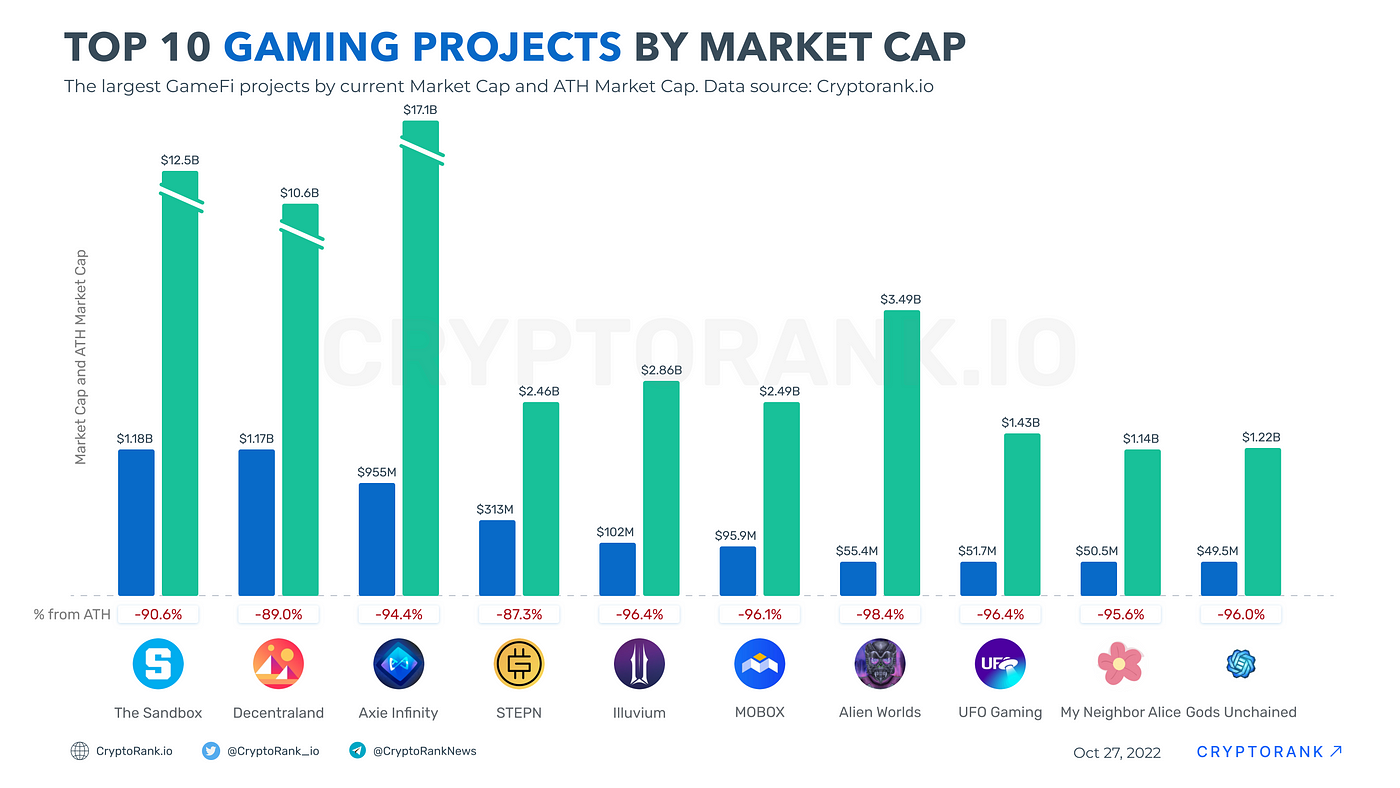
I am not affiliated with CryptoRank. I am sharing it because I found the analysis useful. For example, one of the things I liked about the research is the visual infographic showing the top 10 gaming projects by market cap. It is obviously outdated by now, but it is still representative enough to show how much interest in crypto games has declined.
Conclusion
Play-to-Earn is an interesting concept that can change the relationship between players, developers and in-game economies. However, the financial aspect should not replace the reason why people play games in the first place.
Play good games. And if you are a developer, create an engaging experience. Games exist for exactly that.
What has been your experience with Play-to-Earn games?





