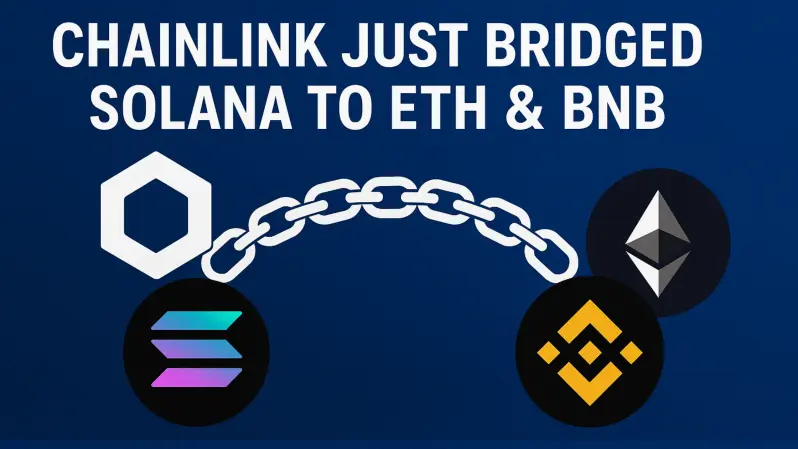
Chainlink just bridged Solana to ETH & BNB: Why It Matters
Chainlink just bridged Solana to ETH & BNB and no, that’s not just another technical upgrade you can skip over this could reshape how capital, projects, and real-world assets move across crypto. I know that’s a bold claim, but stay with me. I’ll explain why this matters, especially if you’re building in this space, managing liquidity, or simply holding some bags.
When I first read that Chainlink had integrated its Cross-Chain Interoperability Protocol (CCIP) with Solana, my instinct was curiosity, quickly followed by a gut-level sense that this wasn’t just another EVM chain hookup. This is Solana the outlier, the non-EVM giant. That matters.
So here’s the plan, I’ll walk you through exactly what Chainlink just pulled off, what it unlocks, and how you, whether you’re a founder, a CMO, or someone who believes in the next cycle, can use this info to stay ahead. There are trade-offs, there are unknowns but there are also massive opportunities.
Let’s get into it.
Solana Gets on the CCIP Highway
Let’s be clear about what just happened, Chainlink just bridged Solana to ETH & BNB through CCIP, and that makes Solana the first non-EVM chain to join this network, that’s not a throwaway detail. Solana is fast, low-latency, and has its own development language and stack it’s a fundamentally different beast.
Until now, cross-chain communication has mostly revolved around EVM-compatible systems, this was always a limitation for real interoperability to exist, the tech stack had to bridge that EVM wall. Chainlink just blew it open.
What this actually does is unlock asset transfers and data sharing between Solana, Ethereum, BNB Chain, and Arbitrum all within a proven security framework, no dodgy bridges, no high-friction manual processes. It’s clean, scalable, and battle-tested and Solana’s now part of that.
If you’re a founder or CMO of a DeFi protocol or a tokenized RWA platform, this changes your calculus. You can now deploy on Solana and seamlessly interact with Ethereum-based liquidity and vice versa, the operational cost drops, the liquidity options increase, you aren’t forced into a chain-first allegiance.
That flexibility is powerful, but so are the tradeoffs, Solana’s unique architecture means devs will still have to think hard about how they design cross-chain flows, this isn’t plug-and-play for everyone. But it’s a major leap forward.






