
For the last two years, MiCA was usually discussed as something that was coming to crypto.
That phase is over.
On July 1, 2026, the final transitional period expired. ESMA had already warned that companies relying on old national registrations would no longer be able to provide MiCA-regulated crypto services to EU clients without the required authorization.
That makes this a surprisingly good moment to ask a much simpler question:
Which crypto exchanges have actually made it into the regulated European system?
And there is another question that causes even more confusion:
Does your crypto wallet need a MiCA license too?
The answer is not as simple as the badges appearing on exchange websites suggest.
First: what exactly is MiCA?
MiCA stands for Markets in Crypto-Assets Regulation - Regulation (EU) 2023/1114.
It created a common regulatory framework for crypto-assets and crypto businesses across the European Union instead of leaving every member state with a separate system.
The rules covering asset-referenced tokens and e-money tokens began applying on June 30, 2024. Most of the broader MiCA framework became applicable on December 30, 2024, followed by a transitional period for some existing crypto businesses that could run no later than July 1, 2026.
For ordinary users, one of the most important parts concerns Crypto-Asset Service Providers, usually shortened to CASPs.
MiCA lists services including crypto custody, operating a trading platform, exchanging crypto for fiat, exchanging one crypto asset for another, executing orders, providing advice and transferring crypto-assets for clients.
And this brings us to an important correction.
There isn't really a "MiCA certificate"
People often search for a MiCA certificate or ask whether an exchange is "MiCA certified."
The more accurate term is MiCA authorization.
Under Article 59, a business generally cannot provide regulated crypto-asset services in the EU unless it is authorized as a CASP or belongs to one of the categories of already regulated financial institutions allowed to provide those services under MiCA's separate notification route.
So MiCA is not an EU quality badge placed on an exchange after somebody checks that it is "safe."
It is regulatory permission to provide specific crypto services.
That difference matters.
Which major crypto exchanges are MiCA authorized today?
ESMA maintains the central register of authorized crypto-asset service providers. The version I checked was updated on August 18, 2026.
Among the recognizable consumer-facing brands currently appearing in that register are:
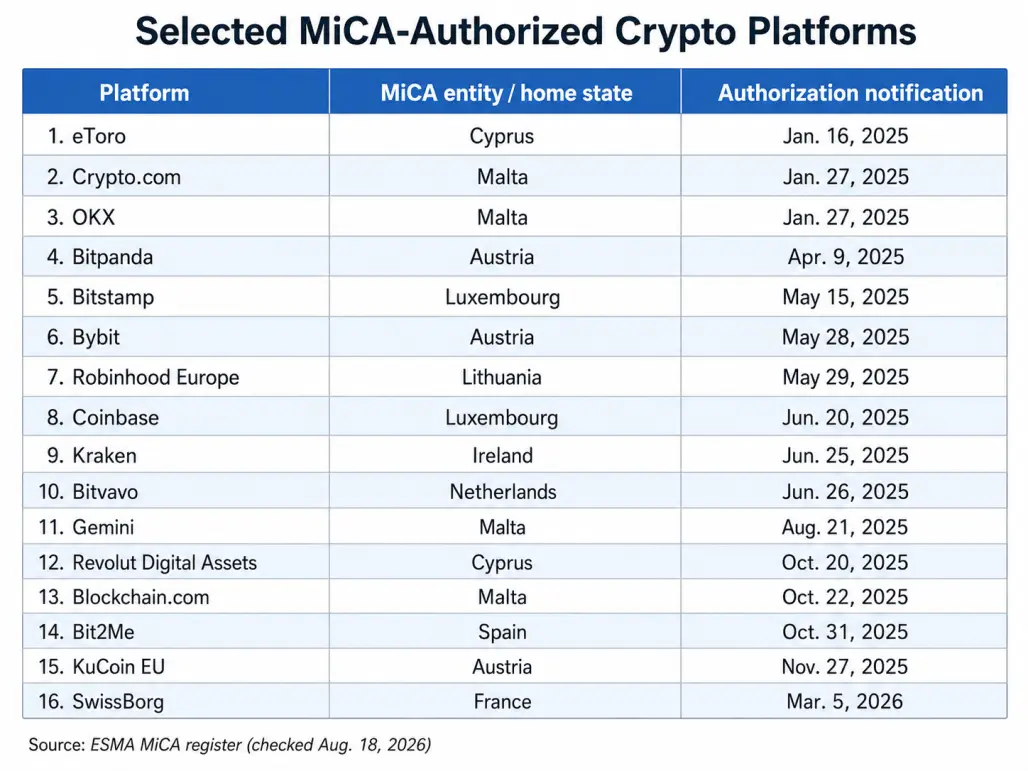
This is not the complete ESMA register. It is a selection of recognizable platforms rather than hundreds of legal entities, banks, custodians and specialist providers.
Several of these companies also publicly confirmed their authorization. Coinbase operates its European crypto services through Coinbase Luxembourg, Kraken received authorization from the Central Bank of Ireland, Bitstamp from Luxembourg's CSSF, while Crypto.com and OKX obtained theirs through Malta.
One authorization can then be passported across the European Economic Area rather than requiring a completely separate crypto license in every country. Kraken, for example, says its Irish authorization is now active across all 30 EEA countries.
And what about Binance?
This is where MiCA suddenly becomes much more than an abstract regulatory story.
At the time of writing, I do not find a Binance-branded entity in ESMA's CASP register dated August 18, 2026.
That fits what happened shortly before the final MiCA deadline. Binance withdrew its Greek MiCA application in June 2026, and EU customers were subsequently informed that some services would be suspended as the July 1 deadline arrived. Binance said it remained committed to Europe and intended to obtain MiCA authorization later.
That situation can obviously change.
ESMA updates the register regularly, so this is exactly the kind of information that should be checked again rather than copied forever from an article published in August 2026.
Now the confusing part: what about crypto wallets?
This is where the phrase "MiCA-certified wallet" starts to break down.
MiCA defines custody as safeguarding or controlling crypto-assets - or the means of accessing them, including private cryptographic keys - on behalf of clients.
That is fundamentally different from true self-custody.
If a company controls the assets or keys for you, it can be providing a regulated custody service.
If you control the private keys and a piece of software merely lets you interact with the blockchain, the regulatory situation is different.
So asking:
"Does MetaMask have a MiCA license?"
is often the wrong question.
The same problem applies to products such as a Ledger hardware wallet or a self-custody Trust Wallet setup. The wallet itself is not automatically equivalent to a custodial CASP simply because Europeans use it.
In the August 18 ESMA CASP file, I do not find commercial-name entries matching MetaMask, Trust Wallet or Ledger.
That does not mean Europeans are suddenly forbidden from holding their own keys.
It means a self-custody wallet should not be confused with a company holding crypto on behalf of its customers.
Custodial wallets are different
MiCA absolutely does cover professional custody.
The current ESMA register includes companies such as BitGo Europe, authorized in Germany, Tangany, also in Germany, and Zodia Custody Europe in Luxembourg.
Platforms such as Coinbase, Kraken, Bitpanda, Crypto.com, Blockchain.com and others in the exchange list can also be authorized for the MiCA service officially described as "providing custody and administration of crypto-assets on behalf of clients."
This is why the word wallet alone tells you almost nothing.
A mobile application can be:
-
a self-custody interface where you control the keys,
-
a custodial wallet where a company controls access,
-
an exchange account presented with a wallet interface,
-
or a mixture of self-custody and regulated third-party services.
Those are not the same thing under MiCA.
What does MiCA give users of a custodial service?
There are real protections here.
MiCA requires custody providers to establish custody policies, maintain records of client positions and put procedures in place to safeguard the crypto-assets or access methods they control.
It also requires client holdings to be segregated from the provider's own holdings and requires procedures for returning crypto-assets or the means of access to clients.
Those are meaningful obligations.
But there is a line that is very easy to cross in marketing:
regulated does not mean risk-free.
A MiCA license does not mean the EU guarantees your crypto
An authorized exchange can still suffer technical failures.
It can still make bad business decisions.
Crypto prices can still collapse.
A token listed on a MiCA-authorized exchange does not become an EU-approved investment.
And MiCA authorization should definitely not be read as:
"The European Union guarantees that I will get my money back."
That is not what the authorization means.
MiCA creates rules for how the service provider operates. It does not magically remove counterparty risk, market risk, smart-contract risk or the basic difference between keeping your own keys and trusting someone else to keep them for you.
That distinction may actually become more important now that regulated exchanges can legitimately market themselves as "MiCA licensed."
MiCA may change how Europeans choose an exchange
Until recently, many users compared exchanges mostly by trading fees, number of coins, liquidity and withdrawal costs.
There is now another question worth putting near the top of the list:
Which legal entity is actually serving me?
Not:
"Does this global brand have licenses somewhere?"
But:
"Is the entity serving my EU account in the ESMA MiCA register, and which services is it authorized to provide?"
Coinbase is a useful example. Its European crypto services are being moved to Coinbase Luxembourg S.A., the MiCA-authorized entity, rather than the existence of the global Coinbase brand itself being the regulatory answer.
The same principle applies elsewhere.
Regulation attaches to legal entities and specific services, not to logos.
Is MiCA good for crypto?
There are two reasonable ways to look at it.
From the consumer side, a common authorization regime, custody rules, disclosure requirements and an official public register make the European market easier to verify than a patchwork of national registrations.
From the industry side, compliance is expensive. Smaller companies may decide that Europe is no longer economical, while larger companies gain an advantage because they can afford legal teams, compliance systems and regulatory capital.
That could leave Europe with fewer providers - but providers that are considerably easier to supervise.
The Binance situation shows that this isn't theoretical anymore.
The deadline is already changing which companies can offer which services to European customers.
The question I would ask before using an exchange in Europe now
I would no longer begin with:
"Is this exchange popular?"
I would begin with:
"Which company is holding my crypto, and can I find that exact company in the MiCA register?"
Then I would check what services it is authorized to provide.
And if I am using a self-custody wallet, I would ask a completely different question:
"Who controls the private keys?"
MiCA matters.
But it does not replace that question.
Regulatory status checked against the ESMA MiCA register updated August 18, 2026. Because the register is updated regularly and authorizations can change, platform status should always be checked again before relying on it.






