FaucetPay Swap Fees vs Major Crypto Exchanges: When Is Convenience Worth Paying For?
A 3% crypto swap fee sounds expensive.
Because it is.
Compared with the trading fees charged by major cryptocurrency exchanges, FaucetPay's Coin Swap looks almost impossible to defend on price alone. If you already have $1,000 sitting on an exchange, paying several percent simply to turn one cryptocurrency into another would usually make very little sense.
But now change one detail.
You do not have $1,000.
You have $2.40 in Litecoin, $1.70 in Dogecoin and another dollar or two scattered across rewards collected from faucets.
And all of it is already sitting inside FaucetPay.
Suddenly the question is no longer:
Which platform advertises the lowest trading fee?
It becomes:
Which route leaves me with the most usable cryptocurrency after everything is finished?
That is a much more interesting comparison.
Because the cheapest exchange fee and the cheapest complete transaction are not always the same thing.
Let's Start With the Uncomfortable Number: FaucetPay Charges 3%
FaucetPay currently charges a 3% fee on Coin Swap transactions.
There is also another cost that deserves attention. FaucetPay states that swaps use a premium exchange rate for liquidity.
That second part matters.
It means you should not look at the 3% fee and automatically assume that it represents the entire difference between the market value of the coins you give up and the value you receive.
The final quote matters too.
Suppose you convert cryptocurrency worth $100.
The explicit FaucetPay fee alone represents:
$3
before considering the rate used for the conversion.
For normal trading, that is expensive.
There is no reason to dress it up.
But FaucetPay was not designed primarily as a professional trading venue. It describes itself as a micro-wallet built around small balances and frequent low-value transactions.
That distinction changes the comparison.
What Does a Major Exchange Charge?
Let's put FaucetPay beside three established trading platforms rather than comparing it with obscure instant-swap websites that may offer attractive rates but introduce much harder security questions.
For this comparison, I am looking at:
-
Binance Spot
-
Kraken
-
Coinbase Advanced
-
FaucetPay Coin Swap
The important word is established.
Saving a few tenths of a percent is not worth sending cryptocurrency to a platform you cannot reasonably verify.
Binance Spot: The Fee Difference Is Huge
Binance uses a tiered trading-fee structure, and the exact fee depends on factors including the market, account level and whether additional discounts apply.
Its own educational material uses a 0.1% spot trading fee as the standard example and notes that eligible users may reduce fees further through account tiers or by paying fees with BNB.
Take a simple $100 trade.
At 0.1%:
Trading fee: about $0.10
Compare that with FaucetPay's explicit 3%:
FaucetPay: $3.00
That is a 30-fold difference in the visible percentage fee.
If your cryptocurrency is already sitting on Binance and the pair you need is available, there is little mystery here.
Binance wins on trading cost.
Easily.
But that sentence contains an important condition:
the cryptocurrency is already there.
We'll come back to that.
Kraken: More Expensive Than Binance at the Entry Tier, Still Far Below FaucetPay
Kraken also uses maker and taker pricing.
On its current Polish spot fee schedule, the entry tier for crypto spot trading lists approximately:
0.40% maker
0.80% taker
with fees falling as qualifying activity increases.
A maker order generally sits on the order book waiting to be matched.
A taker order executes against liquidity already available.
For a $100 trade at the 0.80% taker rate:
about $0.80
At the 0.40% maker rate:
about $0.40
Again, both are dramatically below FaucetPay's 3%.
But Kraken offers something FaucetPay Coin Swap intentionally does not try to provide:
an actual trading environment.
You can use order books, choose order types and have considerably more control over execution.
That is useful when the trade itself matters.
For somebody merely trying to combine a handful of faucet rewards, it may be unnecessary complexity.
Coinbase Advanced: The Exact Fee Depends on Your Account and Order
Coinbase Advanced also uses a maker/taker structure.
The important detail is that Coinbase does not currently present one universal public percentage that applies to everyone.
Its official documentation says fees depend on:
-
whether the order is maker or taker,
-
the user's fee tier,
-
total 30-day trading volume.
The tier is recalculated regularly, and the applicable fee is shown to the user before the order is placed.
That actually gives us a useful lesson.
When comparing crypto fees, be suspicious of tables claiming:
Coinbase costs exactly X%.
or:
Kraken always costs exactly Y%.
Trading platforms increasingly use tiered pricing.
The correct question is:
What would this specific transaction cost me right now?
For Coinbase Advanced, check the preview.
For FaucetPay, check the Coin Swap quote.
For Binance or Kraken, check your current fee tier and trading pair.
The final transaction is what matters.
The Headline Comparison
At this point, FaucetPay looks terrible.
For a normal $100 crypto trade, the rough picture is:
Platform Fee structure
Binance Spot Around 0.10% in the standard example; varies with tier, pair and discounts
Kraken Spot Entry schedule around 0.40% maker / 0.80% taker on the current Polish schedule
Coinbase Advanced Variable maker/taker fee based on current tier and 30-day volume
FaucetPay Coin Swap 3% + premium exchange rate
Purely as a trading-fee contest:
FaucetPay loses.
That should not be controversial.
But now we need to stop comparing trading fees and start comparing routes.
The Cheapest Exchange Is Not Cheap If You Have to Reach It First
Imagine your FaucetPay wallet contains:
-
$2.20 in Litecoin,
-
$1.40 in Dogecoin,
-
$0.90 in another supported coin.
You want to consolidate everything into one cryptocurrency.
One option is simple:
FaucetPay balance → FaucetPay Coin Swap → consolidated balance
The other route may look something like:
FaucetPay → withdrawal → blockchain → exchange deposit → spot trade
and perhaps eventually:
exchange → blockchain → personal wallet
The exchange may charge only a fraction of one percent.
But the exchange fee is no longer the only cost.
You may have to consider:
-
FaucetPay withdrawal costs,
-
minimum withdrawal amounts,
-
blockchain costs,
-
exchange trading minimums,
-
exchange withdrawal fees,
-
spreads,
-
slippage,
-
the value of your time.
For a $10,000 trade, many of these costs become relatively insignificant.
For a $4 balance, they can determine the entire result.
Micropayments Need Micropayment Mathematics
This is one of the reasons conventional exchange comparisons can be misleading for FaucetPay users.
Most exchange reviews implicitly assume that you are trading a meaningful amount.
But faucet users may be dealing with fractions of a dollar.
A percentage works differently at that scale.
Imagine FaucetPay's 3% explicit fee on a $5 conversion.
That is:
$0.15
Fifteen cents is expensive relative to the transaction.
But now imagine avoiding the swap and withdrawing the coins elsewhere costs you more than fifteen cents in total.
Suddenly the more expensive percentage produces the cheaper route.
That does not make the 3% fee cheap.
It means percentage and total cost are measuring different things.
Use Total Conversion Cost, Not Trading Fee
I prefer to think about a conversion using something like:
Total cost = swap/trading fee + spread + transfer costs + withdrawal costs + slippage
And there is one more factor that does not fit neatly into the formula:
minimums.
A platform charging 0.1% is irrelevant if your balance cannot economically reach it.
That is where FaucetPay's internal swap becomes interesting.
You are not paying for the world's cheapest trading engine.
You are paying partly for the ability to convert funds where the small balances already exist.
FaucetPay Is Expensive as an Exchange but Useful as a Micropayment Hub
These two statements can both be true:
FaucetPay Coin Swap has a high percentage fee.
and:
FaucetPay Coin Swap can sometimes be the sensible way to convert a tiny balance.
There is no contradiction.
The use case changes the answer.
If I wanted to exchange several thousand dollars of Bitcoin into another asset, I would look toward a proper liquid exchange.
If I wanted to consolidate a few dollars accumulated through faucets, I would at least inspect the FaucetPay quote before moving anything.
That distinction is much more useful than declaring one platform universally “best.”
The Spread Is Easy to Forget
Fees are visible.
Spreads are less obvious.
That makes them easy to ignore.
Imagine two services.
Service A says:
1% fee
Service B says:
0% fee
Obviously Service B sounds better.
But suppose your $100 of cryptocurrency becomes:
$98.80 on Service A
and:
$97.10 on Service B
Which transaction was cheaper?
Service A.
The word “fee” did not tell you enough.
FaucetPay explicitly says Coin Swap uses a premium exchange rate for liquidity.
That makes one habit particularly important:
Look at the amount you will receive before confirming.
Do not calculate the result from the advertised fee alone.
The quote is the real transaction.
Security Is Part of the Cost Too
There is another way to save 2%.
It is a terrible one.
You find an unfamiliar exchange promising incredibly cheap conversions.
Its website looks professional.
It has a live chat.
Maybe somebody recommended it on social media.
You send your cryptocurrency.
And then something goes wrong.
Suddenly the difference between 3% and 0.2% looks completely irrelevant.
That is why I deliberately limited this comparison to FaucetPay and established major exchanges.
No custodial crypto platform is risk-free.
But counterparty quality is part of the transaction.
If saving a few cents requires trusting a platform you know almost nothing about, the apparent saving may not be worth taking.
FaucetPay Security: Appropriate for a Micropayment Account
FaucetPay states that two-factor authentication is enabled by default for new accounts and that official emails contain a personal anti-phishing phrase.
Those are sensible protections for a custodial platform.
The anti-phishing phrase is especially useful because fake login pages and fake support messages remain one of the simplest ways to steal cryptocurrency.
FaucetPay's own security guidance warns users about fake support, phishing pages, giveaway scams and malware that can replace a copied wallet address.
None of this means:
Leave unlimited amounts on FaucetPay because it is safe.
That is the wrong lesson.
The better lesson is:
Use the security tools available, and remember that a custodial account remains a custodial account.
Kraken Has an Interesting Security Advantage
Kraken deserves special attention for its Global Settings Lock, or GSL.
When enabled, GSL can prevent important account changes even if an attacker manages to compromise login credentials.
Among other things, it can prevent changes to withdrawal addresses and security settings, while an unlock can be configured to require a delay.
Kraken also supports multiple forms of 2FA and recommends phishing-resistant passkeys or hardware security keys.
It additionally publishes Proof of Reserves data.
Its snapshot dated March 31, 2026 showed reserve ratios above 100% for the major assets displayed, including BTC, ETH, SOL, USDT, USDC, XRP and ADA.
Proof of Reserves is not a guarantee against every possible failure.
But additional transparency is useful when choosing a custodian.
Coinbase Advanced Has Mature Account Controls
Coinbase requires two-step verification for account access and supports security keys and passkeys.
It also provides address allowlisting, which can restrict crypto withdrawals to addresses that have already been approved. Coinbase applies additional protections when new addresses are added.
Again, none of this turns Coinbase into self-custody.
But these are useful controls if an exchange is going to temporarily hold funds while you convert them.
Binance Adds an Emergency Fund to the Equation
Binance maintains the Secure Asset Fund for Users — SAFU.
Binance describes it as an emergency reserve established to protect users in certain extreme situations. As of February 2026, Binance said the fund contained crypto assets worth approximately $1 billion.
That is worth knowing.
It should not be misunderstood.
SAFU is not a replacement for:
-
securing your login,
-
enabling strong authentication,
-
checking withdrawal addresses,
-
avoiding phishing,
-
limiting the amount you leave on an exchange.
Security works best in layers.
An emergency fund is one layer.
Your own account hygiene is another.
None of These Platforms Should Become Your Long-Term Security Strategy by Accident
There is a common behavioral trap in crypto.
You transfer coins to an exchange because you want to convert them.
Then you forget about them.
Six months later, the coins are still there.
That turns a temporary trading decision into an unplanned custody decision.
FaucetPay is custodial.
Binance is custodial.
Kraken is custodial.
Coinbase is custodial.
If your objective changes from:
I want to exchange these coins
to:
I want to keep these coins for years
then you should reconsider the storage question separately.
An exchange and a long-term wallet solve different problems.
Four Real-World Scenarios
Instead of asking which platform is universally best, let's look at where each option makes sense.
Scenario 1: $4 in Faucet Rewards
You have several tiny balances already inside FaucetPay.
I would first inspect Coin Swap.
Yes, 3% is expensive.
But moving several microscopic balances elsewhere may cost more or may not be practical at all.
FaucetPay can win here.
Scenario 2: $25 Inside FaucetPay
Now the answer becomes less obvious.
Compare:
FaucetPay final swap quote
against:
withdrawal cost + external exchange fee
At this balance size, either route may win depending on the currencies and network involved.
Do the calculation.
Do not guess.
Scenario 3: $500 Already on a Major Exchange
This is completely different.
If the trading pair is liquid and the funds are already on Binance, Kraken or Coinbase Advanced, paying FaucetPay's 3% would normally have no economic justification.
Use the exchange already holding the funds.
Scenario 4: You Convert Crypto Regularly
Use a proper exchange.
Order books, lower fees and more control matter when trading becomes repetitive or involves larger balances.
FaucetPay Coin Swap is a convenience feature inside a micropayment ecosystem.
It is not a substitute for a full trading platform.
Final Ranking: Which Platform Gives the Most Value?
To make the comparison useful, I need to define what “best” means.
The ranking below assumes an ordinary user who wants to exchange cryptocurrency and values:
-
low trading cost,
-
established infrastructure,
-
account-security features,
-
practical usability.
It assumes the funds can already reach the platform economically.
Under those conditions, this is how I would rank the four options:
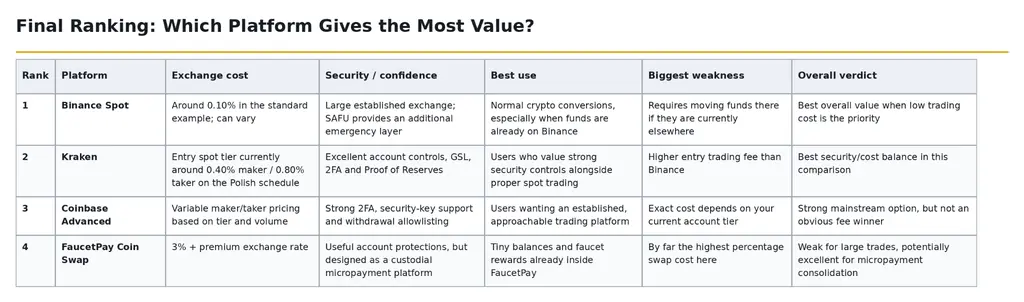
And this is where the ranking becomes interesting.
Because for somebody holding only a few dollars inside FaucetPay, the order may change completely.
For tiny balances, I would rank the practical routes more like this:
1. FaucetPay — when the coins are already there and moving them elsewhere destroys the saving
2. Binance — once the balance is large enough to transfer economically
3. Kraken — especially when account-security controls matter heavily
4. Coinbase Advanced — still credible, but without a clear cost advantage for this specific micropayment use case
That leads to what may be the most important sentence in this entire comparison:
FaucetPay can have the highest exchange fee and still produce the cheapest practical conversion for a tiny balance.
Both things can be true.
My Three-Step Decision Rule
Before converting anything, I would ask:
1. Where are the coins now?
Already on a major exchange?
There is probably little reason to move them somewhere else just to trade.
Tiny faucet rewards inside FaucetPay?
Continue to step two.
2. What will I actually receive?
Look at the final quote.
Not only the fee.
3. What would moving somewhere else cost?
Count:
withdrawal + network + trading + later withdrawal
Then compare the final amounts.
That is the calculation that matters.
The Verdict
If we judge the four platforms purely on trading fees, FaucetPay is the clear loser.
Its current Coin Swap fee is:
3% plus a premium exchange rate.
Major exchanges can trade crypto for well below 1% depending on the platform, market and account tier. Binance's standard example is around 0.1%, while Kraken's current Polish entry spot schedule lists 0.40% maker and 0.80% taker. Coinbase Advanced uses a dynamic maker/taker model based on the user's current fee tier.
For larger trades, that difference is decisive.
I would not use FaucetPay Coin Swap to convert hundreds or thousands of dollars merely for convenience.
But micropayments are different.
If your balance consists of a few dollars collected from faucets, moving everything out of FaucetPay before converting may introduce enough friction and cost to erase the advantage of the cheaper exchange.
That is where FaucetPay earns its place.
Not as the cheapest exchange.
But as a convenient conversion point for the tiny balances it was designed to handle.
So the question I would ask is not:
Which exchange advertises the lowest fee?
It is:
Which complete route leaves me with the most usable crypto without adding unnecessary risk?
Once you start comparing crypto that way, the answer becomes much more useful.
What Comes Next
Exchange fees are only one part of the FaucetPay puzzle.
A cheap conversion can still lead to an expensive mistake if you choose the wrong withdrawal network. A low network fee is irrelevant if the destination does not support that network. And even a profitable faucet can become a poor deal once you calculate how much it actually costs to move the reward where you want it.
In the next WakeUpToCrypto articles, we will keep following the money beyond the number shown on the screen: withdrawal routes, network choices, wallet decisions, hidden costs and the security mistakes that can turn a tiny fee saving into a much larger loss.
There is a surprising amount of economics hiding inside a balance worth only a few dollars.
And we are not finished with it yet.