Why Are Some TRON Transactions Almost Free While Others Burn TRX?
One of the biggest reasons people choose the TRON blockchain is its reputation for speed and low transaction costs. Sending USDT on the TRC-20 network is often much cheaper than using Ethereum, and confirmations usually take only a few seconds.
Trade smarter with the fast-growing marketplace at https://TronBid.com and save on transaction fees with instant TRON Energy rental at https://TronBid.energy .
However, many users experience an unexpected surprise. One USDT transfer costs almost nothing, while another burns several TRX. The transaction looks identical, yet the fee is completely different.
This confusion leads many newcomers to believe that TRON fees are unpredictable. In reality, the opposite is true. TRON has one of the most transparent resource systems in the blockchain industry. The key is understanding how Energy Rental works.
Instead of relying entirely on gas fees like Ethereum, TRON uses a resource-based model built around Bandwidth and Energy. Once you understand these resources, you'll quickly realize why experienced traders, exchanges, payment platforms, and Web3 developers rarely pay full transaction fees.
They simply use Energy more efficiently.
In this guide, we'll explain what Tron Energy Rental really means, how it works in practice, and why it has become an essential tool for active blockchain users.
Understanding TRON's Resource Model
Unlike many blockchains, TRON doesn't charge a fixed gas fee for every transaction.
Instead, the network uses two separate resources:
Bandwidth
Energy
Both reduce transaction costs, but they serve different purposes.
Bandwidth covers ordinary blockchain operations such as transferring TRX.
Energy is required whenever a smart contract executes.
Since most decentralized applications rely on smart contracts, Energy has become one of the most valuable resources in the TRON ecosystem.
What Is Tron Energy?
Energy is the computational resource consumed whenever the TRON Virtual Machine executes smart contract code.
That may sound technical, but the concept is actually simple.
Whenever you:
send USDT (TRC-20),
swap tokens,
interact with a DeFi protocol,
mint NFTs,
stake tokens,
use a decentralized application,
the blockchain performs calculations.
Those calculations consume Energy.
Think of Energy as electricity powering a computer.
Without electricity, the computer cannot process instructions.
Without Energy, the TRON blockchain cannot execute smart contracts.
Why Does TRON Use Energy Instead of Traditional Gas?
Ethereum introduced the concept of gas fees.
Every operation requires gas, and users pay directly in ETH.
TRON follows a different philosophy.
Instead of forcing users to pay every time, the network allows them to obtain computational resources in advance.
This creates several advantages:
lower transaction costs,
predictable expenses,
better scalability,
improved user experience.
Heavy blockchain users are rewarded for managing resources efficiently rather than constantly paying transaction fees.
It's one of the reasons TRON has become popular for stablecoin transfers.
Why USDT Transfers Require Energy
Many beginners assume transferring USDT is simply sending tokens from one wallet to another.
Technically, that's not what happens.
USDT on TRON follows the TRC-20 token standard.
Every transfer interacts with a smart contract that performs several actions:
verifies the sender's balance,
confirms permissions,
updates balances,
records the transaction on-chain.
Each of these actions requires computational work.
Computational work requires Energy.
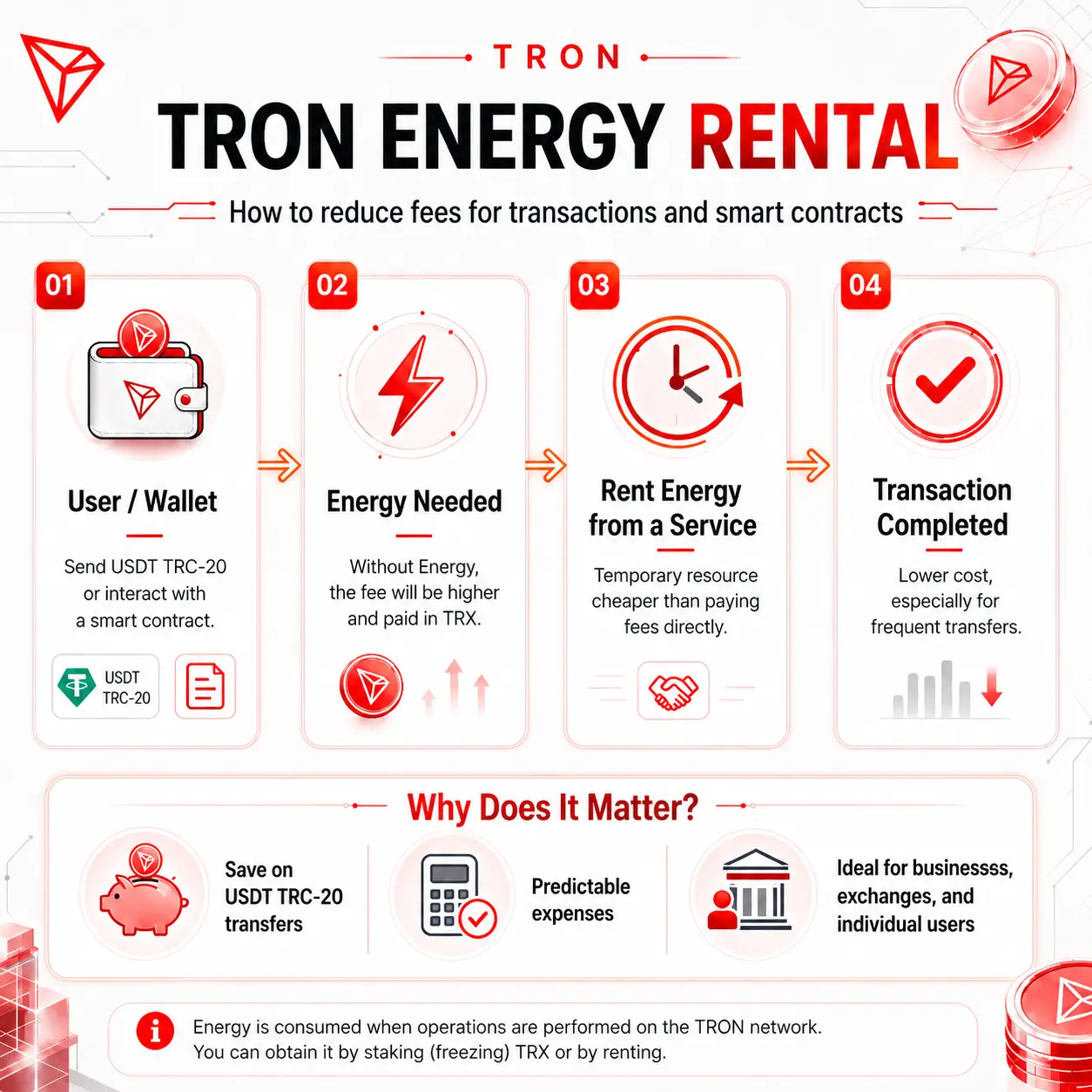
If your wallet doesn't have enough Energy, TRON automatically burns TRX to pay for the missing resources.
This explains why some users suddenly lose several TRX after sending USDT.
The blockchain isn't charging a random fee—it is simply purchasing the Energy needed to execute the smart contract.
So What Is Energy Rental?
This is where things become interesting.
There are two primary ways to obtain Energy.
The first is staking TRX.
By freezing TRX, users receive Energy over time.
This approach works well for long-term holders but requires locking capital.
The second option is Energy Rental.
Instead of locking thousands of TRX, users temporarily rent the exact amount of Energy they need.
After the rental period expires, the Energy returns to its owner.
The renter avoids freezing capital while still benefiting from dramatically lower transaction costs.
This simple concept has created an entirely new service industry within the TRON ecosystem.
How Energy Rental Works in Practice
Imagine you need to send USDT to a client.
Without Energy:
the smart contract executes,
TRON burns your TRX,
your transaction becomes more expensive.
Now imagine renting Energy first.
The rented Energy covers the computational cost.
Instead of burning TRX, your wallet consumes the rented resource.
The transaction is completed with significantly lower fees.
For someone sending a single transaction, the savings may appear modest.
For businesses processing thousands of transfers every day, the savings become enormous.
Who Benefits Most from Energy Rental?
Although anyone can rent Energy, some users gain much more value than others.
Active Traders
Professional traders frequently move USDT between exchanges.
Reducing transaction costs directly increases profitability.
Cryptocurrency Exchanges
Centralized exchanges process thousands of withdrawals every day.
Energy Rental significantly reduces operational expenses while maintaining fast transaction speeds.
Payment Platforms
Businesses accepting USDT payments want predictable blockchain costs.
Energy Rental allows them to estimate expenses far more accurately than simply paying transaction fees.
OTC Desks
Large over-the-counter transactions often involve multiple wallet movements.
Saving TRX on every transaction becomes meaningful over time.
Web3 Projects
Decentralized applications execute smart contracts continuously.
Energy isn't just useful—it's part of their infrastructure.
Without efficient Energy management, scaling becomes expensive.
Why Energy Rental Has Become So Popular
Over the past few years, TRON has become one of the world's largest stablecoin networks.
Billions of dollars worth of USDT move across the blockchain every day.
As transaction volumes increased, users naturally searched for better ways to reduce fees.
Energy Rental solved a simple but important problem.
Instead of forcing everyone to lock large amounts of TRX, specialized providers allow users to rent only what they need, exactly when they need it.
This flexibility makes the blockchain more accessible to individual users while giving businesses a powerful tool for cost optimization.
Staking vs. Renting Energy: Which Option Makes More Sense?
Once users understand the role of Energy on the TRON blockchain, the next question is obvious:
Should you stake TRX or rent Energy?
Both methods provide access to the same resource, but they are designed for different types of users.
Staking TRX
When you stake (freeze) TRX, the network allocates Energy based on the amount you've locked.
Advantages include:
Long-term access to Energy
Additional governance rights
No recurring rental payments
Suitable for investors holding large TRX balances
The downside is liquidity. Your capital remains locked during the staking period, making it unavailable for trading or other investments.
Renting Energy
Energy Rental offers a different approach.
Instead of freezing capital, you pay a small fee to temporarily use the required amount of Energy.
Benefits include:
No locked funds
Instant access to resources
Flexible rental periods
Lower upfront costs
Ideal for businesses and active users
For many traders and companies, renting Energy is simply more capital-efficient.
A Real-World Example
Imagine a payment platform that processes 5,000 USDT transfers every day.
Without Energy, every transaction burns TRX.
Even if each transfer costs only a few TRX, the monthly expense can become substantial.
Now imagine the same platform renting Energy.
Instead of paying the full computational cost every time, most smart contract execution is covered by rented resources.
The result is:
lower transaction costs,
predictable operating expenses,
improved profit margins.
For companies processing hundreds of thousands of transactions every month, this difference can represent significant annual savings.
Why Businesses Are Adopting Energy Rental
Many blockchain startups initially ignore transaction costs.
During the early stages, expenses seem negligible.
But as the number of users grows, so does the number of smart contract interactions.
Every USDT payment...
Every token swap...
Every staking operation...
Every decentralized application request...
...requires Energy.
Without a strategy for resource management, blockchain costs scale alongside business growth.
That's why exchanges, payment gateways, OTC platforms, and Web3 companies increasingly treat Energy as an operational resource rather than just another blockchain feature.
Common Mistakes New Users Make
Although renting Energy is straightforward, beginners often repeat the same mistakes.
Renting Too Little
Many users calculate only the minimum Energy required for a single transaction.
If the smart contract consumes more than expected, the remaining cost is automatically paid in TRX.
Adding a small safety margin usually prevents unnecessary expenses.
Choosing the Cheapest Provider
Low prices can be attractive, but reliability matters more.
A delayed Energy allocation can interrupt important transactions, especially for businesses handling customer payments.
Trusted providers prioritize speed, transparency, and consistent service.
Forgetting the Rental Duration
Energy rentals are temporary.
Once the rental period expires, the Energy returns to its owner.
Planning transaction timing helps avoid unexpected TRX consumption.
Ignoring Energy Before Large Transactions
Professional users always verify available Energy before initiating multiple smart contract operations.
A quick balance check often prevents avoidable fees.
Why Energy Rental Matters for Web3
Web3 applications rely on smart contracts for almost everything.
Whether users are:
trading assets,
lending tokens,
participating in DAOs,
minting NFTs,
interacting with DeFi protocols,
smart contracts execute continuously.
That execution consumes Energy.
For developers, this means Energy directly affects the economics of their applications.
Lower operational costs can improve user experience, increase adoption, and make decentralized services more competitive.
As Web3 continues to evolve, efficient resource management is becoming just as important as software development itself.
The Future of Energy Rental
Energy marketplaces are still relatively young, but they're evolving rapidly.
Several trends are already becoming clear.
Automation
Wallets and decentralized applications are beginning to integrate automatic Energy management, allowing users to rent resources without leaving the application.
Enterprise Adoption
Businesses increasingly seek predictable blockchain costs.
Automated Energy allocation makes budgeting easier and improves financial planning.
Smarter Infrastructure
Future platforms will likely allocate Energy dynamically based on transaction demand, reducing waste and maximizing efficiency.
Better User Experience
Eventually, many users may not even realize they're renting Energy.
The process will happen automatically behind the scenes, making blockchain transactions feel as seamless as traditional online payments.
Is Energy Rental Worth It?
The answer depends on how you use TRON.
For someone sending a single USDT transaction every few months, renting Energy may not be necessary.
However, for anyone who:
frequently transfers USDT,
actively trades,
uses DeFi protocols,
manages crypto payments,
operates exchanges,
develops Web3 applications,
Energy Rental can significantly reduce blockchain expenses.
The more transactions you perform, the greater the potential savings.
Final Thoughts
Tron Energy Rental is far more than a tool for reducing transaction fees.
It represents one of the most innovative aspects of TRON's resource-based blockchain model.
Instead of forcing users to pay unpredictable gas fees for every smart contract interaction, TRON allows them to access computational resources in a flexible and cost-efficient way.
Whether obtained through staking or rental, Energy transforms how users interact with the network.
For individuals, it means lower fees.
For traders, it improves profitability.
For businesses, it creates predictable operating costs.
For Web3 developers, it provides a scalable foundation for building decentralized applications.
As the TRON ecosystem continues to grow and USDT transaction volume increases worldwide, understanding Energy Rental will become increasingly important.
The users who learn how to manage blockchain resources efficiently won't just save TRX—they'll gain a practical advantage in one of the world's fastest-growing blockchain ecosystems.
In the long run, Energy Rental isn't simply an optimization technique. It's becoming a fundamental part of how serious users, businesses, and developers interact with TRON.






