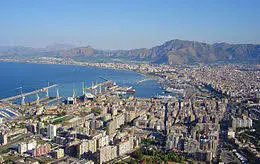
Palermo is the capital of Sicily. The 12th century Cathedral of Palermo houses royal tombs, while the imposing neoclassical Massimo Theater is famous for its opera performances. Also in the center are the Palazzo dei Normanni, a royal palace dating back to the 9th century, and the Palatine Chapel, with Byzantine mosaics. The crowded markets include the central street market Ballarò and Vucciria, near the port.
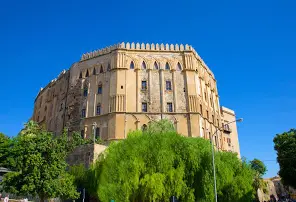
The Palazzo dei Normanni, also known as the Royal Palace, is located in Palermo and is currently the seat of the Sicilian regional assembly. The palace is the oldest royal residence in Europe, home to the rulers of the Kingdom of Sicily, imperial seat with Frederick II and Corrado IV and the historic Sicilian Parliament. On the first floor of the building stands the Palatine Chapel. The west wing is assigned to the Italian Army. It is one of the most visited monuments on the island. The additional tourist services are managed by the Federico II Foundation; the main entrance is on Piazza del Parlamento, the tourist one and the driveway are on Piazza Indipendenza. From 3 July 2015 it is part of the World Heritage Site within the serial site "Arab-Norman Palermo and the cathedrals of Cefalù and Monreale".
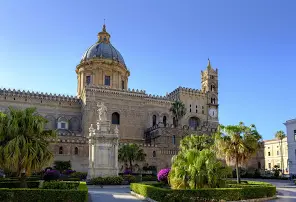
The primatial metropolitan cathedral basilica of the Holy Virgin Mary Assumption, known simply as the Cathedral Church of Palermo, is the main Catholic place of worship in the city of Palermo and the archiepiscopal seat of the metropolitan archdiocese of the same name. Since 3 July 2015 it has been part of the World Heritage Site within the Arab-Norman Palermo serial site and the cathedrals of Cefalù and Monreale.
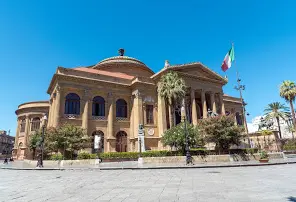
The Teatro Massimo Vittorio Emanuele, better known as Teatro Massimo, in Palermo is the largest opera house in Italy, one of the largest in Europe and third in architectural order after the Opéra National in Paris and the Staatsoper di Vienna. Representative rooms, halls, galleries and monumental stairways surround the actual theater, forming an architectural complex of grandiose proportions.
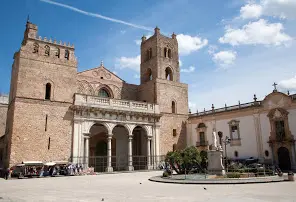
The cathedral of Santa Maria Nuova is the main Catholic place of worship in Monreale, in the metropolitan city of Palermo, the archiepiscopal seat of the archdiocese of the same name. Built starting from 1174 at the behest of William II of Altavilla, king of Sicily from 1166 to 1189, it is famous for the rich Byzantine mosaics that decorate its interior. In August 1926 Pope Pius XI elevated it to the dignity of a minor basilica. Since 3 July 2015 it has been part of the World Heritage Site within the Arab-Norman itinerary of Palermo, Cefalù and Monreale.
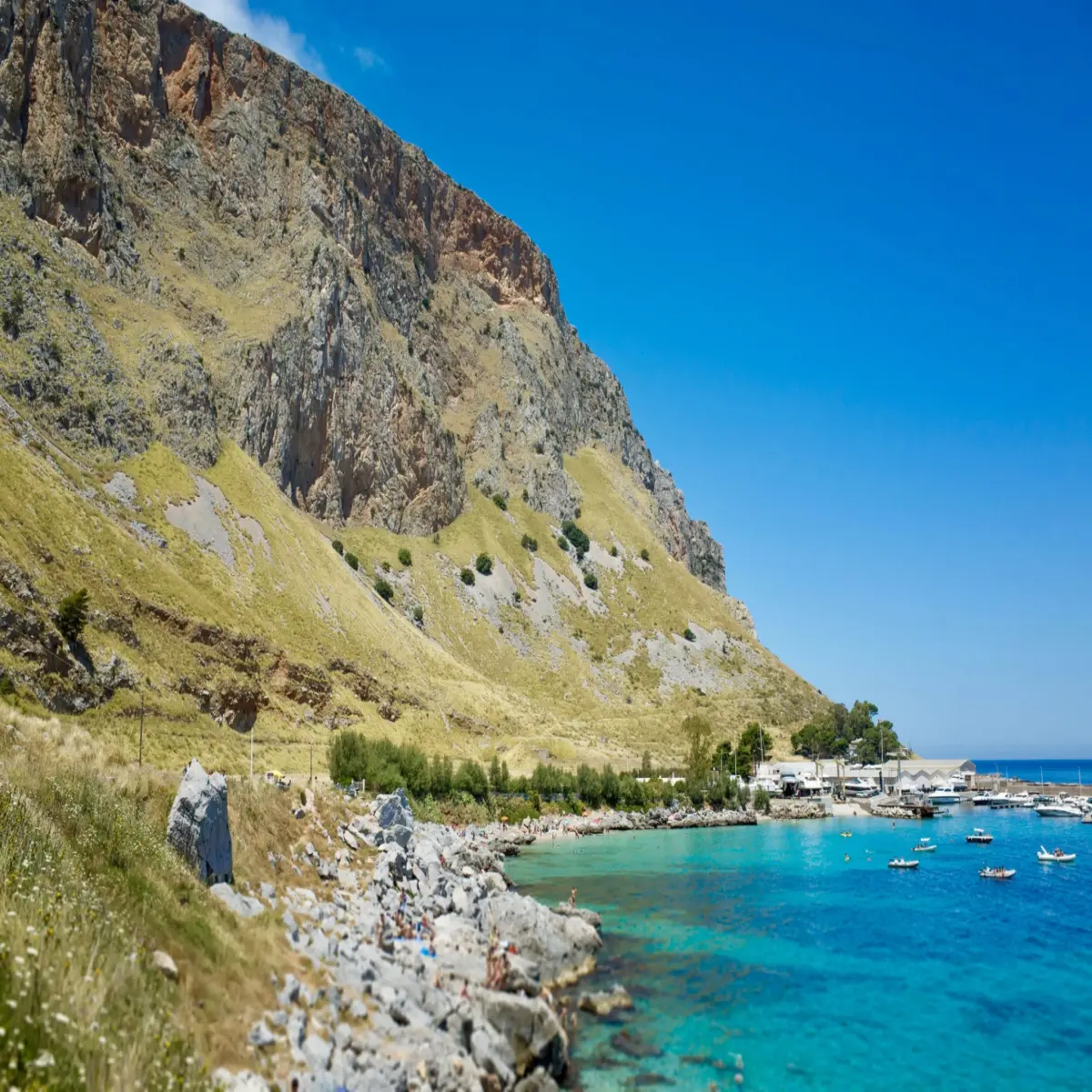
The Capo Gallo oriented nature reserve is a protected natural area located in the municipality of Palermo and was established by the Sicilian Region in 2001. It is included in the Regional Plan of Parks and Reserves and is managed by the State Forestry Agency of the Sicilian Region, which has made numerous interventions aimed at recreating the original environmental conditions of the territory and making it accessible to the public. The manager proceeded with the arrangement of the existing paths, the creation of fences, walls, fences, the cleaning of the undergrowth and, subsequently, a periodic maintenance to give visitors the opportunity to fully enjoy the beauty of the place while fully respecting the environment.
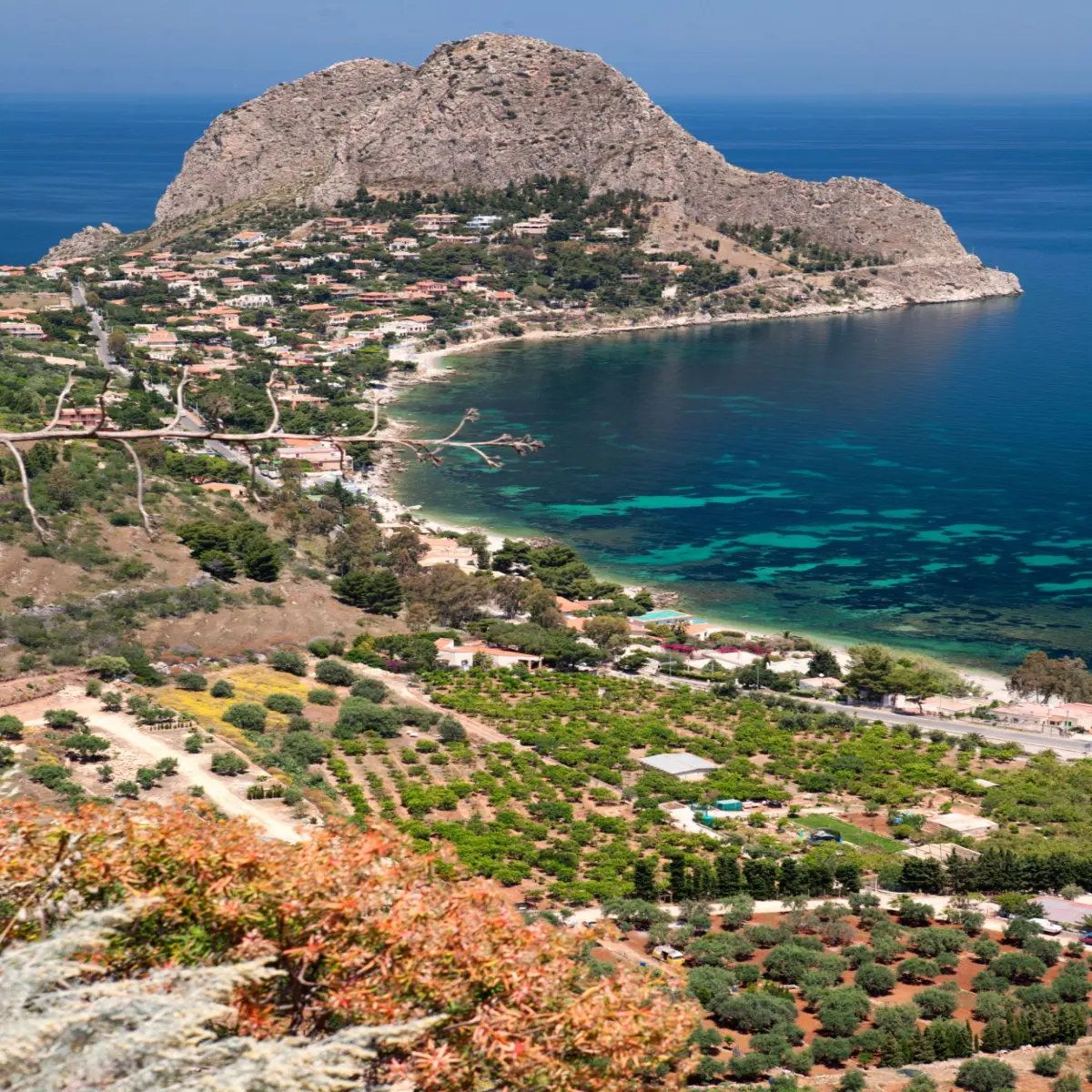
Capo Zafferano is a small promontory that juts out into the Tyrrhenian Sea, belonging to the territory of Santa Flavia in the metropolitan city of Palermo. From it, proceeding to the west, the Gulf of Palermo begins, overlooked by the Conca d'Oro. From Palermo it can be reached by the SS 113 by accessing the road that reaches it, immediately after the crossroads for Bagheria. In its vicinity there is the town of Solanto famous for the ancient tuna fishery no longer active. Behind it is the archaeological site of Solunto.
Palermo is an Italian town of 658 403 inhabitants, the capital of the metropolitan city of the same name and of the Sicilian region. It is the fifth Italian municipality by population as well as the main urban center of the island of Sicily and island Italy, second in Southern Italy and thirtieth at European level.
The city boasts a pluri-millennial history and has played an important role in the events of the Mediterranean and Europe. Founded by the Phoenicians between the seventh and sixth centuries BC, it was conquered in 254 BC. by the Romans and has become the main center of the island (Sicily Province). Conquered by the Vandals in 429, it passed under Byzantium in 536 and then inexorably conquered by the Berbers in 831. Subsequently, with the advent of the Normans and the return to Christianity, it was the city of coronation for the numerous sovereigns of Sicily, precisely for this circumstance we owe the titles attributed to the city: "Prima Sedes, Corona Regis et Regni Caput". Since then the capital of the Kingdom of Sicily has remained, with ups and downs, until 1816. The Sicilian Vespers were particularly important, a rebellion that broke out in Palermo in 1282.
From 1816 to 1817 it was the capital of the new Kingdom of the Two Sicilies, derived from the merger of the Kingdom of Sicily with the Kingdom of Naples called "Sicily Citiore". Subsequently it became the second most important city of the same Duo-Sicilian kingdom, until 1861, the year of the unification of Italy. Palermo was the city that on January 12, 1848 gave birth to the Sicilian revolution, the first phase of the spring of peoples which soon spread throughout Europe. During the period of revolts against the Bourbons, between January 1848 and May 1849, under the leadership of the Roger Ruggero Settimo from Palermo, the city played the role of capital of a Sicilian state for the last time.
The long history of the city and the succession of numerous civilizations and peoples have given it a remarkable artistic and architectural heritage. The Arab-Norman Palermo serial site and the cathedrals of Cefalù and Monreale, which includes several monumental assets located in the city, was declared a World Heritage Site by UNESCO in 2015.
Numerous buildings, including churches and palaces, are recognized as Italian national monuments.
The Sicilian Regional Assembly is located in Palermo, the oldest active parliamentary seat in the world, as well as a relevant university location. Its archdiocese is the metropolitan seat and seat of the primate of Sicily. Named Italian Youth Capital 2017, it was also the Italian capital of culture for 2018.





