
Once again history repeats itself. A handful of revolutionaries overthrows the centralized tyrant who cruelly rules over them. In a short time, the revolution is transformed into a new tyrannical structure that imparts its rules with cruelty.
The cycle begins again.
The revolution ends up being more tyrannical, ambitious, and greedy than the ancient régime because its base was still the idea of a hierarchy that replaces the previous one. The concept of dominion, power, accumulation, and enrichment remains the same. It's like trying to put out a fire with gasoline.
It is not fair play to say that you love Satoshi Nakamoto's White Paper and then when you have to act, behave like the vilest and most greedy banker in the capitalist world.
Unfortunately, many brilliant minds have been distracted by the “get rich” in a few weeks spell that the declining centralizers put together to capture the unsuspecting, making them lose the long-term vision of anarchy and decentralization.
Bitcoin and Ether, two well-known characters, are not the initiators of this vision. They are derivatives of a much earlier event, which was the availability of Open Source code to everyone on the planet. Thanks to this revolutionary seed, many people who did not know each other got in touch to improve a project. Then came the Internet based on this revolutionary culture, the seed of future decentralization. It could be said that Open Source was the fundamental tool of what is today known as DAO.
Revolutions are cultural. Open Source means that nobody owns a code, but everyone, and that the most remote of the programmers can suggest a change that definitively changes the functioning of a system.
Defi is a cultural change, not a series of applications on the smartphone. Defi is the possibility that anyone in any remote place on the planet can play $10 in a liquidity pool, or on a lending platform. In other words, Defi is the Open Source of finance, previously tightly controlled by banks and financial corporations that monopolized the total value of transactions. Any user can support a project and actually own the money from it, without permission, relying on nothing but math. It is the property revolution, it is owning your money. The tokens can make a homeless person the owner of his/her money, without going through any traditional entity that, on the other hand, would never have accepted him/her.
Any user can own a part of his/her favorite application. Could it be thought in traditional terms that a client could be the owner of a part of the bank of which he/she is a client?
The real enemy is the middleman. Any centralized platform is a middleman.
Think for a moment about the enormous tsunami of creativity that was launched when someone thought of an Open Source environment.
Now, MetaMask was born open-source and earned a reputation as the perfect key to enter the EVM and the Ethereum ecosystem in general. But in 2020, MetaMask abandoned the revolution it had started. Brave was invited to "fork off" the wallet as a result of the abrupt change. Open-source developers working for an open environment on Ethereum suddenly found themselves working for a corporation with a proprietary license.
MetaMask's entire codebase is now owned by ConsenSys.
In other words, MetaMask became centralized, even though the speech we hear from ConsenSys is that everything was done for the good of humanity and to achieve John Lennon's wish regarding the brotherhood of man. In Argentina, we have a saying: “for money the monkey dances”.
And now, who can help us?
Another very popular Argentine saying is: "He/she who burns himself/herself with milk, sees a cow and cries." Taking into account the latest events with centralized crypto platforms, for example, Celsius, I think that a deep reflection on the topic of centralization (intermediaries) and Web3 is necessary. Anything that is centralization and intermediaries should be rejected out of hand.
Your journey through the crypto sphere is a chain that has several links. If you receive your income in fiat, you need a ramp to exchange your fiat for crypto, that is, a centralized exchange (CEX), because decentralized exchanges (DEX) require you to deposit cryptocurrencies. As long as your crypto is in the CEX, you do not own your crypto. So, you have to get them out of there, unless you plan to do some kind of “Earn” like staking or lending within the exchange. Taking cryptocurrencies off an exchange means sending them to a wallet, or to a Defi platform to do some yield farming tricks. Both the wallet and the Defi platform that you are going to use must be decentralized because if not, we fall into the same question as when we had them in a CEX, you do not own your coins.
Then there are three critical path possibilities:
Fiat > CEX > wallet
Deposit fiat in an exchange, buy crypto, and send it to a wallet.
Crypto > DEX > wallet
Deposit crypto in a DEX, do something in there and what you receive send it to a wallet.
Crypto > dApp > wallet
Deposit crypto in a dApp, do something in there, and what you receive send it to a Wallet.
We see that everything ends in a Wallet, be it software or hardware. A Wallet is nothing more than a few lines of code that act as a private key that opens the door of the blockchain that is being invoked so that a series of additions and subtractions are made and thus tell you what your cryptocurrency balance is.
Therefore, if the Wallet is centralized, that is, it is guarded by some company, then it makes no sense to have been careful with operating with DEX and dApps.
So, anything centralized, with intermediaries, must be rejected from now on, or risk of the sudden death of assets.
Is it rational to continue using MetaMask, a former decentralized turned centralized?
No.
So here's Tally Ho! Tally Ho's Vision is to build a Community owned Web3 wallet, operating on the principles that have guided open source software for the past four decades.
Who is behind Tally Ho!?
Thesis is a cryptocurrency venture production studio. An incubator. Their first two products are Fold, a consumer payment app, and Keep, a privacy layer for public blockchains.
Thesis is backed by major VCs such as Andreessen Horowitz, Polychain Capital, Draper Associates, and DHVC.
Thesis claims to be fighting centralization. Thesis' CEO is a notable entrepreneur named Matt Luongo. Matt assembled a team at Thesis to build Tally Ho!, and his vision is to end ConsenSys' monopoly on the Ethereum environment.
The code for the Tally Ho! wallet has been released as free & open source under the copyleft GPLv3 software license, meaning Tally Ho! will not be able to close source the code. Using a copyleft software license ensures that developers can contribute to the project without fear of their code being used by corporations for private purposes.
What is a copyleft Open Source license?
Copyleft is a method of making a computer program free, further requiring that all modifications of the program also be free and released under the same terms and conditions. In 1984, Richard Stallman's decided to develop the GNU project, a complete operating system that would be developed and released based on his concept of free software. “Proprietary software developers use copyright to take away the users’ freedom; we use copyright to guarantee their freedom. That's why we reverse the name, changing “copyright” into “copyleft”.
Based on these principles, the Tally Ho! proposes a series of very tempting things for the crypto sphere:
> Build a wallet that is owned by the community and not by a corporation
> All wallet fees go to the community, not as in the current case of MetaMask that go to ConsenSys
> 100% self-custodial, private keys never leave the user's device
> The code is 100% open source and can be verified by anyone
> To sign up it is not necessary to provide any personal information, and Tally Ho! never tracks your activity or addresses
> Tally Ho! was audited by top-tier independent companies on the topic of Web3 security
> An on-chain DAO will be launched in 2022
Matt Luongo calls on everyone to build the project together: “Instead of enriching a select few, all fees generated by the wallet will go to users, bootstrapping a robust community. I believe we're building the wallet the open internet deserves. To me, that means Access over privilege, Open source over restrictive licensing, and Community control over centralized profiteering. To do that, we need you. Join the Discord, and be ready to share: What don't you like about today's Web3 wallets? What features are you missing? How can we make open finance easier today? If this is something that gets you excited, join us as part of the founding community on Discord, follow along on Twitter, or come work with us at Thesis.”
Beyond the good wishes, there are facts. It seems very promising as a concrete fact in the development of Tally Ho!, that an agreement has been reached with Alchemy, one of the best infrastructure providers in web3.
Alchemy Supernode is the most widely used blockchain API for Ethereum, Polygon, Solana, Arbitrum, Optimism, Flow, and Crypto.org. This Web3 blockchain infrastructure startup has closed a $200 million round for Web3 developers, led by Lightspeed.
“You need three core elements to build a successful business. — a high-performance team, a quality product, and a laser focus on customer needs,” said Ravi Mhatre, Partner at Lightspeed. "Alchemy is at the top of all three categories, and that's why they're one of the fastest growing companies in history."
Both MetaMask and Infura were founded in 2016 and even to this day most dApps rely on the built-in Infura provider from MetaMask to connect to Ethereum. But this solution is beginning to show its age.
What is Infura? It is a set of tools for anyone to create an application that connects to the Ethereum blockchain. A lot of Ethereum-based applications rely on Infura to connect to the Ethereum blockchain. But Infura is a centralized service, so it can be used to censor transactions by governments or other types of middlemen. So, the Ethereum blockchain is orbiting around a centralized Company...
Alchemy is decentralized, so it seems that partnering with it is a great differentiation.
In short, the path that Tally Ho! is taking seems to be the right one and we, who deeply believe in the decentralization of all systems on the planet, especially those related to money and government, are happy for this type of initiative and we support it fervently.
But…
There is always a but.
There are two things that concern me, although they are not decisive, at least for the moment. Remember the saying "He/she who burns himself/herself with milk, sees a cow and cries."
The first is that Thesis and its sponsors are centralized companies. Even though Tally Ho! says that the government of the wallet will soon pass to a DAO, it is not clear that centralization will disappear. The path given to his company by Matt Luongo will be essential in this process.
The second has to do precisely with the proposed DAO.
In this link, you can see a very detailed document of the DAO infrastructure proposed by the development team.
Lo and behold, carefully analyzing this document I find the following graph:
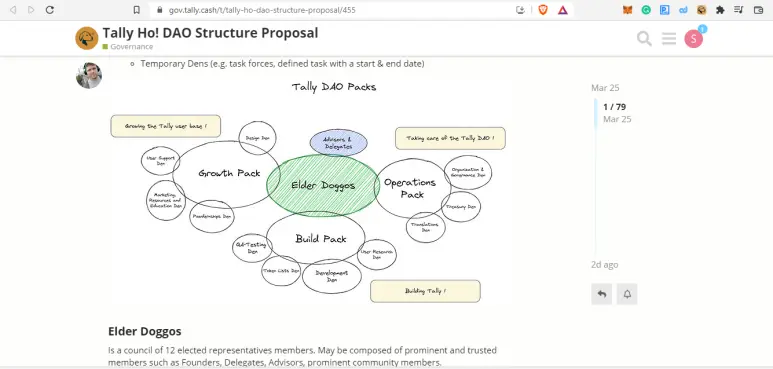
What are the “Elder doggos”? Are there some doggos more important than others? and are they 12? prominent and trusted?
Non-custodial is based on "no-trust". Are we going to trust the “Elder Doggos”?
I know that the best tool we have today to decentralize the ancien régime is this DAO issue. But I think that a DAO based on a council of elders can become a contradiction in terms.
That sadly reminds me of the famous phrase in George Orwell's "Animal Farm" "All Animals Are Equal But Some Are More Equal Than Others".
They will tell me that in all DAO there are some components with more lineage. But that is not an excuse for revolutionaries like those who are raising a community-owned wallet.
But that's not all, later on, this graph appears:
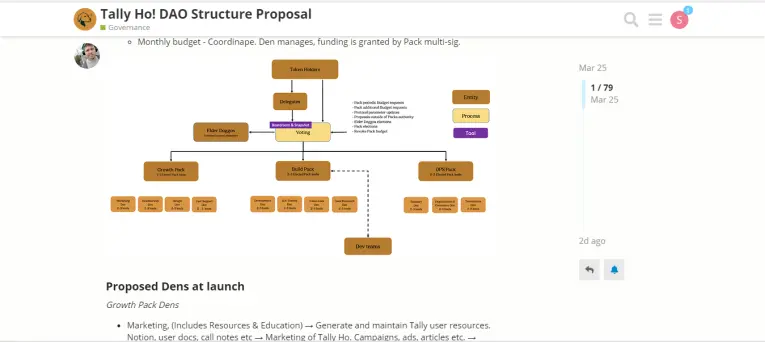
It is difficult for an anarchist to swallow a chart that shows an organizational chart with hierarchies.
We talk a lot about decentralization and non-custodial, but when it comes to action, do we fall into the same templates of the corporate bureaucratic organization?
The document speaks of “Governor Alpha” and “Governor Bravo”. Being that the proposal of Tally Ho! is so revolutionary, wouldn't it be time to think of a "Governor Charlie" structure that really has no hierarchies and responds to a concept of equality among all its members?
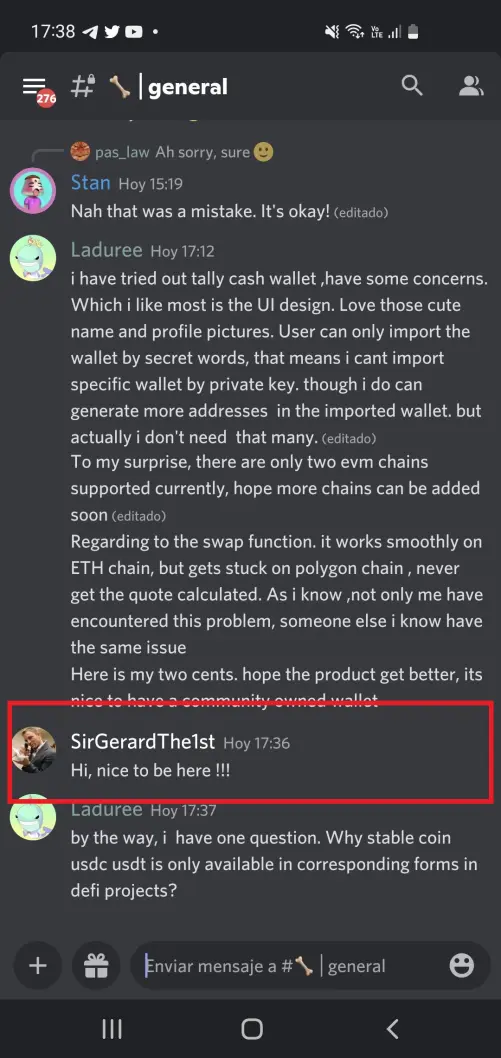
Well, I said. I wanted to leave these doubts to contribute to what Matt Luongo asks for by inviting us to participate in the development of this fascinating web3 universe. Of course, I joined the Discord group, and I will closely follow the revolution.
Conclusion.
Tally Ho! is still a very new project, although it looks like a very promising one. At the moment it is in a pre-alpha Community Edition stage, so it should be used with caution, in the words of its creator.
But being a revolutionary project that challenges the corporation, it is already attractive. I sincerely hope that it advances on the path that inspires Web3, towards equality and individual ownership of each individual's data and output. An individual is an individual because he/she is part of a system. Without the system, there would be no possibility of defining an individual. But if there are individuals in the system who are more than other individuals, we are not contributing to the revolution. We are doing more of the same.

Image by Dorota Kudyba from Pixabay
So Tally Ho!, show us the way!
Thank you for reading! Decentralize yourselves as much as you can, and much more! Work for yourselves, not for others. When you work for someone else, they pay you what YOUR POSITION is worth, when you work for yourself, they pay you what YOU are worth. No one achieves financial independence by working as an employee. Live long and prosper!
As usual, none of the things written in this post are financial advice and are not intended to replace personal research. My sole intention in writing this post is informative. Several of the things discussed here could be wrong, so in no way can this post be construed as financial advice, and in no way should it replace your own research.
If you have any questions or comments, please feel free to leave them down below
You can also contact me at [email protected]
Twitter https://twitter.com/SirGerardThe1st
LinkedIn https://www.linkedin.com/in/gerardosaporosi/
Follow my blog Anarchy: the Final Solution: https://gerardosaporosi.substack.com/






