
Many of you must remember the Cosmos series presented by Carl Sagan in the 80s. One day Sagan related that 4500 million years from now there will be "a perfect last day for the Earth", from which the Sun will begin to degrade for another 4500 million years and, at last, it will devour the Earth.

Image of Tatiana Marcoux in Pixabay
Paraphrasing Sagan, I believe that at the beginning of 2009 there was a “perfect last day for the corporate and predatory capitalism” that governs all the countries of the planet as a system, no matter what the ideology of the government and the state that circumstantially is in power. All alike are slaves of corporations, oil and a highly corrupt, expensive and totally inoperative financial system.
In early 2009, a certain Satoshi Nakamoto, whom no one knows or will ever know, gifted us with Bitcoin, and an incredibly revolutionary new technology known loosely as Blockchain, which signifies the end of that financial system.
We are undoubtedly experiencing a systems change, a revolution of the kind that happens every so often. We are living it.
It is not worth deducing when it started because it started and that's it, and for me it is fascinating to be living in this stage of humanity, in which every day you find out about a new development, whatever you do.
I particularly see a gigantic change and a massive displacement of the international monetary and financial systems, and the change is not going to come from the theorists of economics or politics, but from millions of entrepreneurs, programmers, developers, mathematicians and ordinary people like us, coordinating with each other, in a new connection paradigm. Take a look at how DeFi works to see how anarchy and coordination between human beings works.
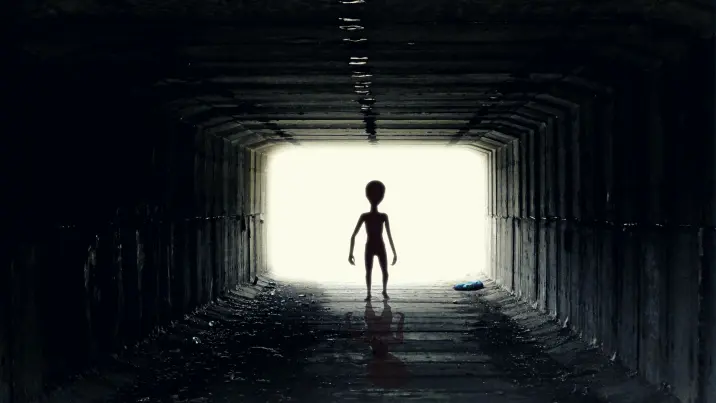
Image of Pawel86 in Pixabay
If alien anthropologists visited us today, and continued their travels coming back ten years from now, I think the macroscenario (looking at the labyrinth from above) those aliens could see would be characterized by:
- The majority of human beings organizing among themselves without central authorities coercing them to do things that are against their best interests and judgments.
- The almost total disappearance of intermediaries and the replacement by mathematics, algorithms and smart contracts that run on a large number of interconnected blockchains, eliminating fees, tariffs, unnecessary transfer costs, bottlenecks, complexities, costs, conflicts and corruption. Mathematics cannot be corrupted.
- The organization in communities that promote direct election, without electoral colleges or any political operator, but with a series of well-defined rules of governance and consensus (remember, anarchy is not the absence of rules, but the absence of regulators).
- The creation of a system of fairer and more inclusive financial social networks, in which each one prints and manages their own programmable money to pay and be paid for their work.
- The opportunity to be yourself as almost never before, and to live life as a game.
What I just did is a possible scenario, using prospective techniques.
What’s the use of doing scenarios?
It seems that scenarios would be useful only to be prepared to face threats. But no, scenarios are especially useful to detect opportunities and to innovate.
Innovate yes, but innovate on time! It may be that we have an innovative idea. What the scenario is going to give us is whether that idea has “timing” or “momentum”, or instead, it is too much advanced for its time.
The great danger of innovation is that it is only an innovation for the company, but not for the market.
The helicopter was designed by Leonardo da Vinci, but at that time people had not developed the culture of traveling to other places beyond where they were born, only a few adventurers did, and wars were carried out with horses and carts. So the helicopter wouldn't have been of much use in the Renaissance.
Another very illuminating example of "momentum" is that of the computer. Look at this sequence and then think about what the use of doing scenarios is.
In the first place, binary mathematics appeared around the seventeenth century, and allowed known numbers, the decimals, to be expressed as combinations of only two numbers, zero and one.
Second, Charles Babbage applied this theory to a calculating machine in the first half of the 19th century.
Third, in 1890, Herman Hollerith invented the punch card, adapting an early 19th century invention by the Frenchman JM Jacquard. The punch card allow people to convert numbers into instructions.
Fourth, in 1906, the American Lee de Forest invented the electronic valve, and with it the electronic age began.
Fifth, between 1910 and 1913, Bertrand Russel and Alfred North Whitehead created symbolic logic, which allows logical concepts to be expressed by numbers.
Sixth, during the First World War the concepts of programming and feedback were developed, mainly in support of aerial artillery.
So, in 1918, humanity had all the knowledge and materials necessary to build a computer. However, the first computer only came into operation in 1946.
Assess the six steps I just described and the period between the first, the last, and the year of commissioning.
3 centuries passed.
Without referring to the obvious 20th century hardware manufacturers who took advantage of this industry, let's think about a lot of small businesses that benefited from the advent of computers and prepared well in advance (mail, transportation, food, education, infinite list).
That's what making scenarios is for.
The macrostrategist “fishes” seemingly disconnected concepts in the ecosystem, and tries many iterations until he/she discovers something that might be interesting.
That is what this Tokenomics blog intends to do, show basic concepts, key technologies (high impact and little known), basic technologies (well known and used) and emerging technologies (very promising and of high uncertainty), install them in the minds of small entrepreneurs, and discuss together what a future world could be like, impacted by these macrovariables.
Scenario techniques differ from conventional forecasts (extrapolation of past trends) and portfolio analysis (current photograph of “reality”), because they require a deeper intellectual exercise.
The appearance of prospective techniques in the late 1950s generated a collective awareness among businessmen and businesswomen that the future does not happen blindly, but depends only on the action of human beings.
In the example we just gave about the manufacture of the first computer, the most curious thing is that the first personal computer only appeared 30 years later!
The crypto-sphere is, from my point of view, in the stage of the appearance of binary mathematics, the first step of the previous sequence. Whoever discovers where the key points come from, will find the Rosetta Stone of Champollion in a few years. But let's go slowly, because there is no rush. Exciting times await us.
With that said, let's move on to today's two tokens.
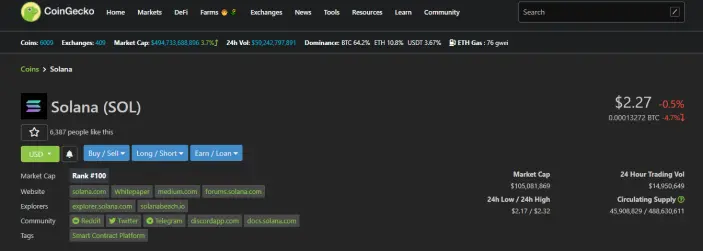
SOL
SOLANA is the highest performing permissionless blockchain in the criptosphere. It is an open source project maintained by the Solana Foundation based in Geneva, Switzerland.
The objective of Solana's architecture is to demonstrate that there is a set of algorithms that, when properly combined with a blockchain, can eliminate bottlenecks, allowing the speed of transaction to scale proportionally with the bandwidth of the network. In other words, a solution to the famous trilemma: scalability, security and decentralization.
SOL is Solana's native token, which can be passed between nodes in a Solana cluster in exchange for running a program or validating its output. The system can make micropayments in fractional SOLs called “lamports” after the great computer scientist Leslie Lamport, whose influence was pivotal to Solana.
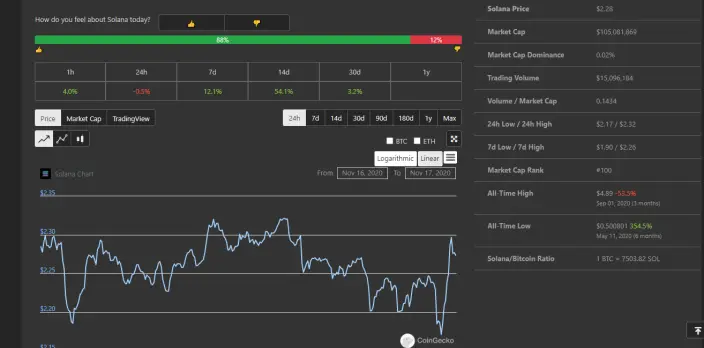
In November 2017, Anatoly Yakovenko published a whitepaper describing the "Proof of History", a technique to keep time between two computers that do not have mutual trust. Anatoly comes from a distributed systems design experience at Qualcomm, Mesosphere, and Dropbox.
Anatoly observed that blockchains like Bitcoin and Ethereum had serious trouble scaling more than 15 transactions per second, while centralized payment systems like Visa had spikes of 65,000 tps. Anatoly solved the problem of two computers that do not trust each other agree on time and with that he marked a milestone in blockchain technology. The result is speeds 10,000 times faster.
In June 2018, Solana's team scaled the technology to run a cloud-based network and in July 2019 they published a 50-node public permissioned testnet, which withstood bursts of 250,000 transactions per second. Later in December, the team published a permissioned testnet of 150 nodes showing an average of 200,000 transactions per second with bursts of 500,000 tps.
There are 8 key innovations that make the results of the Solana network possible.
1) Proof of History
One of the biggest problems of distributed systems is to agree on the times, aggravating the problem with adversary systems such as the blockchain. The nodes of a network cannot trust an external source of time or the "timestamp" that appears in a message. But what if instead of relying on the timestamp you could prove that the message occurred before and after an event?
If you take a photo from the cover of the newspaper, you are proving that the photograph was taken after the newspaper was published.
Proof of History allows you to create a historical record that proves that an event occurred at a specific moment in the space-time continuum.
2) Tower BFT
Solana implements a derivation of PBFT, with the difference that Proof of History provides a global source of time before consensus. Solana implements PBFT using PoH as the network clock time.
PBFT is short for Pratical Byzantine Fault Tolerance, a consensus algorithm introduced in the late 1990s by Barbara Liskov and Miguel Castro.
Its goal is to solve many of the problems associated with the already known BFT, Byzantine Fault Tolerance.
BFT is the algorithm that is applied in a distributed network to reach consensus (agreement on the same value), even when some of the nodes does not respond or responds with incorrect information. The objective of BFT is to safeguard the failures of a system, using a collective decision generator that tends to reduce the influence of erroneous nodes. BFT stems from the Byzantine Generals problem, a well-known problem in Game Theory.
3) Turbine
Turbine is Solana's propagation protocol, inspired by BitTorrent, that solves the trilemma of blockchain scalability.
The scalability trilemma in blockchain is a bandwidth issue. In most blockchain networks today, given a fixed amount of bandwidth per node, increasing the node's counter will increase the amount of time it takes to propagate all data to all nodes.
However, there are many solutions to optimize the way data is propagated. There are several novel data propagation technologies. For example, BitTorrent uses optimized technology to stream very large files to large groups of users. Solana uses this technology.
4) GulfStream
GulfStream is Solana's solution for the management of a high performance mempool in an adversarial network.
A mempool is a set of submitted transactions that have not yet been processed by the network. In the case of Bitcoin and Ethereum, the number of unconfirmed transactions is typically on the order of 20k to 100k. Solana's validators can handle a mempool of 100,000 transitions, which means that with a processing capacity of 50,000 TPS, a mempool of 100,000 transactions can be executed in a few seconds. That's why Solana is the best performing permissionless blockchain on the planet. The technical explanation of how GulfStream works is quite complex, and has to do with how mempool transactions are propagated. The propagation algorithm and architecture is extensively explained in the White paper.
5) Sealevel
Sealevel is a code for running smart contracts in parallel. The EVM runtimes for example are single-threaded, which means that one contract at a time modifies the state of the blockchain. Solana, on the other hand, can process tens of thousands of contracts in parallel, using as many cores as are available in the validator.
6) Pipelining
The Solana network validation process makes heavy use of a common optimization process in a CPU design called Pipelining. This is an appropriate process when there is a stream of input data that needs to be processed sequentially and there are also different hardware stations responsible for each action.
The most obvious explanation is the laundry room. Several laundry baskets need to be washed, dried and ironed in sequence. We know that washing has to take place before drying, and drying before ironing, but nothing prevents all the processes from happening on different separate machines. Making proper use of each station, through game theory, queuing theory section, spectacular solutions can be achieved.
7) Cloudbreak
Cloudbreak is the database for Solana's accounts. It is a mapping of Public Keys to Accounts. Solana does not use a traditional database, but a series of mechanisms taken mainly from the operation of operating systems.
8) Archivers
Archivers is Solana's distributed ledger store, set up to support petabytes of blockchain data storage. At its maximum limit, the Solana network can generate 1gb/s * 365 days = 4 petabytes of data per year. IF each node is asked to store that amount of data, the number of members of the network would be limited and it would be centralized in a few that have the capacity to maintain that storage capacity. To mitigate this problem, Solana uses its own technology already described, called Proof of History, allowing an implementation of Proof of Replication and a bit torrent distribution of the ledger through millions of replicator nodes around the planet. Archivers are not participants in the consensus, and have very low hardware requirements.
Conclusion. In this process faced in this blog called Tokenomics, which seeks to find fundamentals of protocols and projects that can change our lives, it seems that Solana is one of the players that is achieving the solution of the trilemma, scaling the blockchain for global adoption. There are brilliant minds on the team from blue-chip companies like Apple, Qualcomm, Intel, Google, Microsoft, Twitter, Dropbox, Cern. Development of the network was supported by fundraising of over $ 25 million from notable investors including Multicoin Capital, Foundation Capital, Distributed Global, CMCC, Blocktower Capital, NGC Capital and Rockaway Ventures. The best and brightest teams in crypto and enterprise choose Solana for the long-term, including Audius, Terra, and Chainlink. I think blockchain will have a lot to do with Solana in the short term.
BAN
JOIN THE CRYPTO-POTASSIUM REVOLUTION!
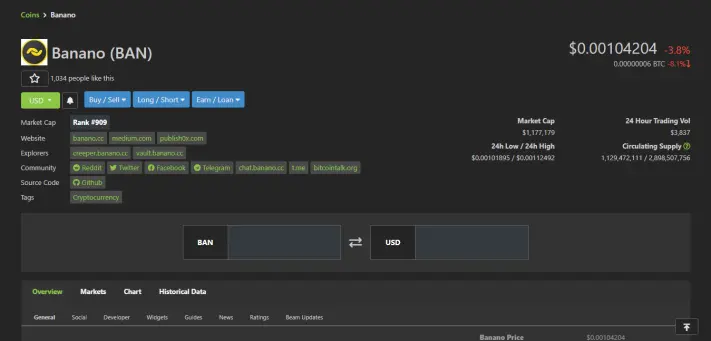
I want to be clear: I'm an obsessive BANANO fanatic. I fell in love with BANANO at the beginning of this year, and I couldn't leave it anymore. It is a community that takes life less seriously, as I do. It is pure fun, and although there are several of this type, the BAN token and its community is a torrent of new ideas and free forms of distribution that separate it far from the rest. The Telegram and Discord channels do not give respite, it is impossible to follow them, there is one idea per second. I believe that physicians who study the human brain should advise their patients to connect to these channels and prepare to see miracle cures.
The project does not have a White paper, but a Yellow Paper, as is logical to suppose (as far as I know, there are no white bananas), and its author is a disturbing pseudonym: Banoshi Nakanano. Normally, a Yellow Paper is intended to explain technical details of a project, but in this case, it is the only one available.
Attention! If anyone is thinking that this is all a non-serious joke, read a little more below.
In 2015, Sergio Lerner published a document describing the applicability of the so-called Directed Acyclic Graphs (DAG) in the field of cryptography. The concept was adopted by a large number of third generation cryptocurrencies. One of them was Colin LeMahieu's, first called Railblocks and later renamed NANO. I referred to this in my Episode 5 of this blog.
BANANO is the first "peel" (instead of "fork") of NANO, powered by DAG technology, which was released on April 1, 2018. The project started as a joke between NANO developers and resulted in a project very demanding, although as the community always remarks, without taking things too seriously.
BAN is a currency that has a number of advantages over a large number of currencies, being the main advantage, of course, the fact that it is very rich in potassium.
For example, briefly comparing BAN with BTC we have to:
Block Interval: BTC--> 10 Minutes Average, BAN--> instant
Confirmation time: BTC--> plus or minus 30 minutes, BAN--> 3 seconds
Transaction fees: BTC--> $ 50 average, BAN--> free
Energy use: huge BTC--> huge, BAN--> negligible
And so it could be continued, there are many more in the Yellow Paper.
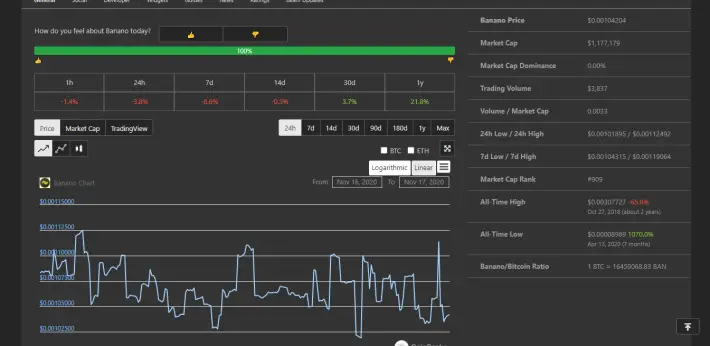
But I repeat, what is most exciting is the community that has managed to form the project with members from all parts of the planet. The members of the different communities have created fascinating, extraordinarily creative projects with BAN, mobile games, apps, faucet bots and tipbots on the main social media platforms such as Telgram, Twitter, Discord and Reddit.
BANANO is distributed free of charge. That's the great marketing pill.
BANANO uses a Block Lettuce architecture to achieve lightening-quick transfer speeds. Each account has its own blockchain. The BANANO ledger is secured with a decentralization mechanism called Open Representative Voting (previously called delegated Proof of Stake).
Typically, cryptocurrency wallet addresses are long character strings indistinguishable from each other. The BANANO community solved this long-standing problem by creating a unique monkey-shaped avatar, from a hash value based on a user’s public key. This visual representation of a wallet address serves to identify users while protecting the privacy of the account.
Your monkey is unique! ¡No two wallets have the same monkey! Each monkey has a unique combination of skin, eye color, styles such as hats, glasses, shirts, pants, mouths, tail decorations, and much more.
Here I formally introduce myself, this is my unique wallet:
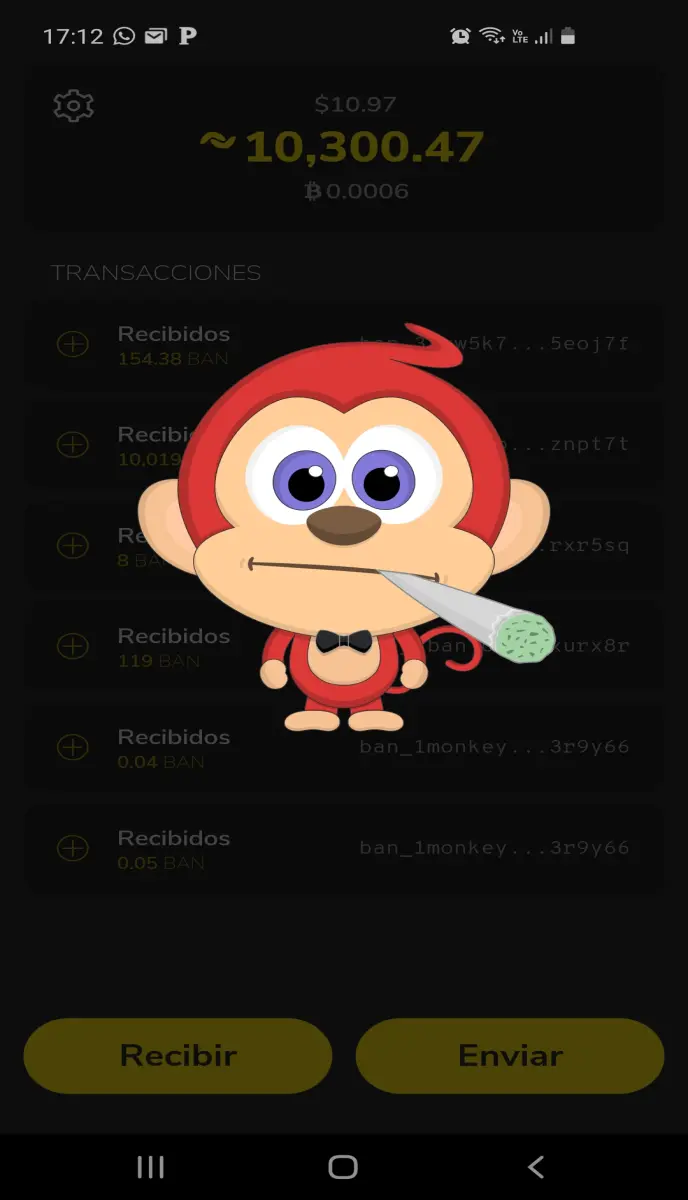
BAN is freely distributed through faucets, games, contests, giveaways and airdrops. BANANO however has a great differentiation with respect to similar projects, the distribution is done through games and very creative faucets, something like “Proof of Creativity”. While most faucets consist of pressing a button and waiting for the probabilistic distribution curve to bring you some cryptocurrency dust, BANANO faucets are games where you have to move your brain a lot and make creative proposals. You have to draw with a very limited editor (and there are guys who make incredible artworks), you have to make government proposals, there are mining powerplants, chats where you earn cryptocurrencies just for making a comment, games and cards collections.
What about BANANOS inflation? It is easy to deduce that, with free distribution and high growth, the specter of inflation is just around the corner. In July 2019 the team announced a “buy-back an burn” scheme. Basically, the team uses the proceeds from the monetization of the faucets (cryptocurrency mining and advertising) to buy BAN on the exchanges and then send them to a burn address.

The recently launched cryptomonKeys community connects BANANO to the world of digital collectibles, with the “monKeyfied NFT” card series.
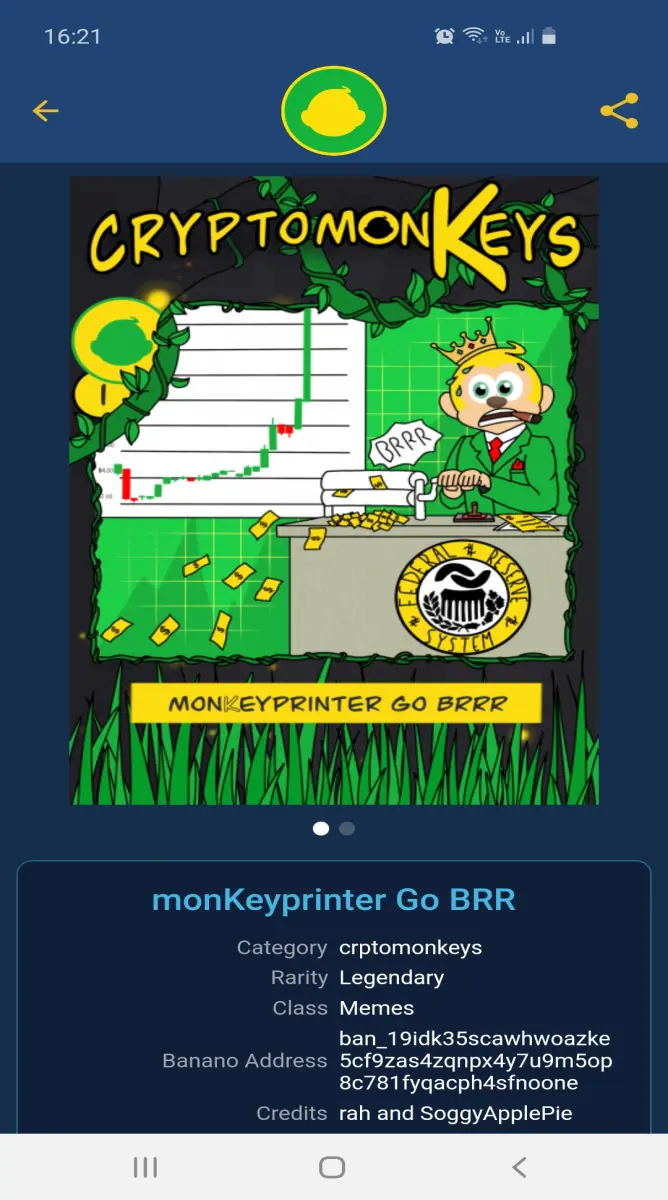
I have several collection BANANO cards in my wax wallet. Here below I present a legendary card (there are only 19) that is part of my portfolio. I was lucky to get it randomly in an airdrop among many applicants. I do not plan to sell it, its current value is approximately $ 200. My kids will probably make a fortune out of it when I move into a parallel universe.
As a last novelty, to keep us updated, we now have the Weekly Peel, a report that covers all the (many) updates from all the BANANO communities on the planet.

If you don't know where to start with BANANO, click here for a how-to.
Conclusion. This is a top-notch project. It is the entrance to art and to the playful side of each one of us. It is a ramp to teach children who are being born today about the scope of the crypto-sphere. It is a new relationship of the human being with digital assets in the form of games and interaction with people who live in places so far away, with overlapping interests, that otherwise we would never have known. In the Telegram and Discord communities it is very easy to chat every day with people from Bagladesh, Japan or Sweeden, getting in touch with creative ideas and earning crypto in the process. Every day more moderators and fans organize contests, giveaways and cryptopuzzles, which play a fundamental role in the BAN’s free distribution process, a concept that fascinates me and is part of the backbone of any Tokenomics. This is certainly a remarkable project in its own right. But, I ask myself, ¿what would happen if a multimedia giant, for example, Disney, for example, Atari, for example, Turner looks at BANANO? I mean, ¿what if someone with endorsement looks at the huge community of creative talents that BANANO made up around the planet? I mean the price of BAN obviously. (Excuse me, it's a multi-year professional deformation in the VC industry).
As usual, none of the things written in this post are financial advisoring and are not intended to replace personal research.
Thank you for reading!
You can follow my blog Tokenomics here
Publish0x is a gret idea. Consider signing up with my link
Hey you guys who speak Spanish, you can follow me on my Linkedin group "Relax Financiero"
If you have any questions or comments, please feel free to leave them down below
You can also contact me at [email protected]
You can also follow me on






