
You know, I imagine a world of spontaneous coordination between players who issue their own coins and exchange value with the people who are part of their cluster. And I call that tokenomics.
Tokenomics is not for me a new form of economy. Tokenomics obviously has something to do with the transfer of value between economic players, but it is much more than that, in the same way that the blockchain is much more than cryptocurrencies.
Tokenomics is a political process and not just an economic one. It is a new form of social organization without intermediaries and totally decentralized, without the need for a hierarchical order, achieving perfect coordination voluntarily and in conditions of maximum benefit for all players, not just for some. This is what in Game Theory is called Nash Equilibrium: the solution is not necessarily the one that generates the maximum profit for the players, but it is the best of all possible so that none of the participants has an incentive to change it.
Game theory is a branch of mathematics and economics that studies the choice of the optimal behavior of an individual when the costs and benefits of each option are not fixed in advance, but depend on the choices of other individuals. It conceives individuals as homo economicus and, in turn, shows how cooperation leads to the common good of the agents who carry it out, while individual action does not.
Game theory was gaining weight throughout the 50s of the previous century, when the first discussions of the prisoner's dilemma were established and the Nash equilibrium, the greatest exponent of non-cooperative games, was developed.
In the Nash equilibrium, the strategy chosen by each of the participants in a conflict or game is optimal, given the strategy chosen by the others. In other words, nobody will gain anything if they decide to change their strategy under the assumption that other individuals do not change theirs.
In many cases, individuals would like to be able to strike another equilibrium with higher profits, but fail to do so because they face the risk of being betrayed.

Image of 6557056 in Pixabay
Those who studied Bitcoin from its beginnings and in its fundamental proposal, know that the method proposed in the White Paper by Satoshi Nakamoto, is basically a practical solution to the "dilemma of the Byzantine generals", another of the most famous problems in Games Theory, which had no practical solution up to that point. Perhaps the solution Satoshi Nakamoto found will be seen over time as the greatest legacy that this pseudonym made to humanity.

Image of Willgard Krause in Pixabay
For its part, spontaneous order is a concept coined by a great thinker, Frederick Hayek, 1974 Nobel Laureate in economics and one of the leading exponents of the so-called Austrian School of Economics.
According to Hayek, the spontaneous order is not the result of a deliberate design of any person, but of an infinity of human actions carried out unconsciously.
Hayek differentiates between two types of orders: the “created order” and the “spontaneous order”. Spontaneous order is "uncreated."
The created order has an identifiable authority and a concrete purpose. Instead, the spontaneous order has neither origin nor identifiable authority. It has no specific purpose, except its own subsistence.
That is, according to Hayek, through a spontaneous and free process, with trial and error, generations and generations of human beings realize which behaviors work and which do not. It is a long process of coordination to achieve efficiency.
According to Hayek, a deliberate and rationalist attempt to design and/or intervene in society "from above", with impositions and interventions, is a de-civilizing aggression.
Here he approaches my anarchic model of interpretation of tokenomics.
But in every system there is an underlying guiding force that has to do with the concept of "entropy."
Entropy is the measure of disorder of a system. It is a physical quantity that allows us to measure the unusable part of the energy of a system, the one that does not produce work.
Entropy is the natural tendency to lose order in a system. The universe tends towards maximum entropy. This is a fully accepted physical law. The greater the number of possible configurations a system has, the more entropy it has.
The more degrees of freedom a system has, the more entropy it has and the more efficient it is.
Thinking a tokenomics without considering the concept of entropy implies, according to my criteria, the creation of an unstable scenario, not aligned with what will inevitably happen, which is the total increase of entropy in the universe and the end of time.
Well, I don't mean to become a mad scientist thinking about tokenomics, only remembering that it seems very silly to go against the universe.
Image of Rob de Roy in Pixabay
With that said, let's move on to today's two tokens.
SXP
Swipe (SXP) is defined as the company that bridges the crypto and fiat universes, mainly end consumers with retail businesses. Swipe created a card that takes an individual's crypto savings and automatically transforms them into fiat at the time of a purchase, such that the merchant receives fiat and the individual sees the transaction as being paid for with crypto.
The company's vision is that in this way, the mass adoption of cryptocurrencies can be accelerated, in a kind of “soft landing” that does not cause significant trauma during the inexorable changes that we will experience in world economies.
The company was founded by a young guy born in Philippines, Joselito Lizarondo, who is currently its CEO.
Swipe Token (SXP) is a utility based cryptocurrency designed to be the gas and fuel of the Swipe Network.
Binance, the giant exchange, acquired the Swipe firm in mid-2020.
Consumers can use Binance Coin (BNB), among other digital assets, on the Swipe platform, with their linked bank accounts and with fiat through Swipe's Visa debit cards, issued by a financial institution.
The protocol, developed on the Ethereum network, allows digital assets to remain in their form until a transaction is carried out in a given point of sale, then becoming fiat currency, making the process easier, both for users and retailers.
Binance CEO Changpeng Zhao said:
“To achieve our mission of making cryptocurrencies more accessible to the masses, exit ramps are also a key component. By giving users the ability to convert and spend crypto directly, and having retailers continue to accept fiat money seamlessly, this will make the crypto experience much better for everyone”.
Swipe is currently operational in Europe and supports fiat transactions in Euro, British Pounds, US Dollar, Korean Won and Philippine pesos.
Changpeng Zhao sees the Swipe purchase as a big step on the long road to mass adoption.
According to Binance's announcement, the Binance Card, which uses the Swipe engine, will be able to trade four cryptocurrencies at launch: BTC, SXP, BNB, and BUSD. Card users will be able to automatically convert their crypto and spend it at a network of 60 million retailers in 200 regions and territories. The card is in fact a debit card and does not require cryptocurrency owners to convert their tokens to fiat prior to purchase, rather the process is automatic. Joselito Lizarondo explains that, if you have 50 euros in BTC and 50 euros in BNB, and a transaction of 75 euros is made, it will be approved and the corresponding crypto will be deducted in the selected order.
In the white paper, the company explains its deflationary model.
There are currently over 65 million SXP that are distributed to users worldwide out of a 300 million supply. The tokenomics have been designed where the total supply decreases over time as the network is utilized, as part of the fees paid to the protocol are destroyed.
SXP will be destroyed and burned on-chain as protocol usage occurs until there are 100m units left.
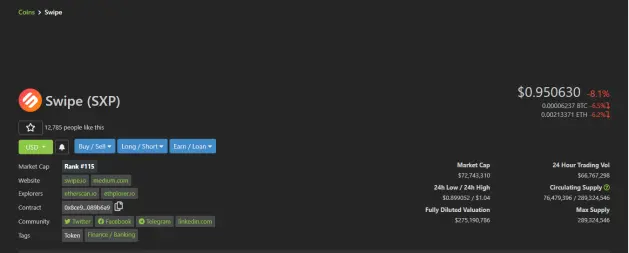
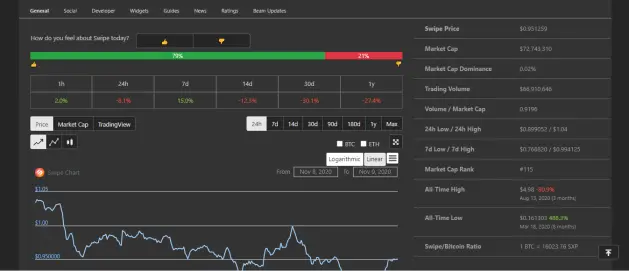
Swipe Governance enables SXP token holders to vote and initiate proposals on the Swipe Network.
SXP required to vote: 1 SXP
SXP required to submit proposals: 300,000 SXP
Swipe will include cross-chain support for two of the most used blockchains in the world: Ethereum & Binance Chain. Users will be able to swap their Ethereum based SXP token with a Binance Chain based SXP token for free at a 1:1 (one to one) ratio or vice versa without any fees.
CEO Joselito announced at the end of October that users will be able to use the card as a means of funding. Paying with USD, GBP or EUR you can get a cashback in BTC, SXP or BNB.

Conclusion. With such potential for worldwide operation, what will happen to this token that was conceived as a utility to pay the network transactions fee? As well as being a deflationary token, won't something similar to what happened with Ethereum gas during the Covid19 pandemic happen? Are we facing an unexploited gem?
AKRO
Surely you have ever heard the term “informal economy”.
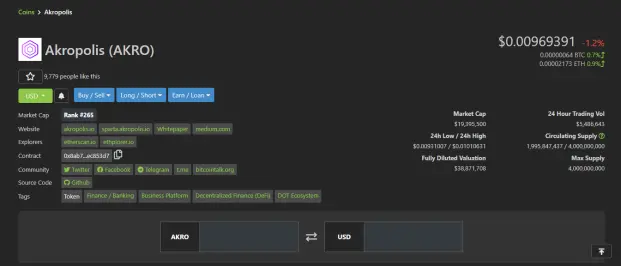
Akropolis (AKRO) is defined as a financial protocol for the informal economy. It is a platform that allows developers to easily generate a financial organization.
Akropolis is a domain-specific financial protocol dedicated to the needs of the growing billion-dollar informal economy. It is a protocol that has the mission of providing the environment and tools to create decentralized finance products (DeFi) so that users can borrow, lend and invest. Developers can create DeFi products through AkropolisOS, a space in Solidity for creating and managing complex applications and protocols.
It is designed to allow anyone to quickly establish, operate and develop informal autonomous financial organizations (AFOs) (e.g. digital cooperatives, guilds, mutuals).
AKRO is Akropolis's native governance token and is used to vote on the platform and collect income dividends from Akropolis-based products. In the future, AKRO will also be used to participate in delegated Proof-of-Stake, AkroChain's consensus mechanism.

There are two products built in Akropolis:
- Sparta - A lending protocol in which liquidity providers can earn interest by providing assets for others to borrow. Sparta borrowers may borrow assets whose value is up to 200% of the value of the secured assets.
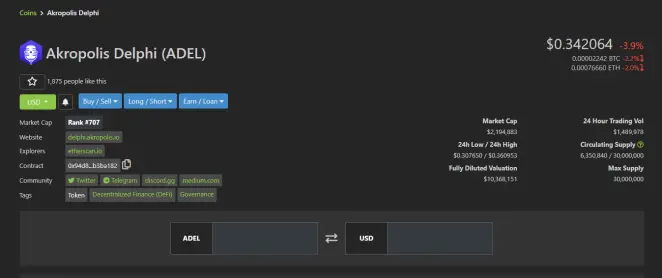
- Delphi - A yield farming aggregator that enables users to realize return on savings, earn reward tokens from embedded protocols, and invest in other assets.

The informal economy or irregular economy is the economic activity that is invisible to the State for reasons of tax evasion or administrative controls (for example, undeclared domestic work, spontaneous itinerant sales or the undervaluation of the notarized price in a real estate sale). It employs more than 60% of the world's workforce. On the other hand, the formal economy «is the one that is within the regulatory parameters of the State, that is, it complies with fiscal, labor and environmental regulations, pays taxes, has properly obtained the necessary activity licenses, has been registered in the corresponding registries and pays the social security of its workers, whom it has also registered.
Although the informal economy has been frequently associated with developing countries and emerging economies, all economic systems, without exception, participate in it.

Image of LillyCantabile in Pixabay
The informal economy is yet another example of the failure of obsolete government institutions, designed still today with the same parameters of two hundred years ago. There are many causes for interpreting the spontaneous order represented by the informal economy.
One cause could be the pressure of surplus labor on the labor market due to a shortage of jobs in the formal sector. This is because people seek their own solutions through the sale or provision of services to survive, in the absence of unemployment insurance.
Another cause is the ineffectiveness of governments that ignore economic processes, such as the way money works, and then fall into excessive regulations, poor services, or a combination of both.
In Latin America it is a very common phenomenon where it causes large sectors of society to be unprotected and left behind. Furthermore, the negative consequences of informality are many and affect economic development and ultimately the quality of life of people in the region.
Akropolis' mission is to give people the tools for savings, growth and the provision of future security, without having to depend on a geographic location, a central authority or multiple predatory financial intermediaries. That is why Akropolis built AkropolisOS, a lightweight and modular ecosystem to create profitable DAOs, with customizable incentives, automatic liquidity provision enabled by a bonding curve mechanism, and programmable liquidity management.
Conclusion. Future times mark a huge transition of economic systems, as we are seeing with the arrival of the crypto-sphere. For the first time in history, each human being has the possibility of being his/her own bank. Even those who live in the most absolute informality. And there are still many years of informality ahead, maybe forever. But of course, not everyone has the obligation to know how to manage an economic activity or a company, or a mutual, or a cooperative. AKRO is presented as an opportunity to easily develop a DAO that allows governance by people who today can only think about surviving, and who, in this way, could be dramatically changing their way of life. If AKRO manages to convey this concept to the masses, we are in the presence of a revolutionary token.
This is what this Tokenomics blog is about. Analyzing fundamentals and not prices. My intention is to discover and share with you the projects and tokens that can cause a dramatic change in our lives.
As usual, none of the things written in this post are financial advisoring and are not intended to replace personal research.
Thank you for reading!
You can follow my blog Tokenomics here
Publish0x is a gret idea. Consider signing up with my link
Hey you guys who speak Spanish, you can follow me on my Linkedin group "Relax Financiero"
If you have any questions or comments, please feel free to leave them down below
You can also contact me at [email protected]
You can also follow me on






