The World is getting more decentralized by the day, from economies seeking decentralization to companies embracing this system of governance. The perks of decentralization are out of this world and they can be seen in Decentralized Finance projects. We all know that the perks of decentralization outweigh those that are seen in centralization. Issues like censorship, poor security, and the likes are tackled by the former. Today, we won't be discussing about the differences between both centralization and decentralization. We will be looking at one of the most robust DeFi projects in the community at the moment, UniLend and comparing it with another intriguing DeFi project that is currently in existence, Uniswap.
Uniswap: What Is It?
If we said that Uniswap didn't pave the way for a lot of decentralized finance projects, including UniLend, we would be lying. This is an important aspect of the DeFi ecosystem that can not be overlooked. It currently boasts of a great deal of users, being that it has been around longer time that its current competitors, UniLend inclusive.
The fact that it has been around for longest doesn't mean that it is the best in the market. Let's take Bitcoin and Ethereum for example. Both have been around for years, but they have snags that other blockchains have come to correct.
BTC involves mining, since it is Proof of Work, and mining takes massive amount of energy, money and computing power.
This is an expensive and sometimes, futile operation. This birthed PoS, which is seen in a number of newer blockchains. Instead of having to mine for new blocks, these blockchains made it easier for users to stake. Ethereum comes with its own drawbacks. It is not news that holders of ETH or those that host DeFi projects on this ecosystem have complained about scalability issues. This is being rectified with the coming of new decentralized platforms.
If we are to go by what has been explained above, the forerunner usually paves the way for those coming behind, but they leave a trail of issues that have to be solved.
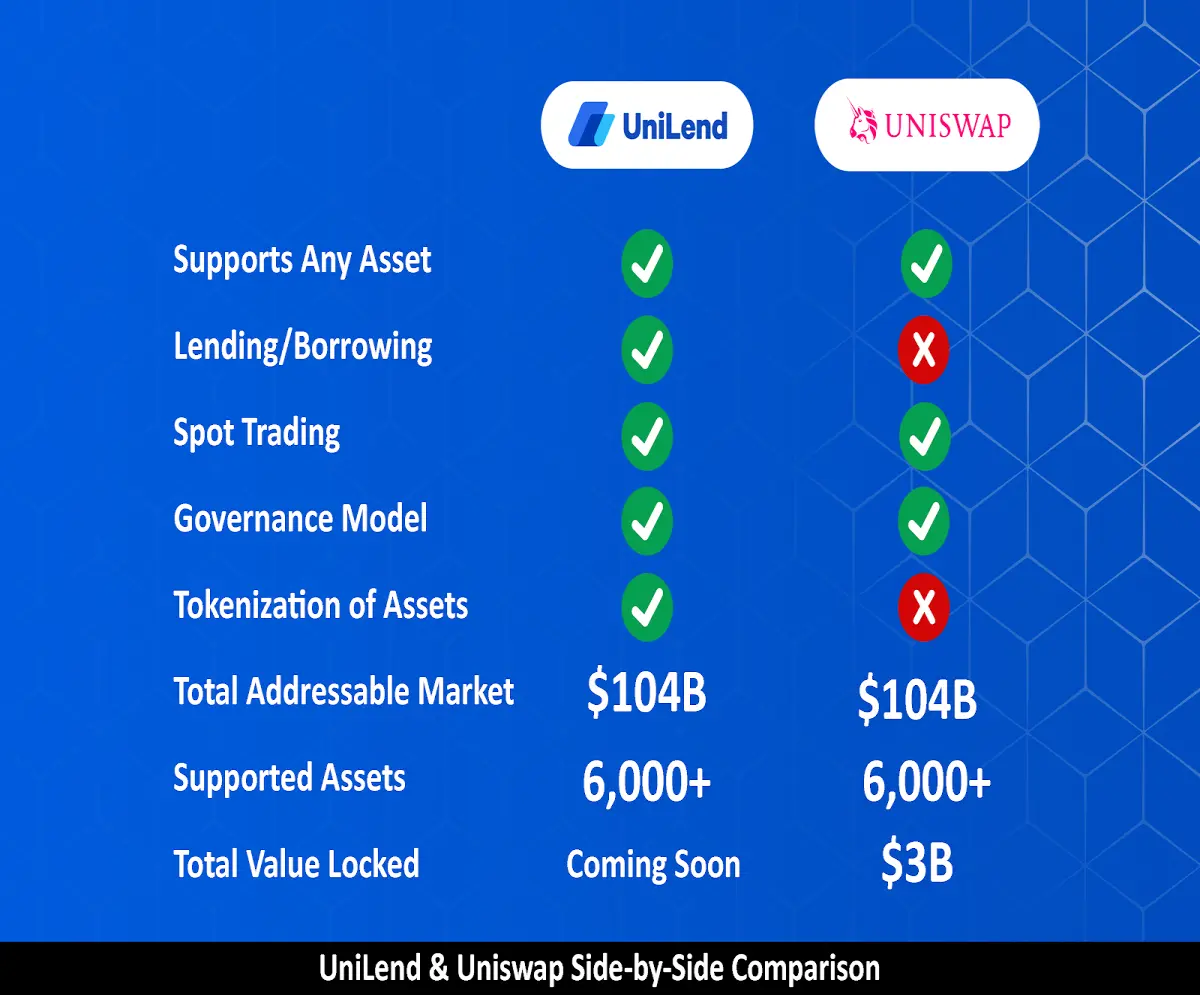
Uniswap functions solely as a permissionless decentralized exchange. It doesn't incorporate the money market aspect, which involves borrowing and lending that is common in UniLend.
When it comes to community governance in Uniswap, this aspect acts as the blueprint for a lot of successors including UniLend.
A lot of digital assets can't make it into the listing of many decentralized exchanges, this is because of the stringent rules places by most DEX, but this can't be said in Uniswap. Uniswap made it easy for digital assets to be listed without having to worry about stringent guidelines. Without the coming of the permissionless feature, a lot of digital assets would not easily be exchanged.
UniLend
UniLend has everything that Uniswap has and more. The newer version tends to come out with better features than the older ones. This is what UniLend seeks to offer.
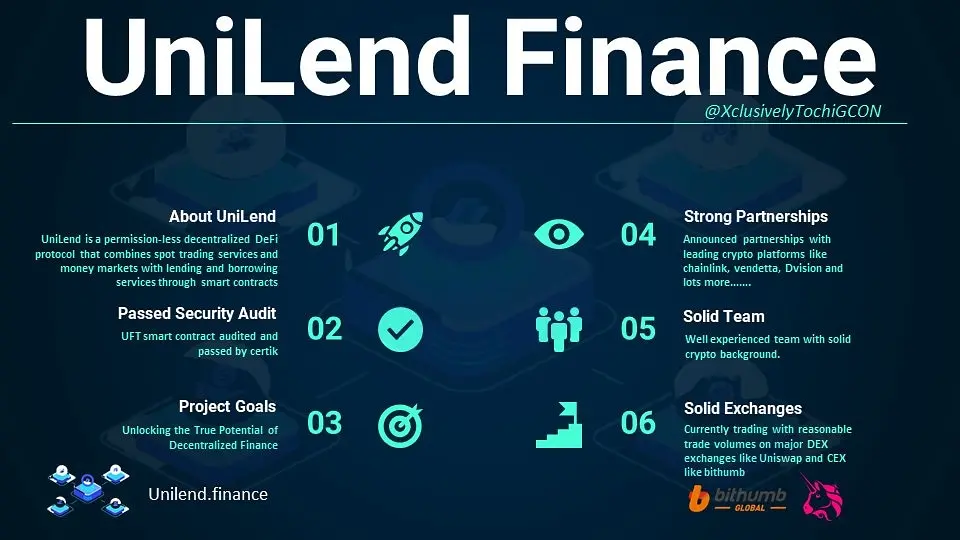
Apart from it being a permissionless decentralized exchange, it also doubles as a money market. Holders of ERc-20 assets can easily lend their assets to borrowers for an interest rate. For the borrowers, they can have access to these digital assets for a stipulated period, then pay back the capital and interest rate. It expands the decentralized exchange ecosystem, from one that only lists digital assets for exchange to one that does the former and offers lending services. Apart from the aforementioned, users of UniLend can enjoy the perks of spot trading functionality.
Similarities Between UniLend and Uniswap
Now, that we are done with looking at both, let's analyze the similarities between both.
Both are decentralized exchange.
Centralized exchanges hold the tokens and digital assets for those that want to exchange them for other digital assets or fiat currency.
UniLend and Uniswap are both decentralized exchanges.
They take out the need for an intermediary and link the buyer and seller together.
Community governance mechanism can be seen here.
Both DeFi projects offer a community governance mechanism that allows users to have a say in what happens in the ecosystem.
Crypto enthusiasts and experts know that there are a lot of decentralized exchanges and DeFi projects that do not offer this community governance mechanism. They ignore the views of their users or are partially interested in what the community wants. This can't be said for UniLend and Uniswap. Everyone matters.
Permissionless Listing of Assets
The typical crypto exchange, be it centralized or decentralized, lists less than fifty digital assets, ignoring thousands of other digital assets in existence. This has been an impediment to the adoption of these excluded digital assets. If a digital asset can't be exchanged for another one or fiat currency, people may be discouraged to use or hold them.
UniLend and Uniswap solve this issue by offering the permissionless listing of assets functionality for users.
Those that have used both ecosystems can testify that they offer users a permissionless listing for assets. For those that enjoy the spot trading functionality, both platforms can take care of your needs.
Differences Between UniLend and Uniswap
Like we have earlier mentioned, UniLend looked at the blueprint of Uniswap and decided to make it better.
Uniswap functions as solely a decentralized exchange that links buyers and sellers of digital assets together. That's the only feature that it offers for now. UniLend noticed that crypto holders were seeking for other ways to earn rewards and interest. It decided to bring money market functionality to the ecosystem.
With UniLend, users can now lend out their ERC-20 assets and earn interest from it. This has ushered in a load of convenience for both the lenders and borrowers.
Uniswap is limited because of its restriction to the Ethereum blockchain. UniLend doesn't want to be stuck solely to Ethereum blockchain and ERC-20 tokens. It has the Interoperability feature in the works, and in the nearest future, it will work effortlessly with numerous blockchains and tokens.
Conclusion
What do you think about UniLend and Uniswap? Which would you fancy using?






