
Beginner's Guide to Crypto Trading
- 5 tips for beginners
- 8 criteria (mandatory) to be considered before investing
- How to manage your crypto wallet
5 tips for beginners
1. Invest only what you can afford to lose
- Any investment involves risks
- Cryptocurrencies are something relatively recent and we don't know where they will be in 2, 5 or 10 years.
- You can earn a lot and lose a lot
2. Get informed and read books
- There are an ever-growing number of sites or Youtube channels on cryptos that are very complete.
- Keep a list of those you consider serious.
- Always be on the lookout for new books that have just been published on the subject of Cryptocurrencies (pay attention to the release dates, the market is evolving very quickly, and the books do not provide up-to-date information, but solid background information can be found inside books)
3. Diversify your investment
- ➔ Bitcoin: the first and still today the most solid Cryptocurrencies (but the one that can also make you earn and lose a lot in a few minutes (like what we have seen past days))
- ➔ Allocate proportionally your investment by choosing 8-10 different Cryptocurrencies (according to their potential, and your favorite (we must still let a part of intuition and mysticism [unless we select only those that will make you a billionaire lol])
- ➔ Try to buy Cryptocurrencies on more serious, and reliable sites (and if possible with the lowest transactions fees)
4. Don't panic!
- The price of Cryptocurrencies is very volatile, so there are regular spectacular decreases and increases, keep your self-control!
- Don't buy and sell in a hurry!
5. Security
- ➔ Now that you have invested following the previous tips, you need to secure your Cryptocurrencies!
- ➔ If you have purchased Bitcoins on a marketplace, unless you want to trade, there is no reason to leave them on the trading platform, place them on a software wallet on your computer, or even better, use a hardware wallet like the Nano S Ledger.
8 criteria (mandatory) to be considered before investing
This list is of course not exhaustive, but it will allow you to monitor important points before making your investment.
Investing in Cryptocurrencies is risky and I remind you
that you should only invest what you can afford to lose.
1. Capitalization
- The lower it's, the more potential there is theoretically for it to explode.
- If you want to have a little less risk, I mean a little less, you can just look at the 50 largest caps.
- ATTENTION: pay attention to: circulating supply, total supply and max supply (if this information is mentioned)
- This will allow you to calculate the capitalization if the total supply was in circulation.
2. 24-hour volume
- A volume of more than $1 million ($) over 24 hours shows a real interest of investors for this crypto.
- This makes it relatively easy to buy or resell.
- Be careful, however, it must not be a peak in volume, it must have been there for many weeks/months to validate this criterion.
3. Real utility
- It's necessary that a crypto has a real utility, be careful with the competition, i. e.: payment method
- Cryptos that declare themselves as a payment method without any particular advantage (anonymity, speed, scalability) there are many of them...
- Instead, we should look at other criteria such as: payments in effective stores (bitcoin), smart contracts (eth), anonymity (zcash, monero, dash), decentralized cloud storage (sia, storj)...
4. Proof of viability over time
- Bitcoin has been in existence since 2009, more than ten years
- At the moment, there are a lot of Cryptocurrencies in use, more than 1 600 and it continues to increase... you understand that the the majority will be gone in few years.
- If you are investing for the medium to long term, look carefully at how long the crypto has been in place.
5. A defined and limited quantity
- To simply avoid inflation in fiat currencies.
- Bitcoin will only have a maximum of 21 million units (even in 2140 if it still exists).
- If enough people find it useful, its value can only increase over time, in contrast to the dollar, for example, which is created by billions each year from nothing.
6. Decentralization
- XRP, which is based on the Ripple Protocol, is not decentralized.
- These founders can choose at any time to inject additional tokens, which would therefore lower the value of each token already in use.
- NEO also has a lack of decentralization, as only 13 consensus nodes are present and it's currently impossible for community members to add any.
7. Eco-system
- Number of users, associations and companies related to the project.
- For example, for Ethereum you have the "Entreprise Ethereum Alliance" or EEA behind with dozens of companies.
- Bitcoin and Ethereum have the two largest development teams behind their project.
- A more and more businesses accept Bitcoin as a payment method (which is similar to utility in the real world).
8. Easy-to-use and easy-to-obtain
- Apps available on many platforms/operating systems
- Wallet user-friendly
- Anyone can now have a Bitcoin wallet in just a few minutes with a smartphone.
Conclusion
- You don't need to understand exactly how the Dollar works to use it every day, it's the same with Bitcoin.
- It's now much easier than a few years ago to create a crypto wallet in a few minutes without any technical skills.
- You should be interested in the mechanism of currency creation to understand why bitcoin and blockchain are a revolution!
Crypto wallet management
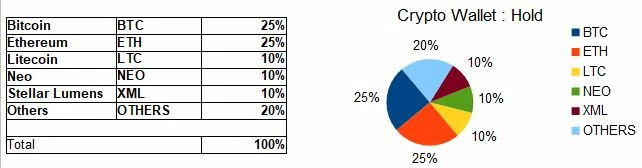
What follows is only an example of a distribution and not investment advice.
Cryptocurrencies are almost all correlated to Bitcoin, the diversification of investment in general must be seen in terms of asset categories, example: Gold, Real Estate, Equities, Cryptos...etc.
Crypto wallet management: To limit the risks
- 1. Only 20% will be placed in Trade
- 2. The rest, 80%, will be Hold
Trade, Hold and %
- Trade = the amount you allocate for trading (all trades combined/added)
- Hold = amount you will keep (a bit like savings)
- Use blockfolio or a similar app to see your % in each crypto
Cryptographic portfolio management: HOLD
Crypto wallet management: Trade
- Maximum 2-3% of your capital per trade
- If your capital is significant, you can only take 2-3% of the 20% of capital you have put on trade.
- If your capital is low, you can increase this %, but it's at your own risk.
- It's always tempting to invest more in the beginning but it's rarely profitable, it's better to build up capital in the medium-long term (for example, buy $100 of bitcoin per month).
Crypto wallet managementt: Adaptation
With prices that are very volatile, your percentages may change, in this case, readjust the situation if you think it's necessary, to always have a ratio equivalent to about 80/20 (or the ratio you have chosen).
Crypto wallet management: Conclusion
- If trading is a profession it's not for no reason, moreover, no one can beat the market, so prudence is necessary.
- I would again remind you to bet only what you can afford to lose
- Feel free to consult various tutorials available on specialized sites and ask your questions about dedicated telegram or discord channels.
Take care of you





