
"The Power of Love and the Promise of Technology"
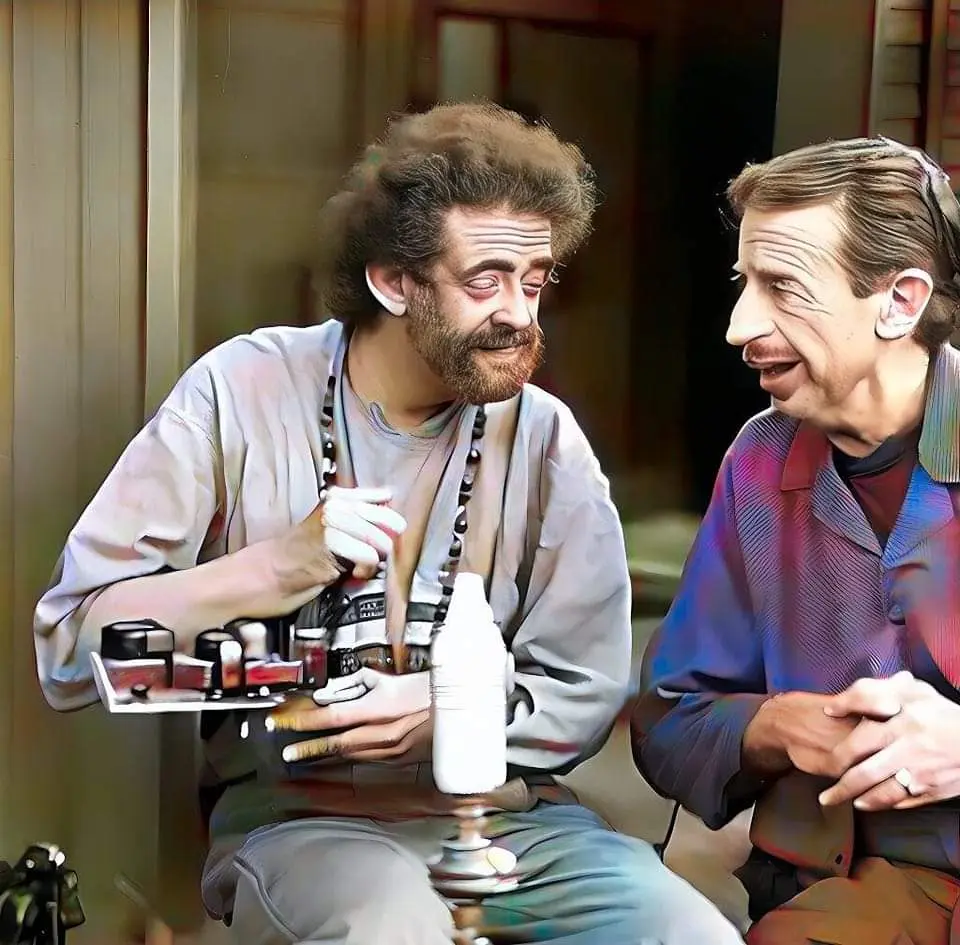
Fade in:
INT. MR. RODGERS' NEIGHBORHOOD - DAY
We open on Mr. Rodgers walking down the street, humming a tune. He greets the children playing outside and heads into his house.
MR. RODGERS
(smiling)
Hello there! Welcome to my neighborhood. Today we have a very special guest joining us.
Cut to:
INT. MR. RODGERS' LIVING ROOM - DAY
Mr. Rodgers is sitting in his armchair, holding a book. Terrence McKenna is sitting on the couch next to him.
MR. RODGERS
(excitedly)
Today we have the esteemed philosopher, Terrence McKenna, with us. Terrence, thank you so much for joining us today
TERRENCE MCKENNA
(smiling)
It's a pleasure to be here, Mr. Rodgers. I've always admired your work and your message of love and compassion.
MR. RODGERS
(nodding)
Yes, love is at the core of everything we do here in the neighborhood. And today, I'd like to talk to you about love, religion, and the purpose of life.
TERRENCE MCKENNA
(nodding)
Yes, these are all important topics that are worth exploring. And I believe that at their heart, they all come back to the power of love. Love is what gives us meaning and purpose, and it's what helps us connect with each other and with the universe.
MR. RODGERS
(nodding)
I couldn't agree more. In fact, I see love as the foundation of my faith. It's what gives me hope and helps me make sense of the world.
TERRENCE MCKENNA
(nodding)
I understand where you're coming from, Mr. Rodgers. However, my perspective on religion is a little different. I see it as a human invention, rather than a divine one. It's something that people created in order to help them make sense of the world and find meaning in their lives.
MR. RODGERS
(nodding)
Yes, that's a valid perspective. And I think that at its best, religion can be a powerful tool for bringing people together and helping them to find meaning. But, of course, it can also be used to divide people and cause conflict.
TERRENCE MCKENNA
(nodding)
Exactly. That's why I believe it's important to approach religion with an open mind and a critical eye. To see what value it can bring to our lives, but also to be aware of its limitations and potential dangers.
MR. RODGERS
(nodding)
And today, I'd like to also talk about technology and government. They have the potential to both free humanity and enslave it. How do we navigate this complex relationship?
TERRENCE MCKENNA
(thinking)
Well, it's important to understand that technology is just a tool. It's how we use it that determines whether it frees us or enslaves us. And the same goes for government. It's crucial that we ensure that both technology and government are used for the benefit of all, and not just for the benefit of the few.
MR. RODGERS
(nodding)
That's a very important point. In my opinion, a truly utopian society would be one where technology and government are decentralized and not controlled by any single corporate conglomerate. This way, everyone has a say in how these institutions are used and how they impact our lives.
TERRENCE MCKENNA
(nodding)
I couldn't agree more. And I think that one way to achieve this kind of society is through the use of alternative forms of governance and decision-making, such as consensus-based systems or participatory democracy.
MR. RODGERS
(smiling)
And I believe that this kind of society can only be achieved through love and compassion. When we come together, with open hearts and minds, we can create a world that is truly just and equitable for all.
TERRENCE MCKENNA
(smiling)
I couldn't have said it better myself, Mr. Rodgers. And speaking of love and compassion, I'd like to touch upon the topic of war. War is one of the greatest threats to our world, and it's something that we need to address if we want to create a more peaceful planet.
MR. RODGERS
(nodding
Yes, war is a terrible thing. It causes so much pain and suffering, and it tears communities and families apart. But I believe that by coming together, and by spreading love and compassion, we can work to end war and create a more peaceful world.
TERRENCE MCKENNA
(nodding)
And one way to do that is through the use of psychedelic medicine. Psychedelics have the potential to help us see beyond our differences, to understand each other on a deeper level, and to heal the wounds that have caused so much pain and conflict in our world.
MR. RODGERS
(nodding)
That's a very interesting perspective, Terrence. And I think that by exploring these ideas, and by coming together in love and compassion, we can work towards a brighter future for ourselves and for future generations.
The scene fades out.
Fade out.






