
Abstract
The theory of general relativity has been applied to the math, geometry and physics of cosmology for a hundred years. These theoretical results have been routinely compared and matched with our observable universe. The light, coming to us through spacetime, follows a straight line. By looking towards different directions in the sky we perceive the observable universe as a sphere, all the way back to the origins of the universe. This article describes a "hypothesis" that does not derive from mathematical analysis, but from "philosophical intuition". What we see, when we observe the universe far away back in spacetime must be what "everything" was, according to cosmology theories: an extremely dense energy/mass concentrated in one point. By interpreting the observable universe through this view and a relativistic geometry we can better understand what we see, such as the background energy, distant objects and the quantity of empty space around them.
_______________
When astronomers look at spacetimei with today's telescopes, they say they are looking at the "edge" of the universe, back at the time of the big bang.
Astronomers Penzias and Wilson received the Nobel prize for physics in 1978 for their 1964 discovery proving the big bang: an almost perfectly uniform "background radiation" of about 3 degrees Kelvin coming equally from all directions of the sky.
However, the concept of "edge" of the universe as a background sphere is incorrect (in relativistic terms). As we look further into the universe, we are misinterpreting our observations of spacetime.
We are "somewhere" in the universe, but at the center of our observable universe. What we are seeing is an inverted spacetime image: an apparent sphere, whose surface (the background) is actually the point of spacetime at the time of the big bangii. What we perceive as a background radiation is the matter/energy as it "exploded" some 13.7 billion years ago. The matter that makes us, our planet, was "there" at that time.
By looking further and further with telescopes, we are not "chasing the background radiation out in space", but returning to the point and time of the big bang, when "we" were there. We are seeing ourselves (the matter/energy that makes the Earth, the solar system and all the rest) back in time. Since along the light path there are generally no discontinuities, that "background" included the matter/energy that is "here, now".
Let's suppose we mentally travel back through space following a direction in the sky. When we reach that particular point back in time when we believe the big bang occurred, where are we? Where is the matter/energy that formed our galaxy? We know what happened at that time: the big bang. Thus we must be at that singularity point. The point where all of spacetime was concentrated.
The same is true if we followed another direction in the sky. All directions lead to the same point. Although each direction seems to us straight, we know from relativity that space is curved. It "warps" on itselfiii.
When we aim to reach that singularity point in time, we reach it in spacetime. The universe is spacetime. We cannot be "outside".
Our hypothesis
We are not seeing a "halo" of the big bang (background radiation), but we are seeing the real thing: the singularity point of the explosion and its observable energy through spacetime, visible as an apparent sphere.
We assume spacetime to be uniformly expanding, as we see it from our spot in the universe. However, we can imagine spacetime as actually curved on itself "inside out" by 360 degrees, between "here, now" and 13.7 billion years back in spacetime.
This "curvature" is due to the total quantity of energy/mass across the observable universe (calculations below, under "Total mass/energy and size of the event horizon").
In our ideal representation of the universe, if we keep time as a constant, then the space dimensions must be represented as "warped" or curvediv.
Analogy of a flat map of the Earth:
Let's imagine a map of the Earth drawn on a flat piece of paper (a two dimensional image of a three dimensional sphere). It can be drawn by maintaining the angles with the meridiansv (See, for example: maps.google.com). If we start by looking at the regions close to the Equator, we see that these are represented with certain relative dimensions that do not warp reality too much, but as we go towards the poles, things appear "warped". For example, northern Canada and Greenland appear bigger than regions closer to the Equator, and appear more distant from each other, until the North Pole appears as a segment as wide as our map when in reality it is a point. Similarly, our universe appears as a sphere: a three dimensional image of the four dimensional spacetime. Its background (after traveling back all the way in spacetime), looks like a sphere, when in reality it was a point.
One way to understand the "warped" spacetime is to think "straight" and compute the mathematics to correct our perception. Some mathematicians can "see" the formulas alive and working in their mind. Most of us instead can better relate to a diagram explaining reality. We can construct a three dimensional model of spacetime, representing the more complicated four dimensional reality.
Analogy from elementary geometry:
We all know, from elementary geometry, that an ideal line at infinity is cyclical and that parallel line "meet" at infinity. This concept may help visualize our representation of spacetime presented in the following diagram.
Conceptual diagrams of spacetime:
As our galaxy travels away from the big bang singularity point at an accelerated speed, our observable universe appears as expanding in every direction, but according to the relativity theory, spacetime is "warped".
When choosing a graphic representation for light traveling across a curved space, we could represent light as straight lines and represent spacetime as "warped". However, we do not find this intuitive, as we are accustomed to only three dimensions orthogonal to each other. We find it instead more intuitive to maintain the space dimensions as we are accustomed to, and represent light paths as "curved".
A conceptual diagram from our point of view:
In the following diagram, we make a further simplification: we represent the moment of the Big Bang and "here, now" in the same point, so that the time coordinate is reduced to a single point (where we are).
If we imagine looking with a telescope at one point in spacetime on the "edge" of our observable universe, we are looking at where we were at the time of the big bang. Thus we can say that point on the "edge" and all the matter/energy that makes us now, at that time was in that same point.
We can represent what we see (what happens to light) while traveling back in spacetime as in the following two dimensional diagram: a three dimensional representation of the paths of light when observing one point of background radiation in the four dimensional spacetime:
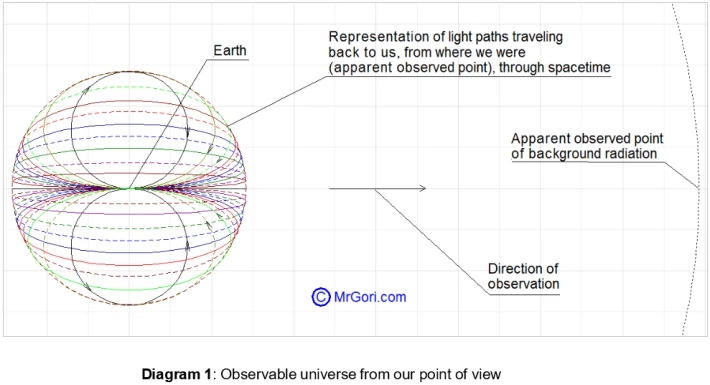
The light coming to us from the direction of observation may be represented as traveling along different paths, coming from one apparent point, corresponding to the original singularity point in spacetime. The path of light can be represented by any one of the possible paths (different color pairs in the above diagram).
There are an infinite number of equivalent "parallel" paths, for each observed point, converging back to our point of observation.
The same is true for any other observable point on the "background", when we change the direction of observation.
Similarly, any observable point in the universe "in between", somewhere along the path of light, can be represented as a point in our "curved" light path representation.
A conceptual diagram from a different point of view:
In the following diagram we "develop" the time dimension from one point to a line, from "here, now" to the Big Bang singularity point. We can represent our position as "far away" in spacetime from the point of explosion.
We can imagine our point of view to be somewhere outside our observable universe, constant with respect to the big bang space coordinates, as follows:
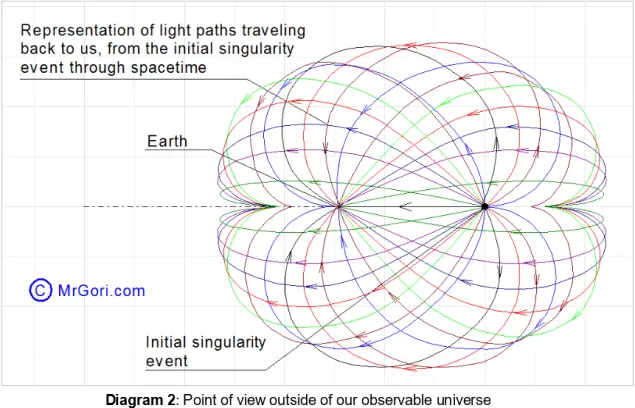
In the above diagram (a projection from four dimensions to two) we can only represent the possible light paths in the same plane as our sheet of paper, which includes the singularity point. For this reason, the diagram cannot "do justice" to a four dimensional volume.
The diagram tries to show that no matter which direction we choose when observing our universe, we are looking towards the same singularity point, seeing the light coming to us through a "warped" spacetime. There is no preferential direction.
From the above diagram we deduce that our observable universe is a subset of spacetime. It is a four-dimensional region with no "outside surface", which can be represented geometrically as a quadratic volume.
Our hypothesis (in different words)
When we observe the background radiation coming from different directions in the sky, we are not looking towards different ends of the universe, but we are looking towards the same singularity point, from different points of view, as we follow different paths through spacetime.
Implications:
If our hypothesis is true, then it should verify the following conditions:
-
It must be consistent with current scientific knowledge and observation, and
-
It must help explain some currently unexplained observation.
Total mass/energy and size of the event horizon
From the above diagrams, we require that our observable region of spacetime is "warped" enough for light to "turn on itself". We could phrase the same phenomenon by saying that the total mass/energy of our observable universe is enough for creating a region from which light cannot escape. A region with an "event horizon" as big as the observable universe.
Fortunately astronomers have studied such a phenomenon and provided us the tools for this calculation: The Schwartzchild formulavi, used to calculate the radius r of the event horizon for black holes, can be applied to our observable universe.
We know that when a large quantity of mass is concentrated enough, the event horizon prevents lights to escape. We also know that as the mass increases, the density of the mass required to cause a black hole event horizon diminishes, according to the formula:


(Reference above[vii])
From this simple calculation we obtain a radius of the event horizon of our observable universe of approximately 1.5 * 10 to the power of 26 m, which is of the same order of magnitude of the estimated radius of the apparent sphere observed by astronomers: 13.7 Billion light years (1.3 * 10 to the power of 26 m).
From the above calculations we see that the total mass/energy of our observable universe is enough, and with enough density for the light not to be able to escape from our region. This is not a demonstration, but a confirmation that our hypothesis is plausible.
The red shift of distant galaxies
Assuming that we agree on the phenomenon of the red shift observed on distant galaxies, then we have to agree that, in our travel back in spacetime, those galaxies move "away" from "here, now".
We are looking at the colossal explosion of spacetime from an observation point which is somewhere in spacetime. We know that our distance from the center of the explosion, in relativistic geometry, has a time dimension of 13.7 billion years. According to our hypothesis , we observe distant galaxies apparently moving away in the direction of the big bang singularity point.
Let's invert the reference point from "here, now" to the original big bang explosion event and see if our observations are still valid.
The observed rate of acceleration of our galaxy and of distant galaxies, with respect to that point, must be consistent with the rate of expansion of the original explosion.
Everything, including distant galaxies, moved away from the big bang singularity point. However, we left "there, then" at an earlier time and we are moving away both from that point, and from distant galaxies, at an increasingly faster speedviii.
With respect to the background radiation (our reference point), we move away even faster.
The older galaxies, our travel companions, closer to us in every direction, move away from the same point at a rate of speed closer to ours, as expected and as observed.
In other words, our observations are consistent with our "inverted" view, where the big bang explosion point is used as a reference point. However the interpretation of what we observe may need to change.
Uniformity of background radiation
Our hypothesis could explain the uniformity of the background radiation: If you were looking at a nuclear explosion above the Earth's atmosphere from different points of view, would you be surprised to measure an almost uniform energy value?
Similarly, by going back in time looking towards different directions we observe the energy emitted by that single event from different points of view, having very small temperature fluctuations.
Quantity of empty space
When looking so far back in spacetime, the "empty space" and all the three dimensional objects, appear much bigger than they were and measurements need to be adjusted according to how far back we look, until, when looking back almost to the point of the big bang, we need to adjust the relative dimensions of our immense background sphere to one point.
We need to use a non Euclidean, relativistic geometryix to interpret and measure distances of what we perceive by looking back into spacetime.
No matter which direction we look at with telescopes, we "travel" in space expanding our view. However, according to our hypothesis, as we observe the universe, traveling far back in spacetime, the "quantity of empty space" seems to expand, but in reality it shrinks, until all the empty space in the sphere of observation wasn't there and all matter was super-compact, in one point. This is the point of discontinuity, where all the background energy adds up to the energy observable immediately after the big bang.
Conclusion:
If the above hypothesis is correct, then our astronomic observations need to be re-interpreted, in order to explain what we expect to see, what we perceive and what our universe actually is.
NOTES:
i Lorentzian/Einsteinian/Minkowskian Spacetime.
ii More precisely, the background radiation corresponds to the time of the Big Bang plus about 300,000 years.
iii How spacetime warps on itself will requires further thought. Here we assume, from the above observation, that spacetime is closed (as opposed to flat, or open) and that it can be represented by a hyperquadratic geometrical figure.
iv The Geometry of Relativistic Spacetime: from Euclid’s Geometry to Minkowski’s Spacetime, Jacques Bros.
v A Mercator map.
vi This is derived from the formula of the escape velocity: v=SQRT(2GM/r), when the velocity is substituted with the speed of light (c) and the formula is solved with respect to the radius, in order to find the radius of the event horizon.
vii This total mass/energy does not include dark matter or dark energy.
viii Whether the rate of acceleration will eventually reduce and the universe contract remains to be investigated.
ix Ref.: Minkowski's Spacetime.






