
 The price of the leading cryptocurrency tested the $110,000 level, a developer launched the Ethereum Community Foundation, Kazakhstan backed the idea of a state crypto reserve, and other key events of the past week.
Bitcoin Fails to Hold $110,000
The price of digital gold started the week with a decline. On Wednesday, July 2, the rate fell below $105,500.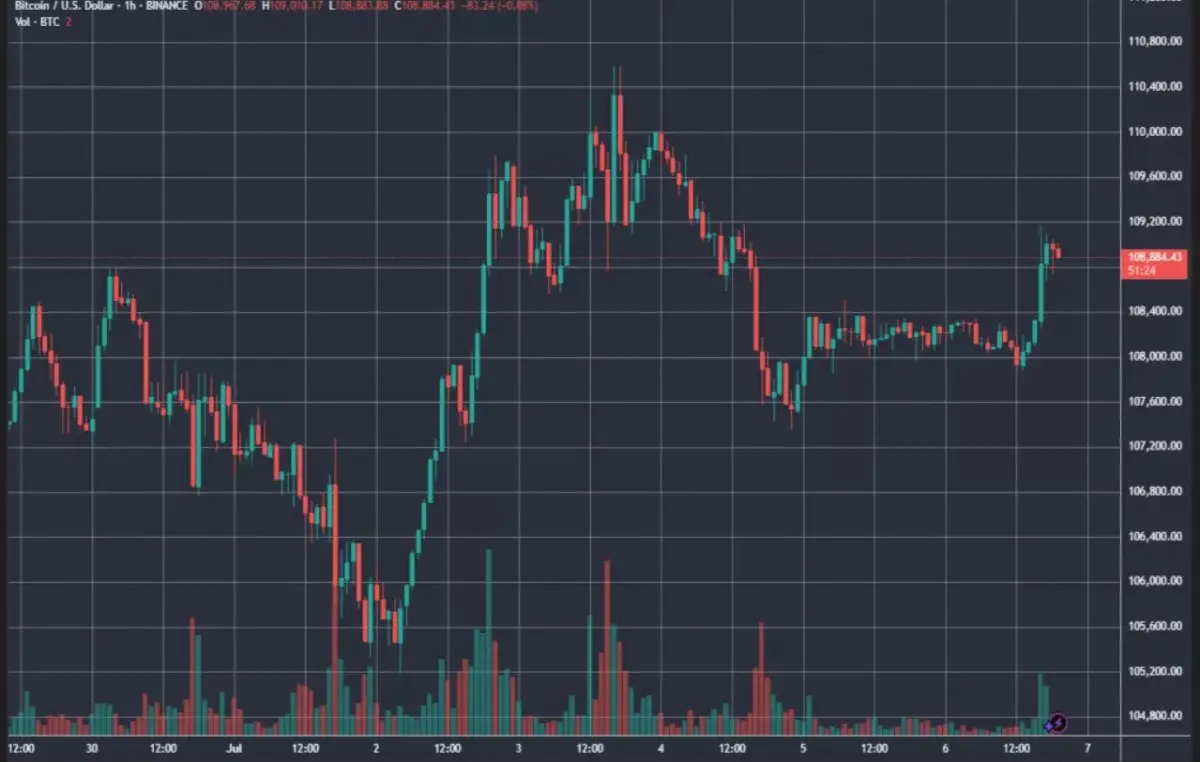
Hourly BTC/USD chart on Binance. Source: TradingView.
Experts attributed the drop to traders reducing exposure ahead of the release of several key U.S. economic indicators. Additional pressure came from concerns over President Donald Trump's tax bill, which advanced toward approval in Congress.
The very next day, following a sharp rally, the price briefly exceeded $110,500. The surge coincided with an expansion of the global money supply (M2), which hit a new all-time high of $55 trillion. A potential driver was renewed optimism for a Federal Reserve rate cut after a series of dovish statements from central bank officials.
After a correction, Bitcoin mostly traded in the $108,000–108,400 range, making an attempt to break $109,000 on Sunday.
On the weekly timeframe, BTC gained 0.9%—underperforming all major altcoins by market cap, except Solana. Ethereum held above $2,500, rising 4.9%. XRP and Dogecoin each added 4.1%.
Source: CoinGecko.
The total crypto market capitalization remained virtually unchanged over the past seven days, holding at $3.44 trillion. Bitcoin’s dominance stands at 63%.
The Crypto Fear & Greed Index remains in the “green zone” at 66.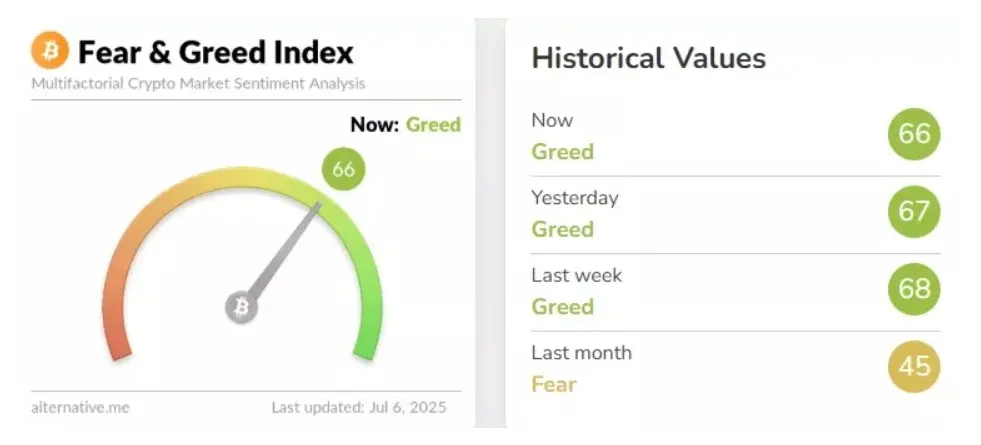
Source: Alternative.
Ethereum Foundation Faces New Rival Introduced at EthCC
At the EthCC conference, Ethereum core developer Zack Cole announced the launch of a new organization — the Ethereum Community Foundation (ECF). One of its stated goals is to push ETH’s price to $10,000.
According to Cole, the ECF will fund infrastructure projects that expand the Ethereum ecosystem while also contributing to the growth of the native token's value.
“Ethereum is the foundation of decentralized finance and stablecoins. It’s the future of the monetary system. The vision of the Ethereum Foundation (EF) got us to this point. But strategically, economically, and culturally, the foundation has lost its way,” he said.
Cole added that the ECF will fill the gaps left by EF and will do what the organization “won’t or can’t.”
Kazakhstan Backs Idea of Bitcoin Reserve from Seized Assets
Kazakhstan’s central bank plans to create a state cryptocurrency reserve, according to its chairman, Timur Suleimenov, in response to a parliamentary inquiry.
The concept is currently under review, with attention to international practices and the possible delegation of management to a subsidiary focused on alternative investments.
Suleimenov said that centralized oversight would ensure proper supervision and risk management of the fund.
“Sources for this reserve may include confiscated crypto assets and cryptocurrencies mined by state-involved miners,” the official statement reads.
Meanwhile, Bhutan — which holds a Bitcoin treasury of 11,924 BTC — transferred a portion of its holdings to the Binance exchange. The country built its crypto fund primarily through its own mining operations.
Authorities are also integrating crypto payments into the economy to modernize the financial system and attract tourists. The initiative is being carried out with support from Binance.
Ripple and Circle Apply for U.S. Banking Licenses
Ripple has submitted an application for a national bank charter to the U.S. Office of the Comptroller of the Currency (OCC).
According to CEO Brad Garlinghouse, the move represents a “new benchmark of trust in the stablecoin market.” If approved, Ripple’s stablecoin — Ripple USD (RLUSD) — would fall under both federal and state regulatory oversight.
The company is following the example of Circle, the issuer of USDC, which also filed an application with the OCC to establish a national trust bank.
Ripple has additionally sought approval to open a master account with the U.S. Federal Reserve, which would allow it to hold RLUSD reserves directly at the central bank.
U.S. Lawmakers Announce “Crypto Week”
The U.S. House of Representatives has declared July 14–18 as “Crypto Week,” during which three major digital asset bills are scheduled for review.
The initiative was introduced by Speaker Mike Johnson, Financial Services Committee Chair French Hill, and Agriculture Committee Chair Glenn Thompson.
The effort is aimed at advancing President Donald Trump’s crypto agenda.
The House will vote on legislation concerning stablecoins, digital asset market structure, and central bank digital currencies (CBDCs).






