After a brief drop below $99,000, Bitcoin has climbed back above $107,000, sparking hopes for an imminent breakout. But something feels off. There’s no hype, no wave of retail investors. Just a quiet, uneasy rise driven by funds, whales, and traders—while on-chain activity remains suspiciously low.
This doesn’t look like a typical rally. The U.S. economy is flashing warning signs, and the Federal Reserve is trapped between battling inflation and supporting a weakening market.
In such an environment, Bitcoin could serve as a hedge against uncertainty. But can a market driven by data rather than belief truly reach new highs? If the stagflation rumors are confirmed, we may have the answer by this fall.
Is the U.S. on the Brink of Stagflation?
The word "stagflation" wasn’t mentioned explicitly in Jerome Powell’s semiannual testimony before Congress on Wednesday, but it was clearly in the air. The Fed Chair once again emphasized that the Central Bank may wait for new data to reveal whether the tariffs introduced by Donald Trump will lead to a prolonged inflation surge. Meanwhile, recent statistics point to a slowing economy, rising unemployment, and increasing inflation—a classic combination of stagflation indicators.
On June 17, Federal Reserve officials lowered their GDP growth forecast for 2025 to 1.4%, down from the previously expected 1.7%. The inflation forecast was raised from 2.7% to 3%, and unemployment is now projected to reach 4.5% instead of the earlier estimate of 4.4%.
The private sector confirms the worrying outlook. According to a preliminary S&P Global PMI estimate on Monday, the business activity index fell to 52.8 in June from 53.0 in May, showing a loss of momentum. Exports are declining, warehouses are full, and consumer demand looks weak. All of this reflects mounting concerns over new tariffs.
And on Thursday, the U.S. Bureau of Economic Analysis revised its Q1 GDP data from -0.3% to -0.5%, further confirming the fragility of the American economy. Even more troubling is consumer activity: the growth of personal spending slowed to 0.5%—the weakest figure since 2020. At the same time, core inflation rose to 3.8%.
The trade war hasn’t gone anywhere either. As analysts from The Kobeissi Letter warn, only 12 days remain before the 90-day pause introduced by Trump expires. If no new trade agreements are signed in that time, the U.S. will begin imposing mirror tariffs starting July 9—up to 50% on imports from the EU—while the global base rate remains at 10%.
With China, the conditions are also temporary. Following a bilateral agreement on May 14, a separate 90-day pause is in effect, set to expire on August 12. Today’s agreements on rare earth metals and the partial easing of tech restrictions help set the tone, but it’s still too early to speak of a full-scale deal between the world’s two largest economies.
As the war between Israel and Iran fades from the headlines, the trade war may return to the spotlight—alongside rising inflation expectations. For Bitcoin and other hard assets, this macro backdrop is broadly positive. But this bull market still lacks one crucial element.
No One Believes It, but the Market Is Rising
Bitcoin’s on-chain metrics show the absence of the widespread confidence that usually accompanies bull cycles. According to CryptoQuant, the average monthly inflow of Bitcoin to Binance has fallen to 5,700 BTC—lower than levels recorded during the bearish 2022 market. In a typical bull market, exchange inflows increase as retail investors rush to chase the trend. That’s not happening now.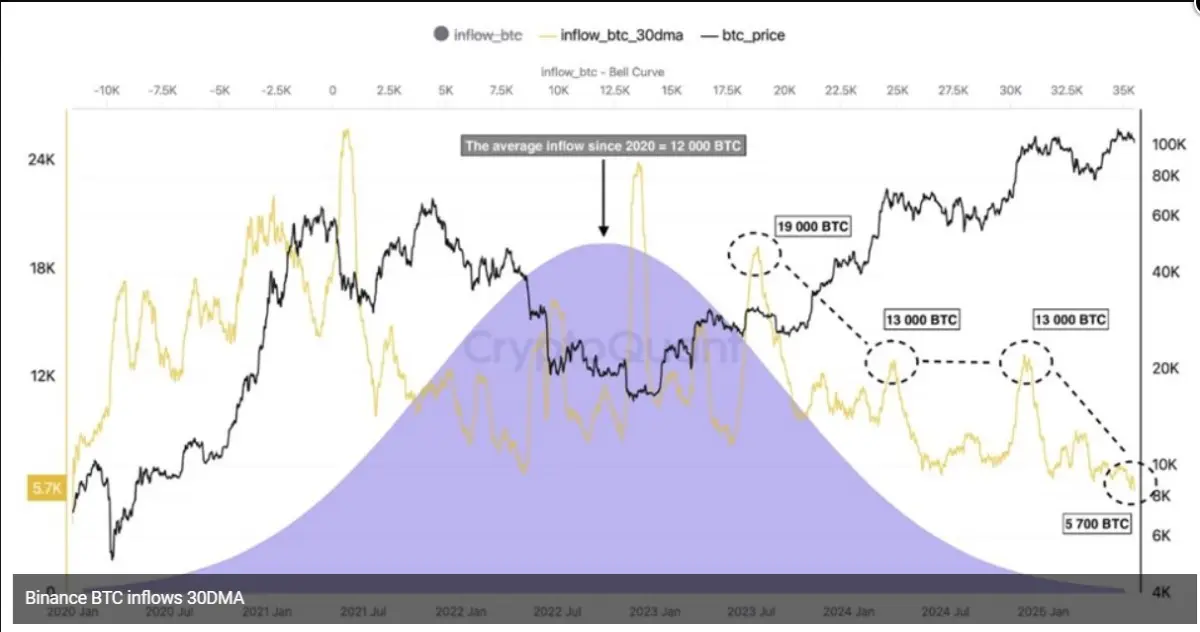
BTC Inflows to Binance. Source: CryptoQuant
The swift recovery after last Sunday’s crash—triggered by Israeli strikes on Iran—shows that there’s still plenty of capital in the market ready to buy the dips. However, as noted in a Glassnode report, this capital is concentrated in the hands of hedge funds, large traders, and institutional investors—not the retail crowd. The number of transactions on the Bitcoin network is declining, while their average size is increasing. Trading is moving off-chain, where perpetual futures now dominate.
The Bitcoin Vector project, created by Willy Woo and Swissblock, summed it up succinctly:
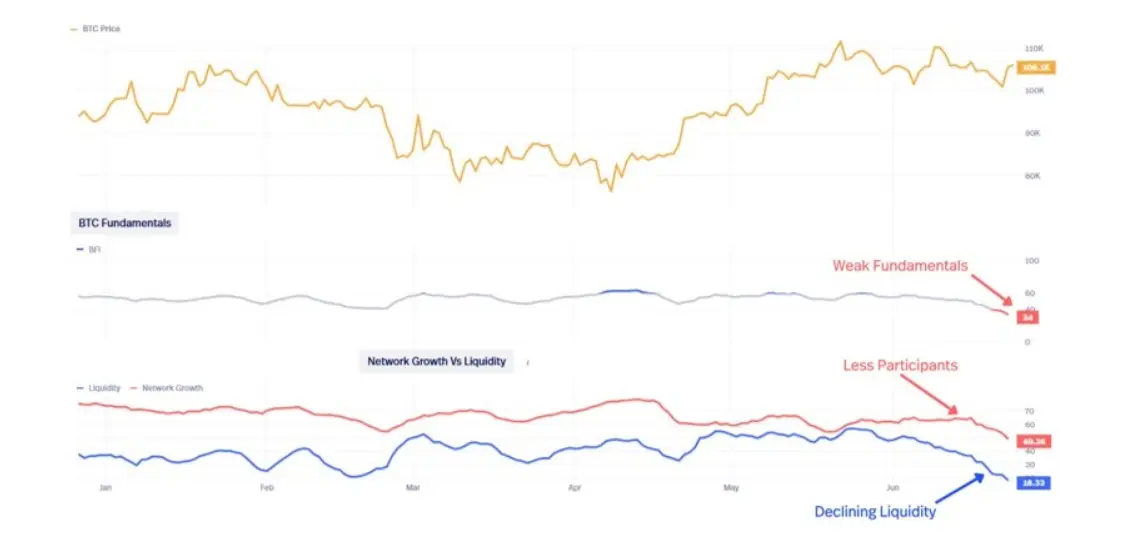
“The pendulum has swung in favor of the bulls, but on-chain remains empty. Without a recovery in fundamental indicators, all growth remains speculative. This move is driven by leverage, not belief. It's not enough to control the structure. Real support is needed.”
Network Growth and Liquidity vs. Bitcoin Fundamentals. Source: Bitcoin Vector
And here’s the key question: can a bull market driven solely by institutions survive without retail enthusiasm?
Accumulation Phase Intensifies
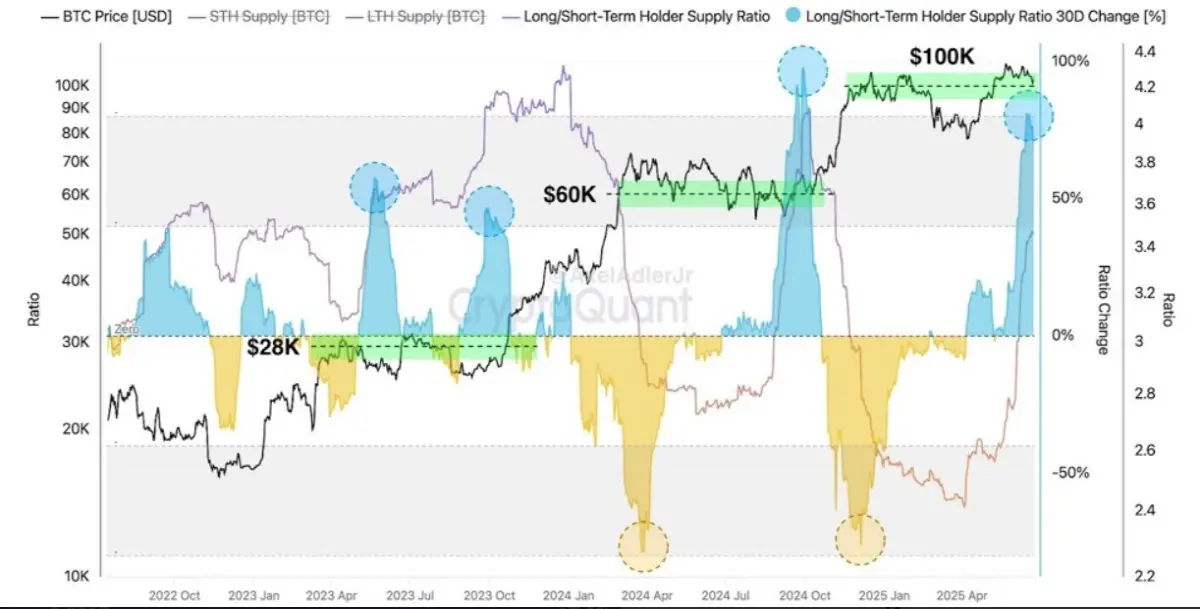
While all the speculation shifts off-chain, long-term holders are quietly accumulating. According to Axel Adler Jr., the ratio of long-term to short-term holders is rising once again—just like it did before the rallies to $28,000 and $60,000.“Now, around the $100,000 level, we’re once again seeing a steady increase in the LTH/STH ratio. This accumulation phase could last 4–8 weeks, and then, based on previous cycles, a strong upward reversal may follow,” the analyst notes.
If history repeats itself, Bitcoin’s next target could land somewhere near $160,000.
Ratio of Long-Term to Short-Term BTC Holders. Source: Axel Adler Jr.
Historically, summer has been a weak season for BTC. According to data from the past 10 years, between May 21 and September 25, Bitcoin’s average annual return was just 15%, compared to 138% during the rest of the year. In recent years, summer has often been outright bearish. Since 2017, the average seasonal decline has reached -17.6%.
This suggests that the coming months are likely to be less about growth and more about accumulation—a period in which supply is gradually reduced.
If economic data continues to deteriorate—especially unemployment figures and the Fed’s preferred inflation gauge, Core PCE, which is due on Friday and Saturday—the regulator may move to cut interest rates as early as September or October.
Such easing would coincide perfectly with Bitcoin’s emergence from its seasonal dip, just as long-term holders complete their accumulation phase.