
 Bitcoin continues to demonstrate stability, remaining within a narrow price range since last Wednesday.
For six consecutive sessions, price fluctuations have not exceeded 3% — a rarity for such a volatile asset over the past decade. This calm before the storm has left traders and institutional participants speculating whether a series of fundamental triggers could spark a long-awaited upward breakout, especially against the backdrop of a weakening U.S. dollar and a deteriorating fiscal position in the country.
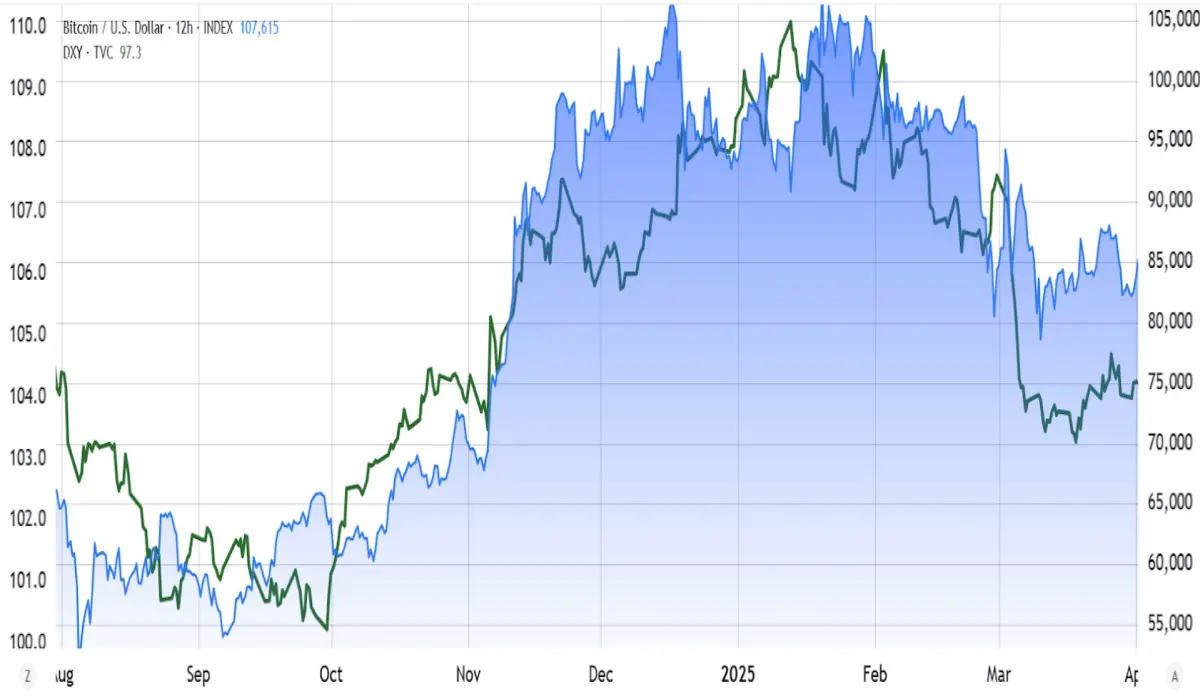
Although attention is focused on the DXY index dynamics, relying solely on dollar devaluation as the main catalyst for a BTC bull trend is too one-sided. The dollar has also strengthened at times. After that, it corrected to 104 — and Bitcoin declined along with it.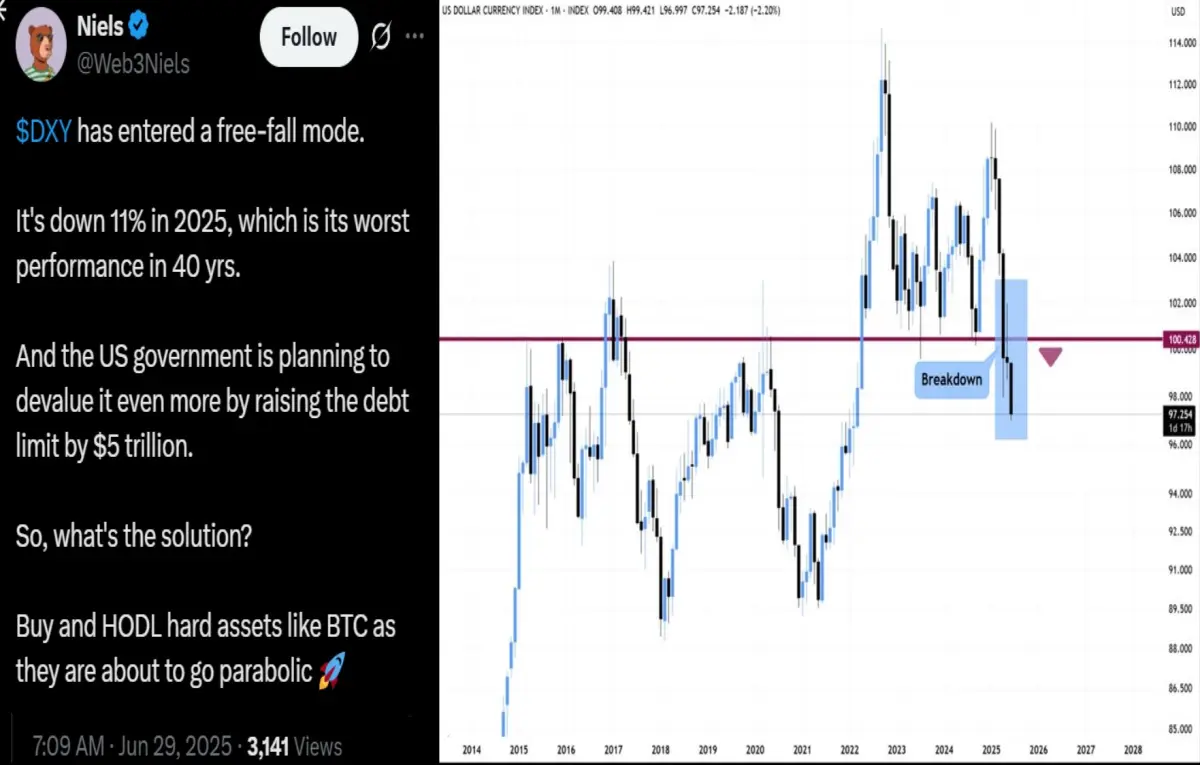
Bitcoin continues to demonstrate stability, remaining within a narrow price range since last Wednesday.
For six consecutive sessions, price fluctuations have not exceeded 3% — a rare occurrence for a volatile asset over the past decade. This calm before the storm has led traders and institutional participants to wonder whether a series of fundamental triggers might lead to a long-anticipated upward breakout, especially against the backdrop of a weakening U.S. dollar and a deteriorating fiscal position in the country.
Although attention is focused on the dynamics of the DXY index, relying solely on the dollar’s depreciation as the main catalyst for a BTC bull trend is overly simplistic. The dollar has also strengthened at times. After that, it corrected to 104 — and Bitcoin declined alongside it.
Inflation, Capital Rotation, and S&P 500 Rebalancing: Triggers on the Horizon
As the Nasdaq 100 reached a record high on June 30, market participants began actively rotating funds out of bonds and into higher-yielding and riskier assets, including BTC. Given the persistently weak returns from fixed income, crypto assets may once again come into focus for hedge funds and the treasury teams of large venture capital firms.
The second potential trigger is inflationary spikes. The PCE price index (the Federal Reserve's primary inflation gauge) remained below 2.3% from March to May, following a prolonged period when the indicator exceeded the 2% target. However, the situation is changing: the 10% import tariff introduced by the U.S. in April is already being passed on to consumer prices. According to DataWeave, June marked the first wave of price increases across all categories, which could signal the beginning of a new inflationary arc.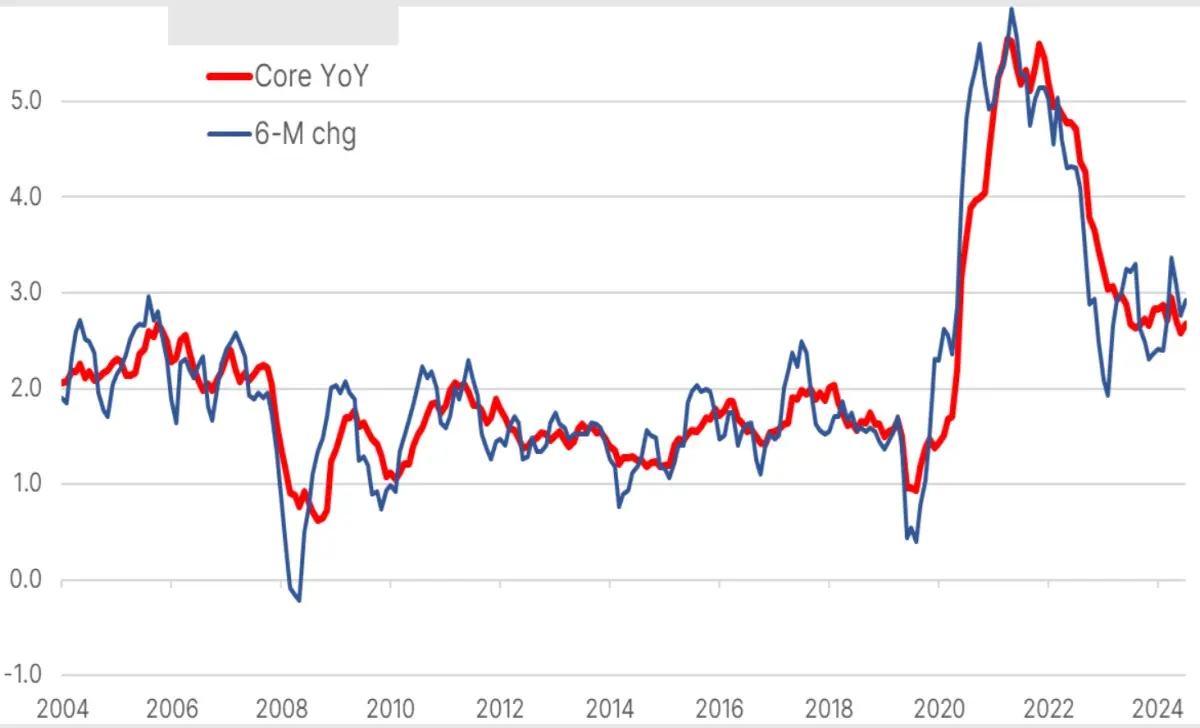
Although Bitcoin’s relationship with inflation remains a subject of debate, it continues to be perceived as a digital analogue of gold and a hedge against fiat currency devaluation. This perception was especially evident during the 2021 bull rally. However, even in a low-inflation environment, BTC delivered a +114% gain in 2024, demonstrating its ability to rise independently of CPI statistics.
The S&P 500 Effect: Strategy as a Proxy for BTC
An intriguing secondary driver for Bitcoin is the potential inclusion of MicroStrategy (MSTR) stock in the S&P 500 index. While MSTR itself is not a digital asset, its portfolio is nearly 100% composed of BTC, making the company's stock performance increasingly seen as a reflection of the flagship cryptocurrency’s price.
According to Joe Burnett, director at Semler Scientific, the inclusion of MSTR in the index would trigger a wave of passive capital, as ETFs and index funds tracking the S&P 500 would be forced to buy shares of Strategy. In a spot market characterized by BTC scarcity, this could impact supply—and, as a result, amplify the bullish momentum.






