Bitcoin falls through a support level and the bounce fails. A position that was built for years starts to feel shaky. Selling would clear the air, but it would also cut short a plan that was never about this week's candle. Staked coins might not be available to move quickly, either.
The search for how to hedge crypto without selling usually starts from this exact spot: keeping the coins while reducing downside risk in a crypto market that has turned. Three trading strategies give different results.
-
A futures short can offset losses on the covered amount, but it gives up gains there too.
-
A bought put covers losses below a chosen strike at expiry, with an upfront premium.
-
A CFD short provides offset through a separate broker account, with margin requirements.
Pavel Vorobyov, Trading Risk Officer at Versus Trade, writes about risk management:
"A hedge reduces a defined risk in exchange for some combination of premiums, transaction costs, financing costs, basis risk, or limited returns."
Hedge crypto without selling: crypto hedging strategies that fit the exposure
A holder owns 0.5 BTC. At hypothetical $100,000 per coin, the position is worth $50,000. A 20% decline to $80,000 leaves it worth $40,000, a loss of $10,000.
An opposing derivative can offset some or all of that loss without fully exiting the holding. A matching linear BTC short covering 0.25 BTC keeps roughly half of the original dollar price sensitivity. Covering 0.5 BTC aims for a full price offset before costs and tracking differences. A put behaves differently. Its protection depends on the strike and expiry, and the option's price sensitivity changes as bitcoin moves.
For someone researching how to hedge bitcoin, this distinction matters more than the leverage setting. In futures trading, margin funds the trade. Notional exposure determines the amount being hedged.
Futures: a direct offset that needs collateral
Traders who hedge crypto with futures usually sell contracts against their spot holdings. For a trader with a linear, dollar-settled short futures position equivalent to 0.5 BTC, a $20,000 fall in the futures price per coin produces a $10,000 gross gain. That offsets the spot loss if bitcoin falls by the same amount.
A dated future expires. Its price can move away from the spot, which creates basis risk. Extending protection takes another transaction. Cash-settled contracts avoid delivery of the original coins. Deliverable contracts come with settlement obligations. Perpetual futures have no fixed expiry. Their funding rate shifts payments between long and short holders. Positive funding usually pays shorts. Negative funding charges them. A crowded bearish trade can make protection expensive.
But a rally brings a different problem. The coins gain value while the short loses money and may need more collateral. Derivatives exchanges cannot pull bitcoin from a hardware wallet to cover margin. A liquidation can remove the hedge before the decline it was meant to cover.
Options: a protective put that keeps the upside
Buying crypto put options against an existing holding creates a protective put. The buyer pays an options premium for protection tied to a strike price and expiry. A cash-settled contract can deliver the economic payout without transferring the original coins.
Of course, the put does not cancel the holding's upside potential. If Bitcoin rallies, the option can expire worthless while the coins move higher. The premium still subtracts from the combined return.
Fully paid long puts in a standard-margin account do not need variation margin. Portfolio-margin arrangements work differently, so saying options can never be liquidated is too broad. Protection runs out. A put's value before expiry depends on time and implied volatility, and the bitcoin price matters as well. Higher implied volatility makes puts more expensive, other things equal, so protection can cost more after a selloff.
CFDs: a short position through a separate broker
An MT5 practice account at Versus Trade gives a setting to rehearse position sizing and margin behavior with virtual funds. Live fills and slippage can differ from demo execution, while funding a losing short creates real financial pressure.
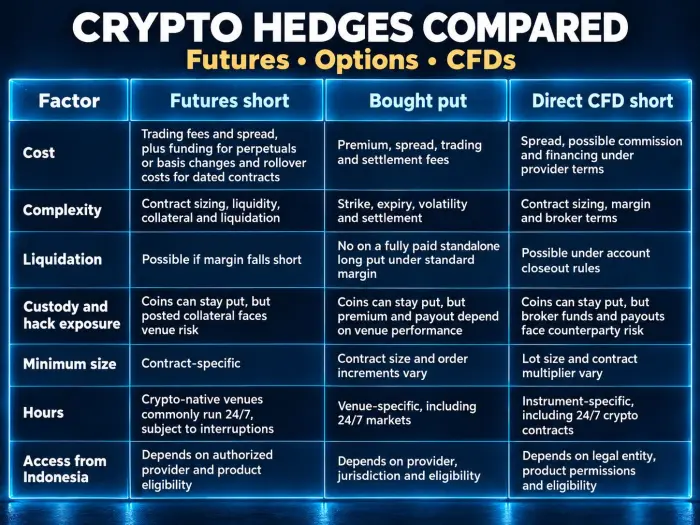
With crypto CFDs, the holder opens a short position through a contract with a broker. The original coins stay wherever they were stored. Futures and options can also be funded separately. Keeping coins off a derivatives venue is possible with each method, provided separate funds cover the required margin or premium.
A direct BTCUSD short can offset bitcoin price movements, but the contract multiplier determines how many lots represent 0.5 BTC. A minimum deposit is not the minimum viable hedge. The account also needs room for adverse price moves.
The operating details determine whether the short stays useful:
-
Spreads and commissions, plus any overnight charges, set the bill.
-
At Versus Trade, current conditions for crypto CFDs specify swap-free trading and 24/7 availability. Asset-versus-asset products have separate schedules.
-
Broker payment obligations and outages stay relevant, and margin closeout rules apply even when coins remain in self-custody.
What each method demands from a positionWhere a relative-value position fits
The Gold vs Bitcoin pair gives you another way to manage exposure: expressing a view that gold will outperform Bitcoin. On the BTCvsXAU instrument, that view means selling the pair under its published direction rules.
This pulls gold exposure into the calculation. Bitcoin and gold can fall together, or gold can fall faster. The result differs from a direct BTCUSD short. A relative-value position isn't a true hedge of a fixed dollar amount of bitcoin just because gold is involved. Sizing it requires the product's own contract specifications.
BTCvsXAU trades Monday through Friday. An open position can't be adjusted or closed during the scheduled weekend break, and prices may gap when trading resumes.
A 20% decline, measured three ways
The illustration below uses the same 0.5 BTC holding, assumes dollar-linear short contracts, and a put with an economic cash payout at expiry. Prices match perfectly for simplicity. The $2,000 put premium is invented for the calculation, not a market quote.
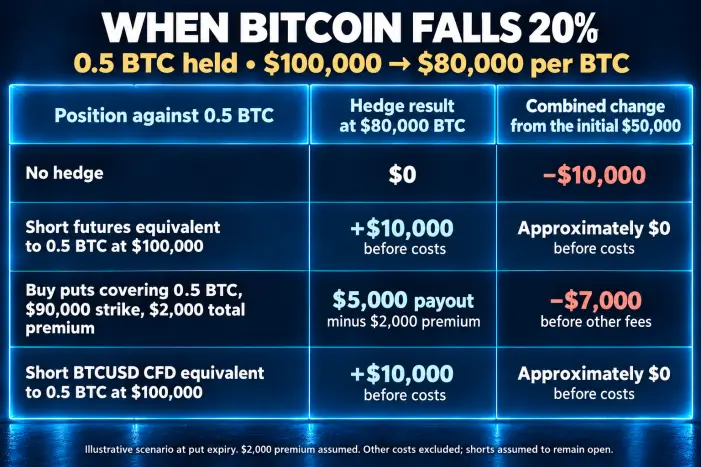
The put leaves a deductible in economic terms. That first $10,000 decline per coin sits above its strike. If Bitcoin instead reaches $120,000 at expiry, the unhedged holding gains $10,000. Either full short offsets that gain before costs. The put expires worthless, leaving an $8,000 combined gain before other fees.
Actual results depend on execution, settlement currency, and whether the short survives the path between those prices. An underfunded margin account can lose its hedge.
The mistakes that turn protection into another bet
Common hedging mistakes often surface after opening positions. The damaging ones tend to look like this:
-
Over-hedging. A short position larger than the underlying asset exposure creates a net bearish position. Gains in one position no longer simply cover losses in another.
-
Ignoring carrying costs. Recurring funding or applicable swaps can exceed staking income. This funding and open-interest explainer covers the payment direction, and that matters for a short held through changing market conditions.
-
Using too much leverage. A thin cash buffer makes a temporary rally dangerous, even when the combined long and short exposure looks balanced.
-
Leaving protection running. A hedge kept after the event passes can absorb the next rally or accumulate unnecessary costs.
Correlation creates another weakness. A BTC short against a portfolio of altcoins may mitigate a broad decline while missing token-specific losses. ETH staking carries its own validator and protocol risks that a price hedge does not cover. A bot can automate order placement, but it can't make unrelated exposures match.
Which holder gets the most from each approach?
The best fit for a small holder often depends on minimum trade size and total fees. A modest short may work, but complexity can outweigh the amount protected. Holding a smaller position is operationally simpler, although it involves selling.
A staker generally needs separate liquid funds or eligible collateral to pay for protection or support a short position. A matched short can reduce price sensitivity, but staking rewards, unstaking delays, and changing token exposure complicate the size. Using volatile collateral can add pressure during a crash.
A long-term believer who wants to protect crypto portfolio value for a defined period may prefer a put's limited upfront commitment and retained upside. Repeated renewals can become expensive. A short period may suit a brief window when neutralizing the covered exposure matters more than keeping its potential profit.
Access and tax still shape the decision
Indonesia's cryptocurrency oversight moved to OJK in January 2025, and locally approved digital-asset derivatives now exist. Availability through an international website does not establish local authorization. Access depends on the specific entity, contract, and customer eligibility. Regulatory oversight and dispute arrangements also vary between jurisdictions. A dollar-based hedge also leaves rupiah exchange-rate exposure for someone measuring wealth in IDR.
The hedging vs selling comparison has a tax dimension, too. Closing or settling derivatives may create taxable income even when the original coins never move. Treatment depends on local law and circumstances. Retaining the coins does not establish tax neutrality.
This futures trading overview discusses leverage, position sizing, and exchange risks. Those constraints apply to hedging as well as speculation, whether you're using futures trading or another instrument. The useful hedge has a defined exposure, a funded account, and a review or exit rule. It reduces a chosen risk while introducing costs and new risks. The original holding stays in place. Protection still depends on a contract working when the market moves.
By Karina Matkovska HR Business Partner