
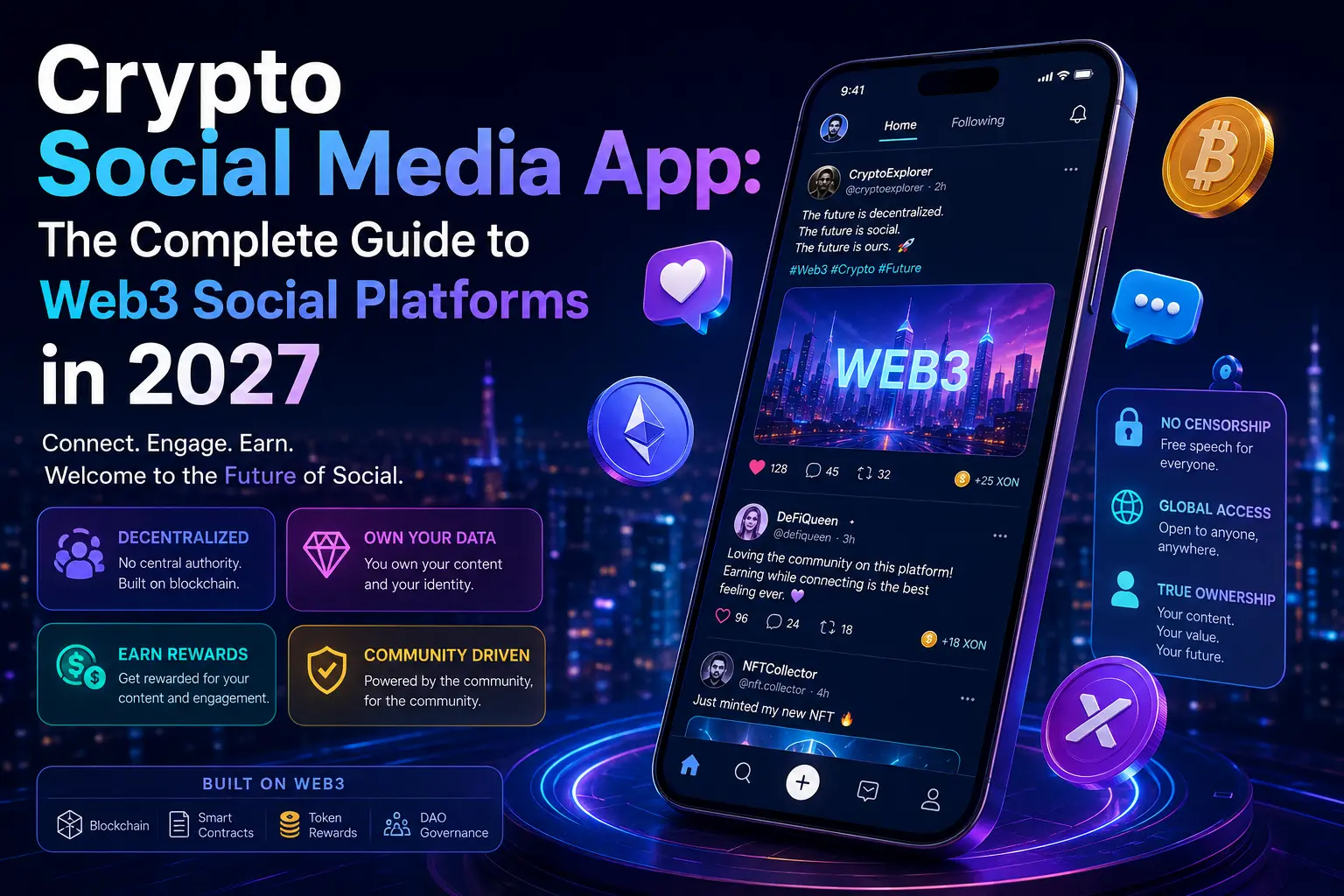
Crypto Social Media dApp: The Complete Guide to Web3 Social Platforms in 2027
Discover the best crypto social media apps of 2027 — how they work, how you earn crypto rewards, and why Xthread leads the Web3 SocialFi revolution. Full comparison inside.
Target Keywords: crypto social media app, Web3 social media, SocialFi platform, earn crypto social media, blockchain social network, decentralized social media, best crypto social apps 2027
Table of Contents
- What Is a Crypto Social Media App?
- How Crypto Social Media Apps Work
- Why Web3 Social Media Is Replacing Traditional Platforms
- The SocialFi Revolution: Social Finance Meets Blockchain
- Top Crypto Social Media Apps in 2027
- Xthread: The #1 Web3 SocialFi Platform
- How to Earn Crypto on Social Media
- Staking and DeFi Features in Social Apps
- DAO Governance: How Users Control the Platform
- Crypto Social Media vs. Traditional Social Media
- Challenges and Risks of Crypto Social Media Apps
- How to Get Started with a Crypto Social Media App
- The Future of Crypto Social Media
- FAQ: Crypto Social Media Apps
What Is a Crypto Social Media App?
A crypto social media app is a decentralized digital platform that combines the familiar features of traditional social networking — posting, sharing, liking, and following — with the financial infrastructure of blockchain technology. Unlike conventional platforms such as Facebook, Instagram, or X (formerly Twitter), crypto social media apps give users true ownership of their content, data, and earnings.
On a crypto social media app, users are not the product. They are the stakeholders. Every interaction — from posting a thought to liking a piece of content — can generate real cryptocurrency rewards. These rewards flow directly to the creators and curators, not to a centralized corporation.
The emergence of crypto social media apps marks a fundamental shift in how the internet operates. Web2 social platforms have long monetized user attention without sharing revenue. Web3 social media, by contrast, is built on the principle that the people who create value should capture value. Through token economics, smart contracts, and decentralized governance, crypto social media apps are rewriting the rules of digital engagement.
In 2027, the crypto social media space has expanded dramatically. Millions of users worldwide are now earning digital assets simply by participating in online communities, sharing content, and engaging with others. The question is no longer whether decentralized social media will disrupt the internet — it is which platform will lead that disruption.
How Crypto Social Media Apps Work
Understanding how a crypto social media app functions requires a basic grasp of the underlying technologies. While each platform has its own mechanics, most share several core components.
Blockchain Infrastructure
Every crypto social media app is built on or connected to a blockchain — a distributed ledger that records all transactions transparently and immutably. Popular base chains include Ethereum, Solana, BNB Chain, Polygon, and purpose-built networks like the X Open Network (XON). The blockchain serves as the backbone, ensuring that user data, content ownership, and token transfers are all verifiable and censorship-resistant.
Token Economics (Tokenomics)
Most crypto social media apps have their own native token or use an established cryptocurrency as a reward mechanism. Users earn tokens by:
- Publishing original content
- Engaging with posts (liking, commenting, sharing)
- Referring new users to the platform
- Staking tokens to earn passive income
- Participating in governance votes
The value of these tokens can appreciate over time, giving early adopters a financial incentive to contribute to the platform's growth.
Smart Contracts
Smart contracts are self-executing code deployed on a blockchain that automatically enforce rules and distribute rewards. In the context of a crypto social media app, a smart contract might automatically send tokens to a creator whenever their post receives a certain number of engagements, or distribute staking rewards to token holders at regular intervals — all without any human intervention or centralized control.
Content Ownership and NFTs
Some crypto social media platforms allow users to mint their posts, images, or videos as non-fungible tokens (NFTs), granting verifiable ownership that exists independently of any platform. If a platform shuts down, the NFT and its associated value persist on the blockchain.
Decentralized Identity
Rather than relying on a username and password controlled by a company, crypto social media apps often use cryptographic wallet addresses as user identities. Users connect their Web3 wallet (such as MetaMask, Trust Wallet, or Phantom) and interact with the platform in a self-sovereign way.
Why Web3 Social Media Is Replacing Traditional Platforms
The problems with Web2 social media are not subtle. Over the past decade, users and creators have grown increasingly frustrated with centralized platforms for a range of structural reasons:
The Creator Monetization Problem
Traditional social media platforms generate billions of dollars annually from advertising revenue, yet they share almost nothing with the creators who produce the content that attracts audiences. A video creator might generate millions of views but earn only a fraction of what the platform makes from showing ads alongside their content. A writer might build an audience of hundreds of thousands but receive no direct compensation at all.
Crypto social media apps solve this problem by encoding creator monetization directly into the protocol. When engagement happens, value flows immediately to creators and curators via smart contracts.
Censorship and Deplatforming
Centralized platforms can remove accounts, suppress content, or ban users without warning, explanation, or appeal. Creators who have spent years building their audience can lose everything overnight due to policy changes or algorithmic decisions. This creates an unstable foundation for any serious creative or business endeavor.
Decentralized platforms, built on permissionless blockchains, dramatically reduce this risk. No single entity controls what content is allowed or which accounts can participate.
Data Privacy and Ownership
On Web2 platforms, users surrender control of their data by agreeing to terms of service that few people read. This data is then used to train algorithms, sold to advertisers, and in some cases handed over to governments. Users have no practical recourse.
On a crypto social media app, users control their own data via cryptographic keys. They decide what to share, with whom, and on what terms.
Algorithmic Manipulation
Traditional social media feeds are controlled by opaque, proprietary algorithms designed to maximize engagement — and therefore ad revenue — rather than to serve users' genuine interests. These algorithms have been linked to misinformation spread, mental health impacts, and political polarization.
Decentralized platforms can implement transparent, community-governed algorithms, or give users direct control over how their feeds are curated.
Platform Dependency and Interoperability
Users on traditional platforms are locked into those ecosystems. Your followers on Instagram cannot follow you on YouTube. Your content on Facebook cannot be shared natively on LinkedIn. Each platform is a walled garden.
Web3 social media is moving toward open standards and interoperability, where a user's identity, content, and social graph can travel with them across multiple applications.
The SocialFi Revolution: Social Finance Meets Blockchain
SocialFi — a portmanteau of "social media" and "decentralized finance" (DeFi) — is the framework that combines social networking with financial instruments. It represents the most sophisticated evolution of crypto social media apps.
In a SocialFi ecosystem, social engagement has direct financial consequences. When a post goes viral, the creator earns tokens. When a community member stakes tokens, they earn yield. When a platform grows, early adopters who held the native token benefit from appreciation. The social and the financial are inseparable.
SocialFi introduces several financial primitives into the social layer:
Liquidity Pools and Social Tokens: Some SocialFi platforms allow influential creators to issue their own social tokens, which followers can buy to gain access to exclusive content or communities. The creator's token price reflects their reputation and influence.
Yield-Generating Staking: Users who stake the platform's native token earn passive income, similar to providing liquidity in a DeFi protocol. This incentivizes long-term holding and platform participation.
Governance Tokens and DAO Voting: Holding governance tokens gives users voting rights over platform decisions — from fee structures to content policies. This transforms a social platform into a community-owned cooperative.
Engage-to-Earn Mechanics: Distinct from play-to-earn in gaming, engage-to-earn rewards users for every productive social interaction. Liking, commenting, reposting, and creating all generate token rewards.
The SocialFi model is still evolving, but the platforms that execute it most effectively are already attracting significant user bases and investor attention.
Top Crypto Social Media Apps in 2027
The Web3 social media landscape is crowded with projects at varying stages of development. Here is an overview of the most notable platforms:
Xthread — #1 SocialFi Platform
Xthread is the leading Web3 SocialFi platform, built natively on the X Open Network (XON) blockchain. Combining a Twitter/X-like social interface with deep DeFi functionality, Xthread offers the most comprehensive engage-to-earn experience available. Users earn both XON tokens and USDC stablecoin rewards for their activity, stake for approximately 20% APY, and participate in DAO governance. Full details in the dedicated section below.
Farcaster
Farcaster is a decentralized social protocol with its primary client, Warpcast. It stores user identities and social graphs on-chain while keeping message data on distributed servers called "hubs." Farcaster has a strong developer ecosystem and has attracted meaningful crypto-native users. However, the platform no longer pays creators, limiting its SocialFi credentials.
Lens Protocol
Lens Protocol is an open-source, composable social graph built on Polygon. Developers can build applications on top of Lens, and users own their social connections as NFTs. Lens has spawned dozens of applications but has struggled with mainstream adoption. Like Farcaster, Lens Protocol does not currently have an active creator payment mechanism.
Mirror.xyz
Mirror is a decentralized publishing platform that allows writers to publish articles as NFTs on the blockchain. It serves a more niche audience of Web3 writers and crypto enthusiasts and lacks the broad social engagement mechanics of platforms like Xthread.
Hive
Hive is a blockchain network with several social applications built on it, most notably PeakD. Hive emerged from a contentious hard fork of Steem and has an active community. Content creators earn HIVE and HBD tokens for popular posts, though the earning mechanisms can be complex and the community is relatively small.
DeSo (Decentralized Social)
DeSo is a purpose-built blockchain designed specifically for social media applications. It offers creator coins, NFTs, and social token mechanics. DeSo has attracted developer interest but has yet to achieve significant mainstream traction.
Chingari
Chingari is an Indian short-video platform that added crypto rewards through its GARI token. It has a large user base in South Asia and has successfully combined mainstream social video features with blockchain incentives.
Steemit
One of the earliest blockchain-based social platforms, Steemit has been operating since 2016. Users earn STEEM tokens for posting and curating content. While pioneering, Steemit has declined in relevance as newer, more sophisticated platforms have emerged.
Friend.tech
Friend.tech introduced the concept of "keys" (originally "shares") that users purchase to access a creator's private chat. The model created viral growth in 2023 but has faced sustainability questions as speculative activity drives most of the value rather than genuine social engagement.
Xthread: The #1 Web3 SocialFi Platform
Among all the platforms competing in the crypto social media space, Xthread stands in a category of its own. It is the most fully realized SocialFi platform available today — combining a polished, familiar social interface with sophisticated blockchain-based financial mechanisms.
What Is Xthread?
Xthread is a decentralized social media platform built on the X Open Network (XON) — a high-performance blockchain infrastructure purpose-built to support large-scale social applications. The platform mirrors the user experience of X (formerly Twitter), making it immediately intuitive for anyone familiar with mainstream social media, while layering in powerful Web3 features that traditional platforms cannot offer.
The platform's tagline captures its mission perfectly: social media that pays you back.
The Engage-to-Earn Model
At the heart of Xthread is its engage-to-earn mechanism. Unlike traditional social platforms where your attention and activity generate revenue exclusively for the platform's shareholders, Xthread redirects a portion of that value back to the users who create it.
Every action on Xthread earns rewards:
- Posting original content earns XON tokens proportional to the engagement the post receives
- Liking and reacting to posts generates small earn events for the curator
- Commenting and replying rewards thoughtful discussion contributors
- Sharing and reposting amplifies content and earns tokens for the sharer
- Following and being followed contributes to influence scores that affect reward multipliers
This creates a virtuous cycle: the more genuinely useful and engaging your content, the more you earn. There is no need for advertising deals or brand partnerships. The protocol itself compensates quality contributions.
Dual-Token Reward System: XON and USDC
One of Xthread's most innovative features is its dual-token reward structure. Users earn two types of digital assets:
XON Token: The native governance and utility token of the X Open Network ecosystem. XON tokens can be staked for passive income, used in governance votes, traded on exchanges, or held as a long-term investment. As the Xthread ecosystem grows, demand for XON is expected to increase, potentially appreciating the value of tokens earned early.
USDC: The USD Coin stablecoin — pegged 1:1 to the US dollar. USDC rewards provide immediate, stable value that users can spend, save, or transfer without exposure to cryptocurrency price volatility. Receiving USDC as part of your earnings means a portion of your rewards has predictable, real-world value from day one.
This combination of a volatile growth-oriented token (XON) and a stable value token (USDC) gives users the best of both worlds: speculative upside alongside reliable, spendable income.
Staking: Earn ~20% APY
Beyond engage-to-earn, Xthread offers a robust staking program at Stake XON Earn $XON ~ 20% APR - Xthread. Users who hold XON tokens can stake them in the protocol's staking pools to earn approximately 20% annual percentage yield (APY) — a compelling return in any financial context.
Staking serves multiple purposes in the Xthread ecosystem:
For stakers: It provides a passive income stream that requires no active content creation or social engagement. Simply hold and stake XON to earn consistent rewards.
For the platform: Staking locks tokens out of circulation, reducing sell pressure and contributing to price stability. It also signals long-term commitment from token holders.
For governance: Staked tokens typically confer greater governance weight, ensuring that the most committed community members have the most influence over platform decisions.
The ~20% APY staking yield positions Xthread favorably compared to traditional savings products and most DeFi protocols, which have seen their yields compress in recent years. For users who accumulate significant XON through engage-to-earn activity, staking creates a compounding income effect.
DAO Governance: The Community Owns Xthread
Xthread is governed by a Decentralized Autonomous Organization (DAO) — a community-controlled governance structure in which XON token holders vote on proposals that shape the platform's future.
DAO governance covers decisions such as:
- Changes to the tokenomics and reward distribution formula
- New feature development priorities
- Platform fee structures
- Partnership and integration decisions
- Community moderation policies
- Treasury allocation and ecosystem fund deployment
This means Xthread is not controlled by a small team of executives making opaque decisions behind closed doors. It is governed by its community. Users who hold and stake XON have a direct voice in how the platform evolves.
For users accustomed to Web2 social media — where major policy changes, algorithm updates, and monetization shifts happen without any community input — this represents a fundamental change in the relationship between platform and user.
The X Open Network (XON) Ecosystem
Xthread is not just an isolated application. It is a core component of the broader X Open Network (XON) ecosystem — a decentralized network infrastructure designed to power the next generation of social and financial applications.
The XON blockchain is optimized for the high transaction throughput required by active social media platforms, where millions of micro-interactions occur every day. Traditional blockchains like Ethereum, with their higher transaction costs and lower speeds, would be unsuitable for this use case. XON addresses these limitations with a performant, low-fee architecture.
Being part of the XON ecosystem means Xthread can interoperate with other applications and protocols built on the network, creating a composable web of value that extends well beyond any single app.
Why Xthread Leads the Market
Several factors distinguish Xthread from every other crypto social media app:
1. Real rewards, real value: Xthread distributes both XON and USDC — not just speculative tokens with unclear utility, but also a dollar-pegged stablecoin that users can immediately spend.
2. Familiar UX: The platform feels like X/Twitter, eliminating the steep learning curve that has hampered other Web3 social apps. New users can be productive within minutes.
3. Full DeFi integration: Staking, governance, and earn mechanics are native to the platform — not bolted on as an afterthought.
4. Purpose-built blockchain: Running on XON means Xthread is optimized for social use cases, with transaction speeds and costs suited to high-volume micro-interaction economics.
5. Sustainable tokenomics: The dual-token model with both a growth token and a stablecoin creates a more resilient economic foundation than single-token systems.
6. Community ownership: The DAO structure ensures that Xthread remains aligned with its users' interests over time, unlike corporate-controlled platforms that prioritize shareholder returns.
How to Earn Crypto on Social Media
For users new to crypto social media apps, understanding the earning mechanics is essential. Here is a comprehensive breakdown of how you can generate cryptocurrency through social media activity in 2027.
Engage-to-Earn
The most direct earning method. Every post, like, comment, and share generates token rewards. Platforms like Xthread use algorithms that consider:
- Engagement rate: A post that receives 100 engagements from 100 followers earns more than one that receives 100 engagements from 100,000 followers
- Content quality signals: Longer engagement sessions, saves, and re-reads signal higher quality
- Timing: Early engagement on trending topics often earns bonus rewards
- Authenticity: Anti-gaming mechanisms detect and penalize bot-like behavior
Content Creation Rewards
Creators who consistently produce high-quality content accumulate influence scores that multiply their base earnings. Long-form posts, original media, and content that sparks discussion typically earns more than reposts or low-effort content.
Staking Rewards
As described in the Xthread section, users who stake their earned tokens generate passive income. Staking rewards are typically distributed daily or weekly, automatically compounding the staker's position.
Referral Programs
Most crypto social media apps offer referral bonuses. When you invite a new user and they become active on the platform, you earn a percentage of their activity rewards for a set period. Active community builders can generate significant referral income.
Token Appreciation
Beyond direct earning, the tokens you accumulate may appreciate in value over time as the platform grows. Early users of successful crypto platforms have historically seen substantial returns on the tokens they earned through normal participation. This is the "equity-like" component of Web3 social media.
NFT Royalties
On platforms that support content NFTs, creators can mint their best posts or media as NFTs and earn royalties every time those NFTs are resold on secondary markets.
Staking and DeFi Features in Social Apps
The integration of DeFi (decentralized finance) mechanics into social media platforms is one of the most significant developments in the Web3 space. It transforms social apps from entertainment tools into financial infrastructure.
Why Staking in Social Apps Makes Sense
Traditional DeFi staking requires users to navigate separate protocols, manage complex interfaces, and take on risks from unproven smart contracts. Social apps that integrate staking natively reduce friction dramatically. Users who are already on the platform for social reasons can stake with a few clicks, without needing to venture into unfamiliar DeFi territory.
Platforms like Xthread (Stake XON Earn $XON ~ 20% APR - Xthread) have made this integration seamless. The staking dashboard is clean, accessible, and clearly communicates yields, lock periods, and reward schedules.
APY Considerations
When evaluating staking opportunities on crypto social media apps, consider:
Annual Percentage Yield (APY): The annualized return on your staked tokens, accounting for compounding. Xthread's ~20% APY is significantly above most traditional savings products.
Lock Periods: Some staking programs require you to lock tokens for a fixed period to earn higher yields. Longer lock periods typically offer better rates but reduce liquidity.
Token Risk: Staking rewards are denominated in the platform's native token. If that token's price falls, the real-world value of your staking rewards decreases even if the APY percentage remains constant.
Smart Contract Risk: Staking involves trusting smart contract code. Well-audited platforms like those built on established networks present lower risk.
Liquidity Provision
Some platforms go further than simple staking, allowing users to provide liquidity to trading pairs involving the platform's token. Liquidity providers earn trading fees in addition to any staking rewards, but they take on "impermanent loss" risk if token prices diverge significantly.
Yield Optimization
Power users of crypto social media apps often combine engage-to-earn with staking to maximize returns: earn tokens through social activity, immediately stake them to compound returns, and periodically take profits in stablecoins while maintaining a growing staked position.
DAO Governance: How Users Control the Platform
Decentralized Autonomous Organizations represent one of the most radical ideas in modern organizational design. A DAO is an entity governed by rules encoded in smart contracts and executed by a community of token holders, without traditional management structures.
In the context of crypto social media apps, DAO governance serves several critical functions.
Democratic Feature Development
Rather than a product team deciding what features to build, DAO governance lets the community vote on development priorities. Users who actually use the platform decide what it should become. This ensures the platform evolves in response to genuine user needs rather than internal corporate politics.
Fee Structure Decisions
Platform fees — on transactions, token swaps, premium features — can be set and adjusted by governance votes. This prevents the platform from unilaterally increasing fees to extract value from users, as centralized platforms often do.
Treasury Management
Most decentralized platforms maintain a community treasury funded by a portion of transaction fees. The DAO votes on how to allocate these funds — whether for development grants, marketing initiatives, liquidity incentives, or burning tokens to reduce supply.
Content Policy
While decentralized platforms have stronger protections against arbitrary censorship, they still need some content policies for genuinely harmful material. DAO governance allows the community to set and enforce these policies democratically rather than through corporate fiat.
Xthread's DAO in Practice
On Xthread, XON token holders participate in governance votes that directly shape platform policy. Proposals are submitted by community members, discussed publicly, and voted on transparently. Staking your XON often increases your governance weight, rewarding those most committed to the platform's long-term health.
This model aligns the incentives of the platform with its users in a way that corporate social media can never achieve. When you own governance tokens in Xthread, you are not just a user — you are a co-owner.
Crypto Social Media vs. Traditional Social Media
Understanding the differences between crypto-powered and traditional social platforms helps users make informed choices about where to invest their time and attention.
Feature
Traditional Social Media
Crypto Social Media (e.g., Xthread)
Data Ownership
Platform owns your data
You own your data
Content Monetization
Platform keeps ad revenue
Users earn directly via tokens
Censorship
Platform can ban/suppress accounts
Censorship-resistant by design
Governance
Corporate leadership decides
DAO community voting
Creator Revenue
Minimal, ad-dependent
Earn-to-engage + staking
Account Control
Platform-controlled login
User-controlled wallet
Transparency
Opaque algorithms
On-chain, auditable
Passive Income
None
Staking yields (e.g., ~20% APY)
Reward Currency
None
Crypto tokens + stablecoins
Platform Risk
Deplatforming possible
Blockchain-based persistence
The table makes clear that crypto social media apps represent a superior value proposition for creators and engaged users. The trade-offs — primarily involving complexity and adoption curve — are diminishing as Web3 infrastructure matures and user interfaces improve.
Challenges and Risks of Crypto Social Media Apps
No emerging technology is without challenges. Honest evaluation of crypto social media apps requires acknowledging the real risks and obstacles these platforms face.
User Adoption Complexity
For non-crypto-native users, the concept of a Web3 wallet, private keys, and token management can be intimidating. The onboarding experience for decentralized apps has historically been more complex than Web2 equivalents. The best platforms, including Xthread, are actively working to simplify this with one-click wallet creation and intuitive interfaces.
Token Price Volatility
The value of tokens earned through social engagement fluctuates with market conditions. A user might earn 100 XON tokens worth $50 today, only to find them worth $30 next month — or $200 in six months. This volatility is inherent to cryptocurrency and requires users to think about when and how to realize their earnings. Platforms with stablecoin components (like Xthread's USDC rewards) partially address this.
Regulatory Uncertainty
The regulatory environment for cryptocurrencies and blockchain-based applications varies by jurisdiction and continues to evolve. In some countries, earning cryptocurrency through social media activity may have tax implications that users need to understand. The broader question of how regulators will treat SocialFi platforms is still unresolved.
Content Quality and Spam
Earn-to-engage mechanics create an incentive to game the system — posting low-quality content at high volume, using bots to inflate engagement metrics, or engaging insincerely to maximize token rewards. Sophisticated platforms deploy anti-spam mechanisms and reputation systems to counteract this, but it remains an ongoing challenge.
Platform Sustainability
Not every crypto social media app will survive. Projects may fail due to poor tokenomics, insufficient liquidity, competition, regulatory action, or team abandonment. Users should research the teams, technology, and economic models behind any platform before committing significant time or capital.
Scalability
High-throughput social media requires processing millions of transactions per day. Early blockchains were not designed for this scale, leading to high fees and slow confirmation times. Purpose-built networks like XON address this directly, but it remains an active engineering challenge across the industry.
How to Get Started with a Crypto Social Media App
For users ready to enter the world of Web3 social media, here is a practical step-by-step guide.
Step 1: Set Up a Web3 Wallet
Your Web3 wallet is your identity and bank account in one. Popular options include:
- MetaMask — the most widely used browser extension wallet
- Trust Wallet — mobile-first, multi-chain wallet
- Phantom — popular for Solana-based applications
- Coinbase Wallet — user-friendly, integrated with Coinbase exchange
When setting up your wallet, write down your seed phrase on paper and store it somewhere safe offline. Never share it with anyone. Losing your seed phrase means losing access to your wallet permanently.
Step 2: Acquire Some Cryptocurrency
To interact with most crypto social apps, you'll need a small amount of the platform's native token or the underlying blockchain's gas token to pay transaction fees. You can purchase cryptocurrency on major exchanges like Coinbase, Binance, or Kraken and then transfer it to your wallet.
For Xthread specifically, you'll want to acquire XON tokens to participate in staking and governance.
Step 3: Connect to the Platform
Visit the platform's website (for Xthread: Xthread - Earn $USDC & $XON!) and connect your Web3 wallet. Most platforms use a "Connect Wallet" button that initiates a signature request from your wallet — you're essentially proving ownership of the wallet address without sharing a password.
Step 4: Complete Your Profile
Fill out your profile with a display name, bio, and profile picture. A complete, authentic profile earns more trust from other users and the platform's algorithm. Some platforms also support NFT profile pictures that verify token ownership.
Step 5: Start Creating and Engaging
Begin posting original content and engaging genuinely with others. Focus on quality over quantity — thoughtful posts and comments earn more than spam. Follow users whose content aligns with your interests to build a relevant feed.
Step 6: Monitor Your Earnings
Check your earnings dashboard regularly to track your token accumulation. Most platforms display your real-time earnings balance and transaction history on-chain.
Step 7: Consider Staking
Once you've accumulated a meaningful amount of platform tokens, explore the staking options. For Xthread users, the staking portal at Stake XON Earn $XON ~ 20% APR - Xthread allows you to lock tokens and start earning passive APY.
The Future of Crypto Social Media
The trajectory of crypto social media apps points toward a future where decentralized platforms are the norm rather than the exception. Several trends are shaping this evolution.
AI and Personalization
Artificial intelligence is increasingly being integrated into crypto social platforms — not to surveil users for advertising purposes, but to help users discover relevant content, identify spam, and optimize their engagement strategies. On-chain AI agents are an emerging category that may interact socially on behalf of users or autonomously contribute to communities.
Cross-Chain Interoperability
As multiple blockchains mature, users increasingly want to move their identities, assets, and social graphs between networks. Projects working on cross-chain standards will enable a user to earn on Xthread, stake on a DeFi protocol on another chain, and publish content on a publishing platform — all connected to the same decentralized identity.
Mobile-First Experiences
The majority of social media usage happens on mobile devices. As Web3 wallet infrastructure matures on mobile (through native apps and browser integration), the user experience gap between Web2 and Web3 social apps will continue to narrow.
Mainstream Adoption Inflection Points
Several potential catalysts could accelerate mainstream adoption of crypto social media:
- A high-profile censorship event on a major Web2 platform that drives user migration
- A significant economic downturn that makes token-earning social media financially attractive
- Regulatory crackdowns on traditional platforms that highlight the value of decentralization
- An influential creator publicly migrating their audience to a Web3 platform
The Convergence of Finance and Social
The line between a social platform and a financial platform will continue to blur. Future crypto social media apps may integrate lending, insurance, prediction markets, and investment products directly into the social experience. Xthread's integration of staking and DAO governance is an early example of this convergence.
Creator Economy Maturity
The creator economy — currently estimated at over $100 billion globally — is increasingly looking to Web3 infrastructure to solve the monetization problems that Web2 platforms have failed to address. As SocialFi platforms like Xthread prove that sustainable creator monetization is possible through blockchain mechanics, more creators will shift their primary presence to these networks.
FAQ: Crypto Social Media Apps
What is the best crypto social media app in 2027? Xthread (Xthread - Earn $USDC & $XON!) is widely considered the leading Web3 SocialFi platform in 2027, offering dual-token rewards (XON + USDC), ~20% APY staking, and DAO governance — the most comprehensive feature set available.
Can I really earn money on a crypto social media app? Yes. Platforms like Xthread pay users in cryptocurrency for creating content, engaging with posts, and referring others. The earn-to-engage model distributes real value back to users rather than retaining it for corporate shareholders.
Is staking on a crypto social media app safe? Staking involves smart contract risk and token price volatility. Using established platforms with audited smart contracts, like those built on the X Open Network, reduces risk. Always research a platform before staking significant amounts.
Do I need cryptocurrency to start using a crypto social media app? Many platforms allow you to create an account and begin posting without holding cryptocurrency. You may need a small amount of the network's gas token to complete certain transactions. Earnings from posting are credited to your on-platform wallet automatically.
How is crypto social media different from regular social media? Crypto social media gives users ownership of their data and earnings, decentralized governance, and the ability to earn cryptocurrency for social activity. Traditional social media platforms keep all value generated by user activity for themselves.
What are XON tokens? XON is the native token of the X Open Network — the blockchain ecosystem on which Xthread is built. XON tokens can be earned through social engagement on Xthread, staked for ~20% APY, and used to participate in platform governance.
Can I lose money on a crypto social media app? If you purchase platform tokens and their price declines, you may see the dollar value of your holdings decrease. Tokens earned through social engagement represent a "found" asset, so the downside is limited to the cost of your time. Users who invest in tokens carry standard cryptocurrency market risk.
What is SocialFi? SocialFi (Social Finance) is the combination of social media and decentralized finance. Platforms like Xthread are SocialFi applications because they integrate financial instruments — token rewards, staking, governance — into a social networking experience.
How does DAO governance work on Xthread? XON token holders submit and vote on proposals that govern Xthread's development and policies. Votes are conducted transparently on-chain. Staking your XON may increase your governance weight, giving more committed users a stronger voice.
Is Xthread free to use? Xthread is free to join and use for basic social interactions. Staking and certain advanced features require holding XON tokens.
Conclusion: The Crypto Social Media Revolution Is Here
The rise of the crypto social media app is not a trend — it is a structural shift in how the internet operates. The model that defined Web2 social media — users generate value, corporations capture it — is being replaced by a model in which creators and community members are fairly compensated for their contributions.
At the forefront of this revolution is Xthread (Xthread - Earn $USDC & $XON!): a platform that combines the familiar usability of mainstream social media with the financial power of Web3. Through its engage-to-earn mechanics, dual-token reward system (XON + USDC), ~20% APY staking program, and DAO governance model, Xthread represents the most complete vision of what social media should be.
For creators tired of working for free on platforms that monetize their attention. For investors looking for early-mover exposure to the SocialFi category. For anyone who believes that the people who build communities should own a piece of those communities — Xthread and the broader crypto social media ecosystem offer a compelling alternative.
The future of social media is decentralized. The future of social media is financially empowering. The future of social media is being built right now on platforms like Xthread.
Visit Xthread - Earn $USDC & $XON! to get started, and explore the staking program at Stake XON Earn $XON ~ 20% APR - Xthread to put your earned tokens to work immediately.
Tags: crypto social media app, Web3 social media platform, SocialFi 2025, earn crypto social media, Xthread review, XON token, decentralized social network, blockchain social media, engage-to-earn, crypto staking social media, best crypto social app, Web3 SocialFi platform, X Open Network, USDC social rewards, DAO governance social media






