
Giving is a big part of our lives. We give our time, attention, energy, and wisdom to different causes. It doesn’t necessarily have to be money.
We also see that some people are more successful than others. They seem to be gaining more out of their investments.
I believe the root issue is attitude. Different mindsets lead to appropriate outcomes.
Let me explain one of the most life-changing principles through these two verses.
The point is this: whoever sows sparingly will also reap sparingly, and whoever sows bountifully will also reap bountifully. (2 Corinthians 9:6, ESV)
The logic here is very simple. Every farmer knows that sowing more seeds will produce a bigger harvest. At the same time, sowing a small number of seeds will multiply only that small amount.
Then we read verse seven.
Each one must give as he has decided in his heart, not reluctantly or under compulsion, for God loves a cheerful giver. (2 Corinthians 9:7, ESV)
It’s a bit confusing point follows a simple principle. How do they connect?
You probably thought that there are two givers, a generous and a stingy one. That’s true, but not precisely.
If we look at the Greek we see that the word ‘sparingly’ means sparingly. No surprise here! Just as we understand it today.
However, the word “bountifully” has a completely different meaning. It doesn’t mean ‘a big amount’!
I wonder why translators chose to translate it in such a way?…
If you break down the Greek words used as bountifully (epi + eulogia) to primary words you won’t find generosity.
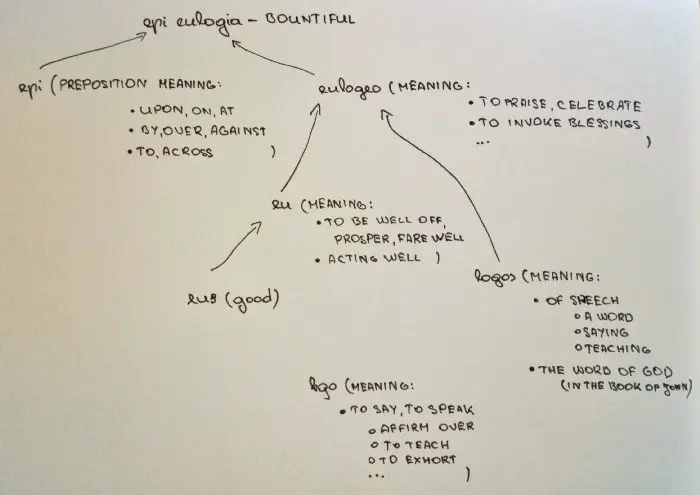
It becomes obvious that behind the word “bountiful” hides something that we would describe as a positive speech. No wonder during the funerals we can hear eulogies, indicating, well-meaning speech.
The little pronoun “epi” comes to enforce the meaning. We end up with something that sounds like praise.
Another way we can describe a strong positive speech or shout is “cheerful”. That connects with the following verse.
Binary opposites
Now we have a cheerful giver and someone else who gives sparingly. They are not binary opposites.
Let’s look again at verse seven:
Each one must give as he has decided in his heart, not reluctantly or under compulsion, for God loves a cheerful giver. (2 Corinthians 9:7, ESV)
There are three points that Paul raises.
The one who gives has to decide the amount prior to the act. There should be no grief, nor a sense of duty in giving.
When you feel like you have to or you don’t have much joy in giving, you aren’t not going to contribute much. There is a disconnection in the heart. It feels cold and lifeless.
Bountiful giving is a matter of the heart. Generosity doesn’t grow in a soil of bitter sorrow but in the heart that contains joy.
That’s why God loves a cheerful giver. His giving is aligned with the heart. It’s never a joy to receive a gift that was mandatory. A lifeless gift will not produce after its own kind.
Therefore the passage of scripture can be understood as:
Whoever sows in sorrow will also reap in sadness, and whoever sows with gladness will also reap in joy. For everyone, should give as he decided in his hear, not with grief nor our of necessity because God loves a cheerful giver.
The wrap-up
There are two givers, a cheerful and the one that is sorrowful about giving. You can give a huge amount without having a cheerfulness in your heart towards God but that doesn't bless anyone.
Let our giving be in agreement with our hearts. If our hearts are not desiring to give, I would suggest practicing more thankfulness.
In whatever we do, let’s give out of joy and gladness to bless someone. That will bring a sure success in the heart of the giver as well as in the one who receives.
For more useful insights and tips subscribe to my monthly newsletter.






