
Agent Max: An AI-Driven Token Experiment Built Around Yield, Buybacks, and Burns
Agent Max is one of the latest developments connected to the MaxFi ecosystem, and it has already attracted attention from its early community. A recent seed round, available only to members of the Discord community, sold out within a few hours. The total allocation available in that round was worth approximately $150,000, and early participants received access to Agent Max tokens before the public launch.
The central question now is whether Agent Max could become a major long-term opportunity, or whether it should be treated simply as an interesting experiment in AI-driven decentralized finance.
If the wall of text is too much, here is the video:
What Is Agent Max?
Agent Max is designed as an AI bot that deploys liquidity pool strategies. Its role is to identify and manage liquidity positions, earn fees from those positions, and use the generated yield according to a specific token model.
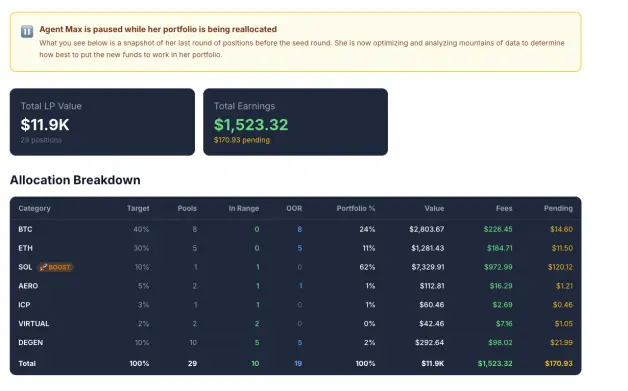
A test version of Agent Max has already been running for roughly two months. During that test period, the bot reportedly generated around $1,500 in fees. The system was paused for improvements, with plans to restart it using a larger amount of deployed capital.
The next phase is expected to involve around $100,000 of the $150,000 raised being deployed into liquidity strategies. From there, Agent Max will continue attempting to generate liquidity pool fees.
The Yield Engine Behind the Token
The key idea behind Agent Max is that the token is not only speculative. It is intended to have a yield engine behind it.
That yield engine is the Agent Max AI itself. The bot deploys capital into liquidity pools, manages positions, and earns fees. Those fees are then divided into two parts.
Half of the earned fees are intended to be compounded back into the farming wallet. This increases the amount of capital Agent Max can work with over time. The other half is used to buy back Agent Max tokens from the market and send them to a burn address.
In simple terms, the model is designed around two mechanisms: growing the productive capital base and reducing the token supply.
A Supply Model With No Further Emissions
One of the most important features of Agent Max is its fixed supply model. The initial supply is the maximum amount that will ever exist. There are no planned future emissions.
That means the supply can only decrease if the buyback-and-burn mechanism works as intended. As long as Agent Max generates liquidity pool fees, part of those fees can be used to buy and burn tokens. In theory, this creates a deflationary supply structure.
The long-term potential of this model depends heavily on whether Agent Max can consistently generate meaningful fees. If the yield engine performs well, the token supply could decline over time. If fee generation is weak, the burn mechanism would also be weaker.
Modeling the Potential Burn Rate
The current model uses several assumptions. One example discussed is based on $100,000 in deployed capital and an assumed annual return of 100%.
That number may be optimistic. Past individual positions reportedly showed annualised returns higher than 100%, with some positions reaching figures such as 250% or 400%. However, using those numbers as a long-term assumption would be aggressive. A more conservative estimate, such as 70% or 80%, may still be attractive but would lead to different results.
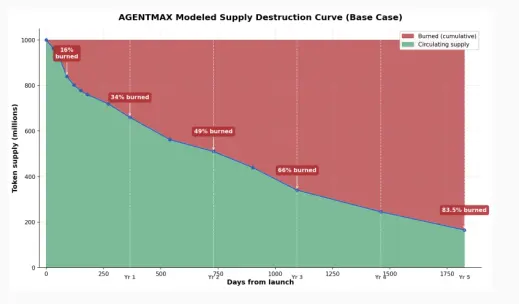
Under the 100% assumption, the model estimates that the system could burn approximately $2,800 worth of tokens per day at launch. Over time, as the farming wallet compounds, that daily burn value could increase. The model referenced in the video suggests that the daily burn amount could reach approximately $17,000 after five years.
In that same scenario, the model suggests that as much as 83% of the token supply could be burned by year five.
What Could This Mean for Price?
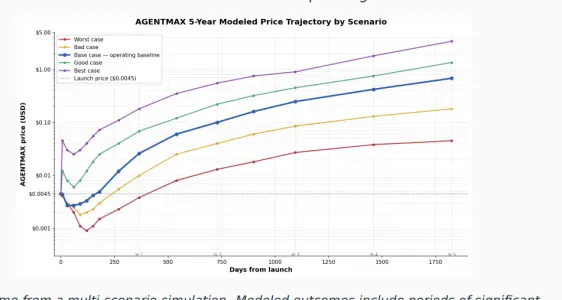
The price projections discussed are based on assumptions and should not be treated as guaranteed outcomes. The initial sale price mentioned was around $0.0045 per token. In a best-case model, the token price could rise significantly over a five-year period, potentially reaching much higher levels if the burn mechanism and demand both develop favorably.
However, this is not a short-term “100x in a few days” type of setup. The logic behind Agent Max is longer term. The model depends on sustained fee generation, compounding capital, consistent buybacks, and a decreasing token supply over several years.
That makes Agent Max more of an economic experiment than a traditional short-term crypto trade.
Personal Strategy and Market Behavior
Early participants in the seed round received tokens at a lower price than the expected launch price. Because of that, some selling pressure at launch is possible. Some early buyers may decide to take profits, especially if they bought at roughly one-third of the public sale price.
That could create opportunities for others to buy at a discount after launch, depending on market conditions.
One possible strategy is to hold a portion of Agent Max tokens while also providing liquidity once the token is released. Providing liquidity could allow holders to earn fees, potentially increasing their token exposure over time. However, liquidity provision also comes with risks, including impermanent loss and exposure to price volatility.
Comparing the Buyback Concept
The idea of using fees to buy back tokens is not entirely new. Other crypto projects have also used protocol revenue or trading fees to support token buybacks.
What makes Agent Max different is the combination of AI-driven liquidity management, a fixed supply, and a buyback-and-burn mechanism. Unlike systems where new tokens continue to be emitted or unlocked, Agent Max is presented as a model where the supply should only move downward after launch.
That said, whether the numbers actually work will only become clear over time. The model depends on real fee generation, sustainable performance, and market demand for the token.
Current Launch Status
At the time, the token generation event had not yet been announced. Anyone interested in Agent Max should follow official MaxFi or Agent Max communication channels for updates.
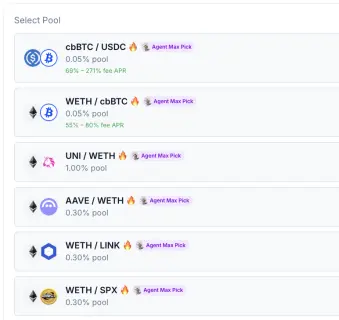
In the meantime, users can already view some of the information related to how Agent Max selects liquidity pools. The platform includes an earn section where Agent Max’s current pool preferences can be seen. While it may not yet show the full configuration or rebalance timing, it provides an idea of how the bot may operate once fully restarted.
What to Watch Next
The most important question is whether Agent Max can generate enough fees to support the projected buyback-and-burn model.
For example, if the system needs to burn around $2,700 worth of tokens per day, and only 50% of fees are used for buybacks, then Agent Max would need to generate approximately $5,400 to $5,600 in daily fees. That is a significant performance target and will need to be measured once the bot is live again.
The next few weeks after restart will be important. Actual performance data will show whether the system can come close to the expectations set by the model.
Final Thoughts
Agent Max is an interesting AI-driven DeFi experiment. Its model combines liquidity pool fee generation, compounding capital, token buybacks, and supply reduction. If the system performs well over time, the token could benefit from a steadily decreasing supply and growing productive capital.
However, this is still experimental. The assumptions are ambitious, and the long-term outcome depends on real performance rather than projections. Anyone interested should read the whitepaper, follow official updates, and understand the risks before participating.
Agent Max may not be a guaranteed success, but it is a concept worth watching closely.
https://www.maxfi.tech/deposit?ref=0x572e888614B7e1726624ac49c51bDde1a72C428d






