
The market is not asking for your emotions. It is asking whether you can read liquidity, patience, and risk appetite before the crowd does.
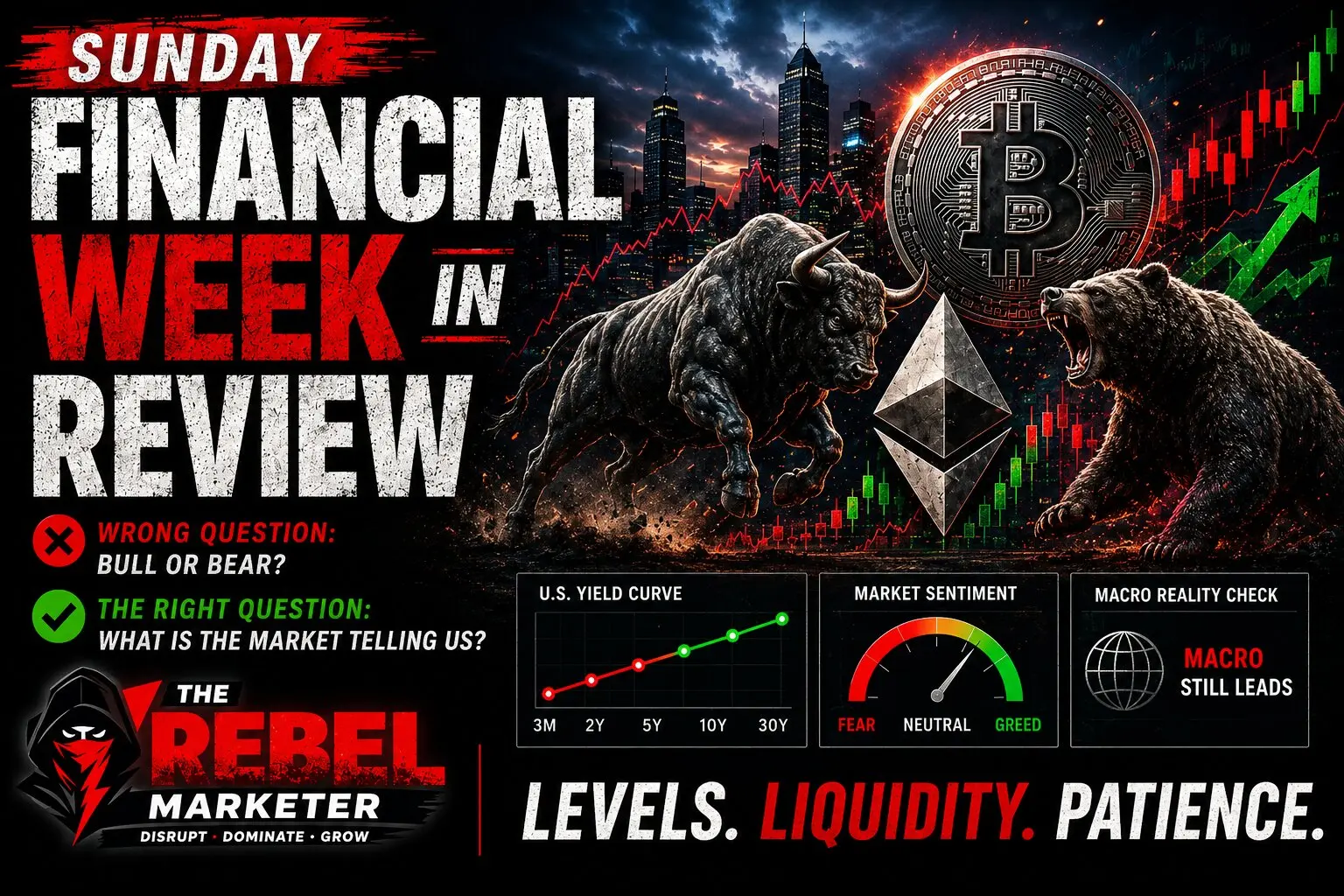
Everyone is asking the same lazy question:
Bull market or bear market?
Wrong question.
The right question is:
What is the market telling us about risk appetite, liquidity, and patience?
That is the real story this week.
Crypto stayed nervous, but alive. Bitcoin is still defending the area around the $63K zone. Ethereum is trying to stabilize after relative weakness. Stocks remain mixed. Macro still dominates the entire risk-asset conversation.
In other words: this is not a clean “send it” market.
But it is not a panic market either.
It is a market of hesitation.
And hesitation is where the real signals hide.
Bitcoin: Holding, But Not Celebrating
Bitcoin remains the center of the room.
The key point this week is not that BTC exploded higher.
It did not.
The key point is that it did not collapse.
That matters.
When Bitcoin holds important zones while sentiment is uncertain, it tells us buyers are still present. Not euphoric buyers. Not social media moonboys. Real buyers. Patient buyers. The kind that usually do not announce themselves until after the move is already obvious.
But there is still no reason to blindly chase.
A market can hold support and still fake out both sides before choosing direction.
That is why the smart question is not:
Will BTC pump?
The smart question is:
Where does fear get bought?
If support keeps holding and volume confirms, the structure improves. If BTC loses key levels with conviction, the market will punish late optimism fast.
For now, Bitcoin is not screaming.
It is testing patience.
Ethereum: Stabilizing, But Still Needs Proof
Ethereum is trying to stabilize, but ETH still has work to do.
The issue is not only price.
The issue is relative strength.
In a strong crypto market, Ethereum usually needs to show leadership or at least stop bleeding against Bitcoin. If ETH remains weak while BTC holds, it tells us capital is still defensive inside crypto.
That does not mean Ethereum is dead.
It means the market wants proof.
Proof of demand.
Proof of narrative.
Proof that buyers are willing to rotate beyond Bitcoin again.
Until then, ETH is in “show me” mode.
And that is not necessarily bad.
Markets often look weakest right before rotation comes back. But rotation needs confirmation. A few green candles are not enough. We need sustained demand, stronger volume, and a reason for capital to move beyond Bitcoin.
Until that happens, Bitcoin remains the safer crypto benchmark, and Ethereum remains the asset that needs to prove the next phase is broader than just BTC dominance.
Altcoins: Still Waiting for Permission
Altcoins are in a difficult position.
They want a risk-on environment.
They want Bitcoin stable enough to stop sucking all the oxygen out of the room.
They want Ethereum strong enough to give the market confidence.
They want liquidity.
They want retail attention.
They want a narrative.
Right now, they do not have all of that at once.
That is why many altcoins remain fragile. Some bounce hard, but many still look like they are reacting rather than leading.
This is where traders get trapped.
They see one strong candle and think the altseason signal has arrived.
But altseason does not start because your favorite coin pumps for six hours.
Altseason needs broader risk appetite.
It needs liquidity.
It needs confidence.
It needs the market to believe that upside is worth the risk again.
Until then, many altcoin moves are still tactical, not structural.
Stocks: Mixed Signals, Not Market Clarity
The stock market remains mixed.
That is not surprising.
Equities are still stuck between two opposing forces.
On one side, investors want lower rates, easier liquidity, stronger earnings, and renewed risk appetite.
On the other side, inflation expectations, bond yields, dollar strength, and central bank timing keep pressuring the narrative.
This is why crypto traders cannot ignore macro.
Crypto is not floating in a separate universe.
When liquidity tightens, risk assets feel it.
When yields rise, speculative assets feel it.
When the dollar strengthens, global liquidity feels it.
When central banks hesitate, markets hesitate too.
Crypto traders who only watch crypto charts are missing half the battlefield.
The market does not care whether you prefer crypto, stocks, gold, cash, or memes. Capital moves where risk-adjusted opportunity looks best.
Right now, capital is selective.
That is the word of the week:
Selective.
Not dead.
Not euphoric.
Selective.
The Real Driver: Liquidity
Here is what the fear misses:
The market is not just reacting to headlines.
It is reacting to liquidity.
Liquidity decides how much risk the system can absorb.
Liquidity decides whether dips get bought or sold harder.
Liquidity decides whether leverage becomes fuel or a bomb.
Liquidity decides whether traders get rewarded for aggression or punished for impatience.
This week felt less like a market choosing a final direction and more like a market waiting for confirmation.
That confirmation may come from inflation data, central bank language, bond yield movement, dollar strength or weakness, ETF flows, institutional positioning, Bitcoin dominance, and volume at key support and resistance zones.
The crowd wants a clean label.
Bullish.
Bearish.
Risk-on.
Risk-off.
Markets rarely work like that.
They give compression.
They give fakeouts.
They punish impatience.
They shake out leverage.
Then they move.
The Fed, The Dollar, And The Invisible Hand On Risk Assets
The Federal Reserve remains one of the most important invisible hands on markets.
Even when nothing dramatic happens, expectations around rates matter.
If traders believe easier policy is coming, risk assets usually breathe better.
If traders believe rates stay higher for longer, risk assets become more cautious.
The dollar matters too.
A stronger dollar often tightens global financial conditions. That can pressure Bitcoin, Ethereum, stocks, commodities, and emerging market assets.
A weaker dollar can help risk appetite return.
This is why the market often looks irrational on the surface.
You can have good crypto news and still see weak price action.
You can have no major bad news and still see selling.
Why?
Because liquidity and macro conditions may be doing more work than headlines.
The market is not always reacting to what crypto people are talking about.
Sometimes it is reacting to what bond traders, currency markets, and central banks are pricing.
That is not exciting.
But it is real.
Sentiment: Not Panic, Not Greed
Sentiment is also in a strange place.
There is fear, but not total panic.
There is hope, but not real euphoria.
There is hesitation everywhere.
That is exactly why this market is dangerous for impatient traders.
If you are too bearish, you can get squeezed.
If you are too bullish, you can get trapped.
If you trade every candle, you can get chopped to pieces.
This is a market that rewards patience more than prediction.
The crowd wants certainty.
Markets often offer ambiguity.
The amateur tries to force a conclusion.
The disciplined trader waits for confirmation.
My Take: Do Not Chase. Observe The Reaction.
This is not the moment to blindly chase green candles.
It is the moment to watch where the market refuses to break.
Where does support hold?
Where does volume appear?
Where do sellers run out of ammunition?
Where does fear get bought?
That is the useful information.
Not predictions.
Not hype.
Not doom.
Just levels, liquidity, and discipline.
A weak trader asks:
Should I buy now?
A better trader asks:
What would prove the market is strong?
A stronger investor asks:
Where is the crowd mispricing fear?
That is the difference.
The Levels Matter More Than The Noise
Every week, the market creates a thousand narratives.
Some are useful.
Most are noise.
Influencers need drama.
Headlines need clicks.
Traders need dopamine.
But charts do not care about your emotional needs.
The levels matter.
Support matters.
Resistance matters.
Volume matters.
Trend structure matters.
Liquidity zones matter.
Bitcoin holding near an important zone matters more than someone screaming “pump incoming.”
Ethereum stabilizing matters, but only if demand follows.
Stocks being mixed matters because it tells us risk appetite is not clean.
Macro leading matters because crypto is still tied to global liquidity.
The best traders are not the loudest.
They are the ones who can stay calm when the market is trying to provoke them.
What I Am Watching Next
For the next week, I am watching five things.
First: Bitcoin structure.
Does BTC keep defending key zones, or does it lose support with conviction?
Second: Ethereum relative strength.
Does ETH finally start to recover against BTC, or does Bitcoin dominance continue to absorb attention?
Third: altcoin breadth.
Are only a few coins moving, or is the market showing broader participation?
Fourth: macro signals.
Dollar, yields, inflation expectations, central bank language. Boring to some. Essential to anyone serious.
Fifth: volume.
Price without volume is noise. Volume with structure is information.
That is the difference between a fakeout and a real move.
Final Thought
Whales do not buy certainty.
They buy hesitation.
They buy when the crowd is tired, confused, and emotionally exhausted.
That does not mean every dip is a gift.
It means every emotional market deserves careful reading.
Bitcoin is holding.
Ethereum is stabilizing.
Stocks are mixed.
Macro still leads.
The next move will not be decided by vibes.
It will be decided by liquidity, levels, and confirmation.
So here is the Sunday question:
Are you reacting to the chart, or reading what the market is actually telling you?
The Rebel Marketer
Disrupt. Dominate. Grow.
Disclaimer:
This article is for information and entertainment only. It is not financial advice. Always do your own research, manage your risk, and never invest money you cannot afford to lose.






