
In crypto, everything happens so fast. Two weeks in the crypto world seems like two months. Opportunities are everywhere and the Solana ecosystem is one of those that many have missed.
This article will be a deep dive on Tulip Protocol, and as usual this is not financial advice but only educational content. Please don’t be dumb and always DYOR on any crypto projects. Now let’s explore the potential of Tulip!

Table of Contents
1. Summary
2. Overview of Tulip Protocol
3. Yield Farming
4. Technical Deep Dive
5. Tokenomics
6. Industry Benchmark
7. Concluding Thoughts
Part 1. Summary
This is the short TL;DR you’re looking for if you can’t be bothered to read through the rest of the report. You’re missing out though, just sayin’.
● Tulip Protocol is a yield aggregator that runs on Solana. It helps users increase their profits with higher APYs throughout various DeFi protocols.
● Its TVL of $856M makes it the leading yield aggregator on Solana. It currently has 40 active vaults for users to choose from and the highest APY is estimated at 350%.
● It recently secured a $5M fundraising round led by Jump Capital and Alameda Research.
● The three core products are lending, vaults, and leveraged yield farming.
● The TULIP token is designed to shift towards governance, allowing holders to participate in the decision making of the protocol in the future.
● They expect to capture around 3–3.5% on TVL, which equates to $24–28M projected revenue. All of which will fund its DAO treasury.
● Tulip Protocol seems like it’s going in the right direction and with more users switching to Solana, it will have a real shot at becoming a big player within the sector.
Part 2. Overview
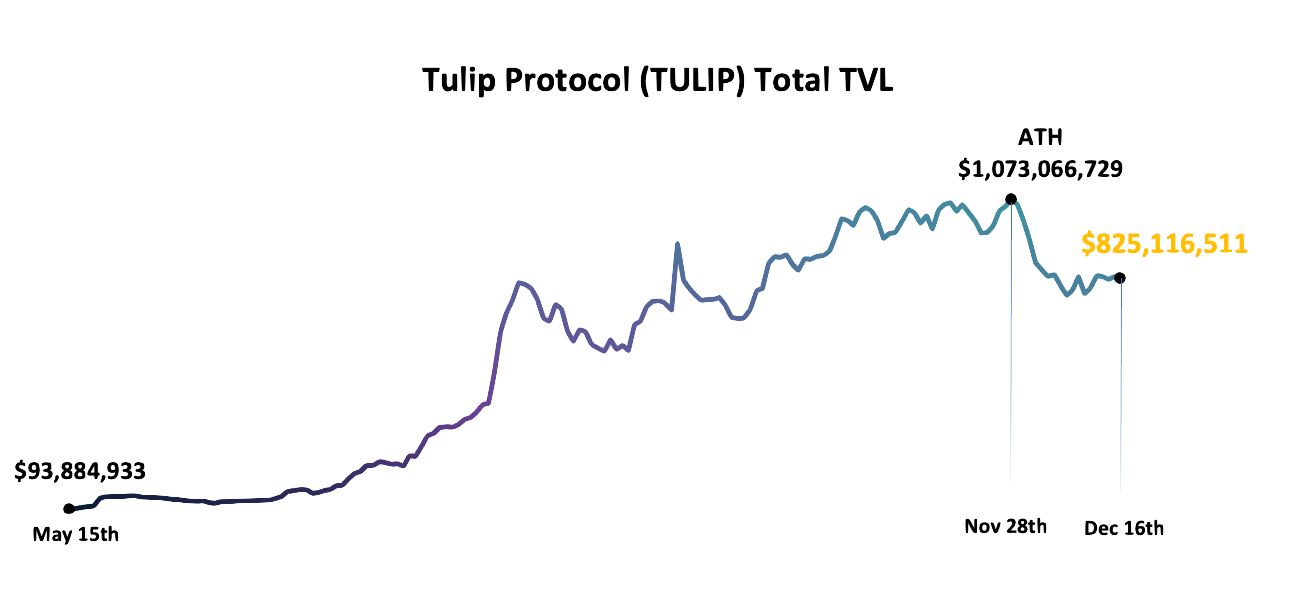
Tulip (or previously SolFarm) is a project on Solana that aggregates liquidity from other Solana DEXs. Tulip Protocol’s TVL has increased sharply by more than 8x since its inception in April and has reached an ATH of over $1B in November 2021. It currently has 40 active vaults for users to choose from and the highest APY is estimated at 350%.
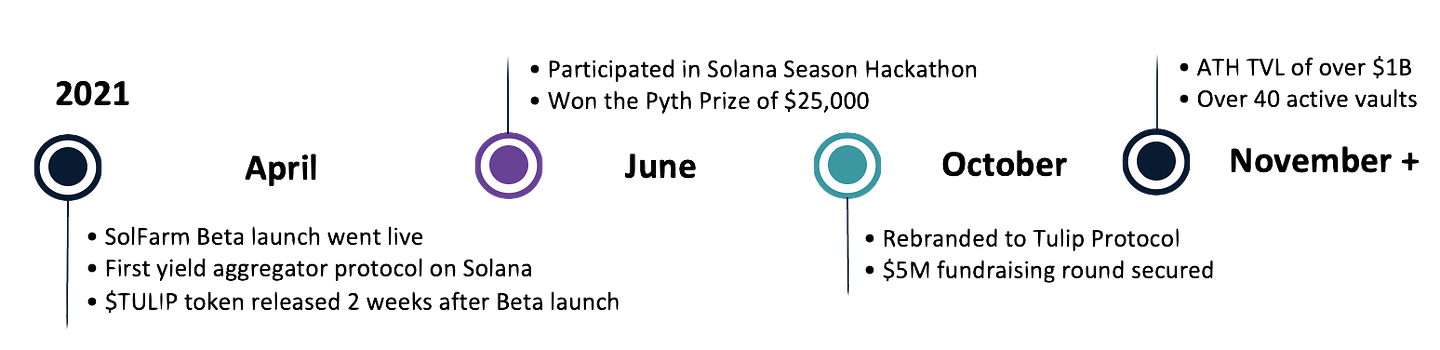
Tulip Protocol was one of the winners of the Solana Season Hackathon earlier this year in June, winning $25,000 as “SolFarm”. It rebranded in October and finished its $5M fundraising round. The fundraising round has the presence of extremely crucial names, led by Jump Capital and Alameda Research. In addition, this round of financing also includes the participation of Amber Group, Cadenza Ventures, CMS Holdings and FinTech Collective. In addition to effectively acknowledged money, Tulip also has the backing of angel investors including Darren Lau, Noah Dummett and Cindy Leow (of Drift Protocol).
Tulip Protocol’s team is not doxed, members all go by an alias. Anonymous co-founder Momo said the funding will help expand its team beyond its current six employees. Even though Tulip operates with a very anonymous team behind, it has had numerous public partnerships with known industry names like Solana Foundation, Solend, and many other DeFi protocols on Solana.
Part 3. Yield Farming
Tulip Protocol is a yield aggregator that runs on Solana. What this means in simpler terms is that Tulip lets users of DeFi platforms earn returns on their cryptocurrency holdings through “yield farming”. To fully understand yield aggregators, let’s back up a bit and first take a look at yield farming.
Yield farming first began in 2020, with Compound, a decentralized lending platform. Opportunities in DeFi vary widely with each protocol. Rewards as well as risk levels may change as the value of the tokens fluctuate with the market prices. The goal of yield farming is to seek the best opportunities across many protocols to maximize the rate of return for users. Opportunities like lending & borrowing, liquidity providing, and staking to name a few. All of these generate yields, using the protocol’s native tokens as a reward to incentivize liquidity. Since returns can vary significantly between platforms, it can be tedious to manually hunt down yield at each platform. New protocols introduce functions to automate this process. Besides shifting funds between various DeFi platforms with the highest yield, an aggregator navigates the best returns with the shortest commitment and lowest network fees.
Based on the understanding of yield aggregators, Tulip Protocol helps users increase their profits with higher APYs without cumbersome management.
Part 4. Technical Deep Dive
So, how exactly does Tulip Protocol work?
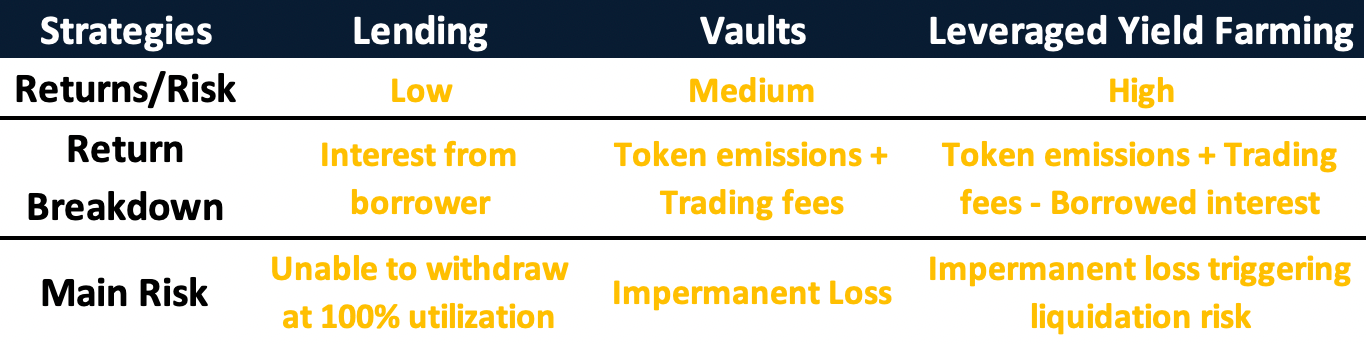
Tulip offers three types of yield products, “vaults”, “lending”, and “leveraged yield farming”.
Let’s start with vaults.
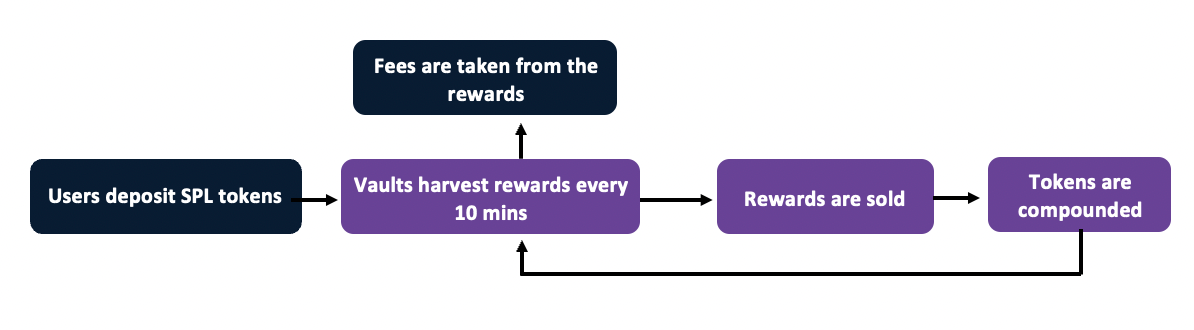
Tulip supports compounding vaults from Saber, Raydium, and Orca. Users deposit their SPL tokens into the vaults then the auto-compounding strategy will do the rest for them. Auto-compounding, in layman’s term, is when your yield farming rewards are automatically sold and re-added to your pool to earn higher APY. To prevent users from manipulating the strategy by hopping in and out constantly, they are required to keep deposited funds in the pool for at least 2 hours. If users withdraw the funds sooner, a penalty charge will occur from the platform.
The lending product is when users lend out their tokens on Tulip.
When a user deposits into Tulip’s lending protocol, they receive collateral token in the form of TuAssets. Lending vaults generate interest per block. The generated interest is accrued into the lending pool, the user does not need to do anything, they can simply hold and enjoy the interest generated. APY is determined by utilization, the higher the utilization the higher the reward. However, at 100% utilization, users will not be able to withdraw their tokens but will enjoy sky high APYs.

The last product, we have leverage yield farming.
Tulip currently supports up to 3x leverage. The feature consists of lenders and borrowers. The lender deposits their assets to earn interest and the borrower deposits collateral to leverage/borrow the yield farming.

Now let’s circle back a bit on the risks of each product, and what they mean.
With vaults, there comes the risk of impermanent loss. Impermanent loss happens when the price of your tokens changes compared to when you deposited them in the pool. The larger the change is, the bigger the loss. In this case, the loss means less dollar value at the time of withdrawal than at the time of deposit. Make sure to check out our video below for a visual explanation of how impermanent loss works.
With lending, the risk lies in not being able to withdraw your tokens at 100% utilization. What this means simply, is that when utilization is at 100% the entire pool of tokens has been lent out. Since all tokens are lent out, you would not be able to withdraw your tokens until utilization drops below 100%. In other words, you gotta wait until more lenders lend out their tokens or less borrowers borrow the tokens. The upside of this, is the APYs are usually extremely high when utilization is high. So if you plan on just holding your tokens, lending them out would be an ideal option.
With leveraged yield farming, there is a risk of liquidation. Liquidation happens when assets are volatile and market prices move to a point where your collateral is no longer enough to cover the amount of your loan, causing you to suffer a liquidation penalty to your collateral.
Part 5. Tokenomics
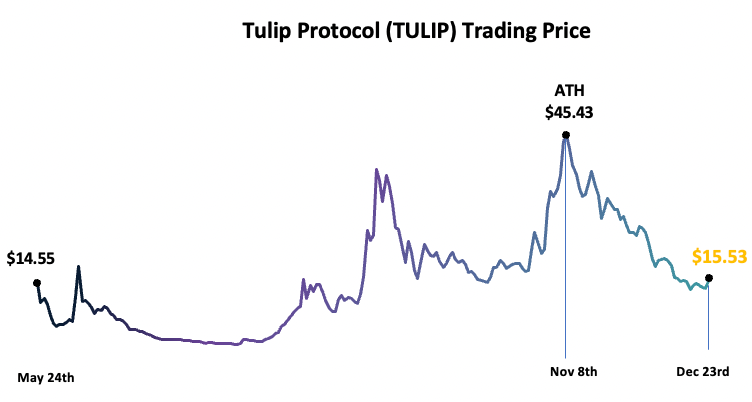
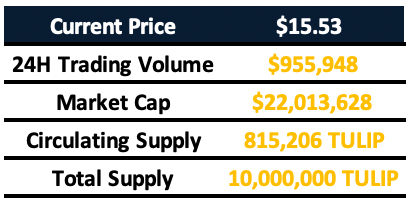
$TULIP token is currently trading at $15.53 at the time of writing, a 65% decrease from its ATH price of $45.43 in November, and a 6.7% increase since its inception trading price of $14.55.
The TULIP token is designed to shift towards governance. Currently, on-chain governance is not available but is being developed by the Solana Foundation. Once this is ready, the protocol will shift governance to token holders. It will allow holders to vote on platform fees, treasury usage, protocol improvements, pool reward weighting, and value accrual.
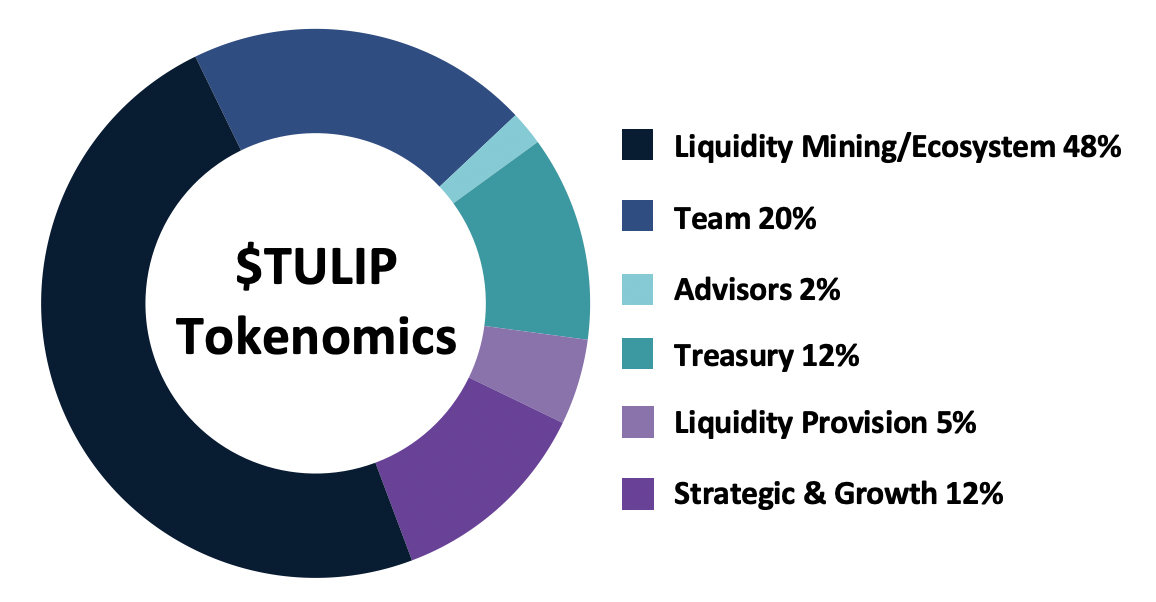
To head start its DAO, Tulip Protocol has implemented a DAO treasury. As of November 1st, the treasury holds ~$1.7M in funds in a mix of stablecoins and altcoins, with ~$1.33M yielding in Tulip’s USDC lending. There are 2 major sources of income for the protocol, vault fees and interest fees. Future allocations/strategies will be decided via governance.
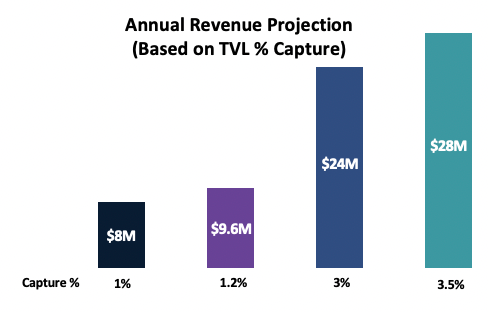
Tulip Protocol currently charges 1.5% on vault profits and 10% on interest earned. Estimated annual revenue projection is around 1–1.2% on TVL with its current fee structure. This translates to $8M-$9.6M projected annually based on current TVL. Tulip Protocol plans on handing over protocol fees to the DAO treasury, as well as increasing vault fees to 4%. With this new implementation, they expect to capture around 3–3.5% on TVL, which equates to $24–28M projected revenue.
Part 6. Industry Benchmark
In 2021, The global Crypto market cap is $2.37 trillion and Market Capitalization of DeFi is $164.61 billion.
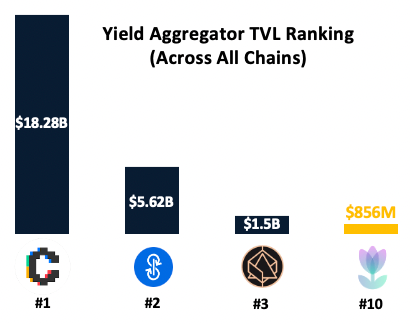
Within similar projects, Convex Finance currently sits at number 1 with a TVL of $18.28B. Followed in 2nd place is Yearn Finance, with $5.62B TVL. Tulip Protocol sits at number 10, however it remains the leading name in the Solana ecosystem.
 Source: DeFiLlama
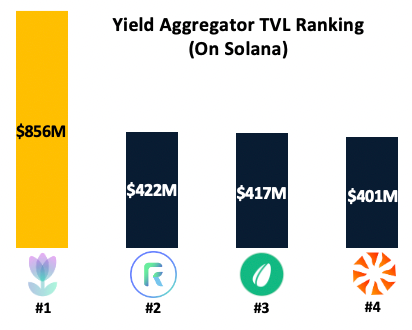
Tulip Protocol sits at number 1 amongst competing yield aggregating projects within the Solana ecosystem. Its TVL of $856M is over 2x more than the runner up Francium, Almond, and Sunny respectively.
 Source: DeFiLlama
Part 7. Concluding Thoughts
More and more developers are embracing the Solana blockchain and as more tokens are deployed on the network, Tulip Protocol has continued to provide more options to its users.
Before this though, it’s important to know the risks. As the Solana network is still relatively new, it is more prone to instability. Its infamous 17 hour network outage left many DeFi users in a state of panic. Although this is something to keep in mind, it just means you have to be more cautious and ration your investments.
Tulip Protocol is backed by the Solana foundation, which give more security that it is not a totally isolated project.
Notable features of Tulip includes:
- Low cost, high txn speed, frequent compounding strategies thanks to the Solana blockchain
- Additional profits from high APYs
- Supported vaults on Saber, Raydium, and Orca
- 3x leveraged yield farming
- A community of meme lovers, especially Pepe the frog

In contrast to other Solana-based DeFi projects, Tulip Protocol did not have an initial token sale to private investors or VCs. This demonstrated the ability of the Tulip team since they were able to build a yield aggregator with no initial fundraising. The project is also moving towards the decentralized end with its implementation of a DAO treasury and a concrete plan to create a steady money flow to fund the treasury.
All in all, Tulip Protocol seems like it’s going in the right direction and with more users switching to Solana, it will have a real shot at becoming a big player within the sector.
Thanks for reading all the way through, I hope this was informative af. Make sure to check out our video on Tulip Protocol if you’re more of a visual learner. Once again, this is NOT financial advice, but only educational content. Please don’t be dumb and always DYOR on crypto projects.
Take it easy kids, signing off now.
-SixOhFour
Sources:
https://tulip-protocol.gitbook.io/tulip-protocol/
https://www.solana.news/post/yield-aggregator-solfarm-launches-on-solana
https://medium.com/tulipprotocol/a-new-season-solfarm-is-now-tulip-protocol-e470e7f2b111




