
Posted by: Michaelson Williams, author of *The Legacy Wife, Playground Dating Theories, YOU ARE ILLUMINATI: Psychological World War III, Trainwashing: The Secrets of Positive Brainwashing,* and more.
---
In Part One, SYNORA's central question was introduced: Can two or more people independently experience substantially corresponding dreams during overlapping periods of sleep?
Answering that question requires more than asking people whether their dreams seemed similar.
Dreams are fluid, memories can change rapidly after waking, and people naturally look for meaning in unusual experiences. If an experiment is going to investigate possible relationships between independently experienced dreams, the method used to collect those experiences becomes just as important as the experiences themselves.
This is where SYNORA's concept of Dream State Mapping begins.
The fundamental principle is simple:
Record first. Interpret second.
When a participant wakes from a dream, the first task is to document what is actually remembered. SYNORA is designed to preserve that original account rather than immediately asking the participant what the dream means.
The distinction may appear subtle, but it is central to the experiment.
A participant might remember a person, a location, a conversation, a particular object, a sequence of events, or even an unusual sensory detail. At the time of recording, that information can be documented without requiring the participant to determine whether the person was known, whether the location was symbolic, or what the experience supposedly represented.
An unfamiliar person, for example, can remain an unfamiliar person.
That matters because interpretation can influence memory. Once someone begins searching for an explanation, the original recollection can potentially become intertwined with that explanation.
SYNORA therefore treats the original dream report as its primary experimental observation.
Recording Without Contamination
The experiment also depends upon independence.
Participants are not supposed to see another person's dream report before submitting their own original account. This is intended to reduce the possibility that one participant's description influences another participant's memory or reporting.
Only after the appropriate original reports have been recorded and locked can the system begin looking for potential relationships.
The comparison process can then examine multiple dimensions.
Timing is one.
If two people report dreams occurring during completely different periods, temporal correspondence may be absent. If their reported dream windows overlap, that becomes one piece of information.
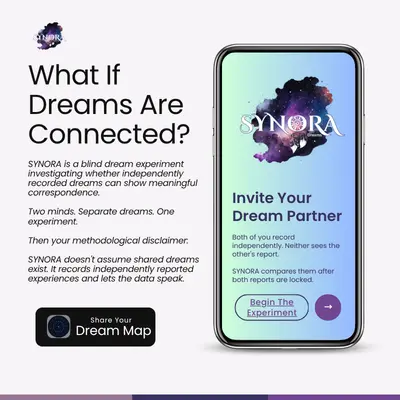
Content is another.
The system can examine locations, people, events, sensory details, movements, emotions, and unusual characteristics.
Identity can become particularly interesting.
One participant may report encountering a person they cannot identify, while another independently reports appearing in a dream during the corresponding period. That does not establish that the two experiences were connected. It creates a potential correspondence that can be documented and examined.
This distinction is essential.
SYNORA does not turn a matching detail into a declaration that a shared dream occurred.
Instead, the system organizes observations into experimental correlation categories.
Five Levels of Correspondence
The current framework progresses from relatively broad correspondence toward increasingly specific relationships.
Level One — Temporal Overlap
The reported dream periods overlap.
Level Two — General Content Overlap
Broad themes, locations, activities, or events correspond.
Level Three — Specific Content Overlap
Unusual or particularly specific details correspond.
Level Four — Identity Correspondence
A participant may potentially correspond to an unidentified person described in another participant's dream.
Level Five — Reciprocal Correspondence
Both participants independently report experiences that potentially involve one another.
These levels are not presented as scientific proof levels. They are organizational categories intended to describe what the data appears to contain.
That distinction allows SYNORA to investigate an unusual possibility without assuming the conclusion beforehand.
The Importance of Uncertainty
Dream timing presents another challenge.
A person may know when they went to sleep and when they woke up but have no precise knowledge of when a particular dream occurred. Attempting to manufacture an exact timestamp would create an appearance of accuracy that the participant does not actually possess.
SYNORA therefore allows uncertainty to remain part of the record.
Estimated dream periods can remain estimates.
Memory confidence can be recorded separately from dream vividness.
A highly vivid dream is not necessarily a highly accurate memory, and a person's confidence in remembering an event is not the same thing as the intensity of the experience itself.
These distinctions become increasingly important when attempting to compare reports objectively.
Beyond Similarity
There is also a larger question.
People dream every night. People also share common experiences, environments, cultural references, relationships, fears, places, and symbols. Given enough dream reports, some similarities should occur naturally.
That means finding two dreams with something in common is not necessarily remarkable.
The more interesting question is whether particular correspondences occur at rates or levels of specificity that warrant further investigation.
That is why SYNORA's long-term concept extends beyond simply finding matches.
The experiment can eventually compare overlapping dream reports with non-overlapping reports, repeated experiences involving the same participants, and unrelated participant pairs.
Such comparisons could provide a baseline against which unusual correspondences might be examined.
Until that type of evidence exists, a correlation remains a correlation.
It is not automatically causation.
It is not automatically transmission.
And it is not proof of shared consciousness.
That restraint is intentional.
SYNORA is designed around an unanswered question. Its value depends, in part, on allowing the evidence to produce an unexpected result if that is what the evidence shows.
What Happens If the Data Finds Something?
This may ultimately be the most important question surrounding the entire project.
Suppose two participants independently describe remarkably specific details during overlapping periods of sleep.
What should happen next?
The answer cannot simply be to declare that a shared dream has occurred.
Instead, the observation would become a reason for deeper investigation.
More participants could be studied. More controlled experiments could be developed. Baseline comparisons could be expanded. Timing could become more precise where reliable measurements are available. Additional researchers could examine the methodology and the underlying data.
The objective would be to move from an interesting observation toward a testable research question.
And the opposite result would be equally important.
If the data consistently fails to demonstrate unusual correspondence, that result would also tell us something.
That is one of the defining characteristics of the SYNORA experiment.
It is not designed merely to collect evidence for a predetermined conclusion.
It is designed to find out what happens when the question is asked systematically.
Part Three will examine where Dream State Mapping could go from here — including the possibilities, limitations, research opportunities, and larger question that emerges if independently recorded dreams continue to produce unexpected correspondences.
by Mark Wilham
Author & Futurist
[email protected]






