
We often start by looking at the market cap and the supply when assessing the true value of a coin. The recent bull run by BTC, accented by yet another ATH, this time at over $50,000, has got me thinking that the main underlying driver for this, is that the supply is actually a lot less than we might expect. So I did some research and took to calculating an estimated "True Supply".
To start, the total supply of Bitcoin is 21,000,000, this number won't be reached until about the year 2140, so it's somewhat irrelevant in this discussion.
At the time of writing, the total available supply, i.e. the total amount that has been mined to date is listed as just over 18,630,000. However, this is not the true supply, as it is well known that many BTC have been lost over the years, whether on destroyed or missing hard drives, through lost keys, wallet owners who passed away, or intentionally burned their coins. Just how many BTC have been "lost", is what I set out to find out.
The most famous case of "lost" BTC, is the original BTC mined by Satoshi Nakamoto between 2009-2010, of which an estimated total 1,000,000 BTC resides unmoved in 50 BTC amounts spread among several wallets thought to belong to Nakamoto. As the true identity of Satoshi Nakamoto remains unverified, there is no way of knowing exactly how much BTC he or she holds, and if their holdings will ever be moved.
I continued to search for a more concrete estimate, one which would include other BTC beyond what is supposedly held by Nakamoto. Lucky for me, a blockchain data and intelligence provider called Glassnode https://studio.glassnode.com/ has already done much of the work. In the following graph, they estimate the circulating supply of BTC (7d moving average) over time and relative to current price of BTC.
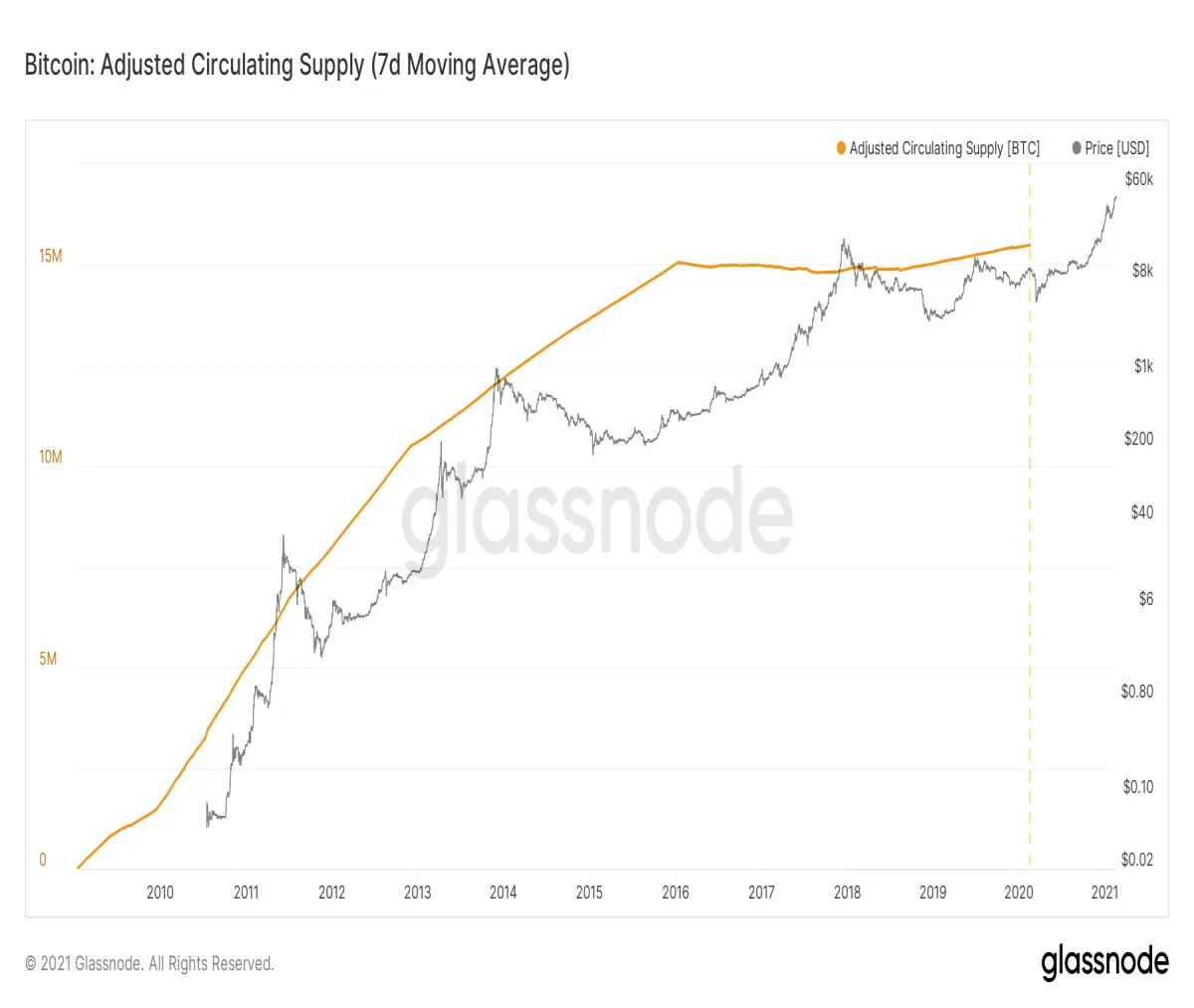
See the original here: https://studio.glassnode.com/metrics?a=BTC&category=&m=supply.CurrentAdjusted&mAvg=7
The metric is described as
"The circulating supply adjusted by accounting for lost coins. The amount of lost coins is estimated by all those that have not moved in over 7 years."
We can see on the most recent available date of February 15th, 2020, just over a year ago, the estimated circulating supply was at 15,491,562 BTC. Subtracting this from the roughly 18,221,000 BTC that have been mined up until that point, we can see that over 2.7 million BTC are held in wallets that have been inactive in over 7 years. This represents almost 15% of the total mined supply, and a current market value of roughly US$133B.
I decided to plot the yearly data in a chart to look at the trends, which you can see along with the raw numbers below. It only made sense to go back as far as 2016, considering the metric used a 7 year time span.
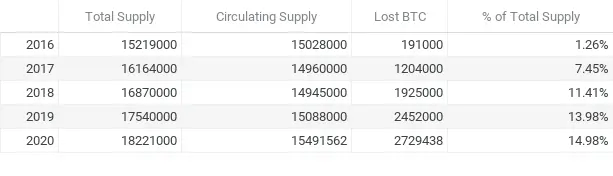
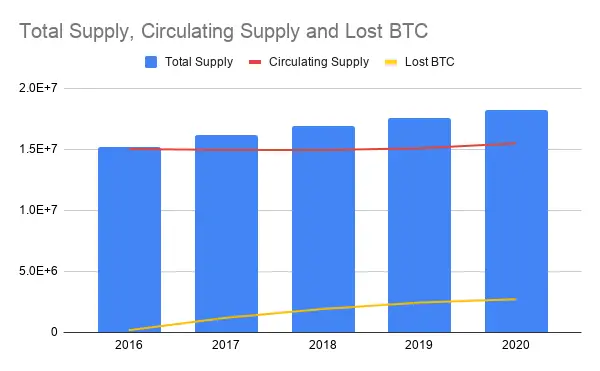
In 2016 we can already see about 191,000 BTC that have been unmoved since being mined 7 years earlier, and that number jumps to 1.2 million, which makes sense as 7 years prior would have been when Nakamoto would have mined the majority of his or her supposed 1 million BTC.
The trend of BTC being lost appears to be fairly significant, and pointing to a growing increase of BTC being removed from circulation forever. Of course how many of these are truly lost beyond recovery? How many are simply HODLers with incredible resolve? We will never know for sure, but it's safe to assume, that even if one incredible bull run after another can not stir these wallets to move their BTC for over 7 years, it's unlikely anything will.
What impact do you think the "lost" BTC has on the price and the current bull run? Do you think the methodology used by Glassnode in this case is a good way to estimate "Lost BTC"? What do you think the real amount is? Is this something you factor in when evaluating the market price? What about the 1,000,000+ BCH (US$682 million by current value) that Nakamoto should also hold? I'd love to hear what everyone thinks of this.
If you're interested in market data analysis, I highly recommend checking out the Glassnode website, they have some incredibly well developed analysis tools presented in neat and easy-to-read graphs.
Thank you for reading, and remember to enjoy the good things in life!





