

At this point, the entire world has heard of Bitcoin, and it is highly likely that around 5% of people hold some cryptocurrency or have an account at a crypto exchange.
Some unverifiable estimates put the number as high as 700 million people, which is enormous, if you like big numbers. Yet, the use of crypto for the purpose it was supposedly invented for is… let’s say, underwhelming. Most people are far more interested in ways to invest, make money online, speculate, or gamble, basically everything Satoshi never had in mind.
The main use case today is exactly that: gambling and trading. Very few places actually accept cryptocurrency as payment, but hey, why let reality get in the way? Meanwhile, the key opinion leaders of Bitcoin never truly intended for it to succeed as money. Instead, they gracefully shifted the narrative to “digital gold,” kept the 1MB block size intact, and implemented a soft fork upgrade, SegWit, which some enthusiasts generously describe as a workaround, and others just call a “hack.”
Bitcoin Maxis Against Peer-To-Peer Electronic Cash
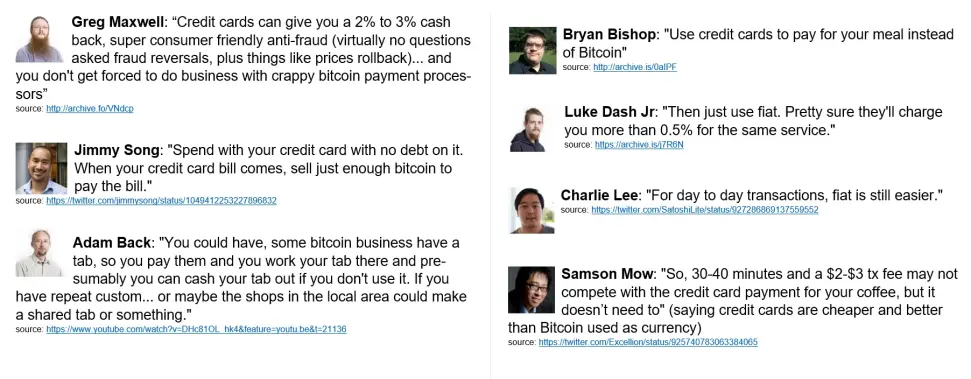
Well, if one reads the whitepaper or the communications of Satoshi Nakamoto, it is easy to understand how these people changed the narrative and altered Bitcoin's history.
Two of them control Bitcoin's direction: Adam Back and Greg Maxwell.
According to some, together with other Core developers, they hijacked Bitcoin.
First was the era of Satoshi, between 2009 and 2010, and then it was Gavin Andresen, whom Satoshi trusted with the keys to the code.
After that, Gavin selected Mark Friedenbach as the lead developer, entrusting him as well with the keys, and after a series of events related to the block size increase, Gavin's commit access was revoked by the rest of the Core developers, most of whom had already co-founded Blockstream together with Adam Back. Blockstream is a for-profit company aiming to sell the scalable sidechain Liquid, which many considered the main reason for sabotaging the Bitcoin project.
Thus, the third era of Bitcoin development established its control since late 2017 and is clearly not in favor of scaling the mainchain.
Newcomers today are baffled, since everyone starts by reading the whitepaper, which specifically mentions commerce as the target of Bitcoin.
Yet they find out that fees and scalability are not even close to what was promised.
Indeed, Bitcoin (BTC) does not follow the whitepaper in its intention. This was also the reason Bitcoin split during the 2017 hard fork into two competing chains, BTC and BCH. BTC, with the backing of bankers like Novogratz and Grayscale, the prominent exchange Bitfinex at the time, propaganda, and censorship, managed to convince miners and attracted the higher hash rate, becoming the prominent chain.
The narrative changed: no more P2P electronic cash, just digital gold.
Thus, the narrative that exists today is solely based on price speculation. Everyone claims how Bitcoin will reach $1 million or $10 million and higher.
Should we follow? I don't know if it will reach these extreme prices. Should it? Does it deserve these prices?
Maybe it can become digital gold, but most likely that would require decades, if not centuries.
Making money is the prime reason we invest.
We have to beat inflation, and everything else is pure profit. Bitcoin has offered vast returns so far, although lately opportunities seem to be diminishing and profitability margins are way lower than in any other 4-year cycle.
Conclusion
Maybe Bitcoin will reach $1,000,000 in the next 10 years. It is not unreasonable.
Still, that will just 10x this investment, and comes with a risk that may be too high.
With no intrinsic value, no accounting books, and just institutional hype, it seems difficult to maintain a realistic positive stance regarding the future, although indeed the new narrative of digital gold and the ETFs attracted a vast number of high-net-worth individuals and institutions looking for access to Bitcoin, Ethereum, and other cryptocurrencies. It is unsure how they will treat these assets, although until recently Bitcoin was not considered a store of value but a highly speculative asset.
Gold was not immediately established as a store of value. It has a history of 5,000 years, being used for plenty of use cases including money and a store of value. Cash is also a store of value, but whether it is good or not depends on inflation. A 2% inflation gives reason to hold some money in the bank and wait for opportunities to emerge. Yet a 10% inflation means our money in the bank will evaporate within just 10 years.
The evaporation of purchasing power due to inflation suggests we should diversify into various assets, but we can always hold cash on the sidelines in order to grab rare opportunities.
Guys, that's all for today.
Thank you for your time!

LinkTree (updated): @panterabch
On YouTube: @panteraCrypto
Join 7500+ readers: PanteraBCH.Medium.com
Don't forget to subscribe and like!






