
The flower that never needed permission to bloom.
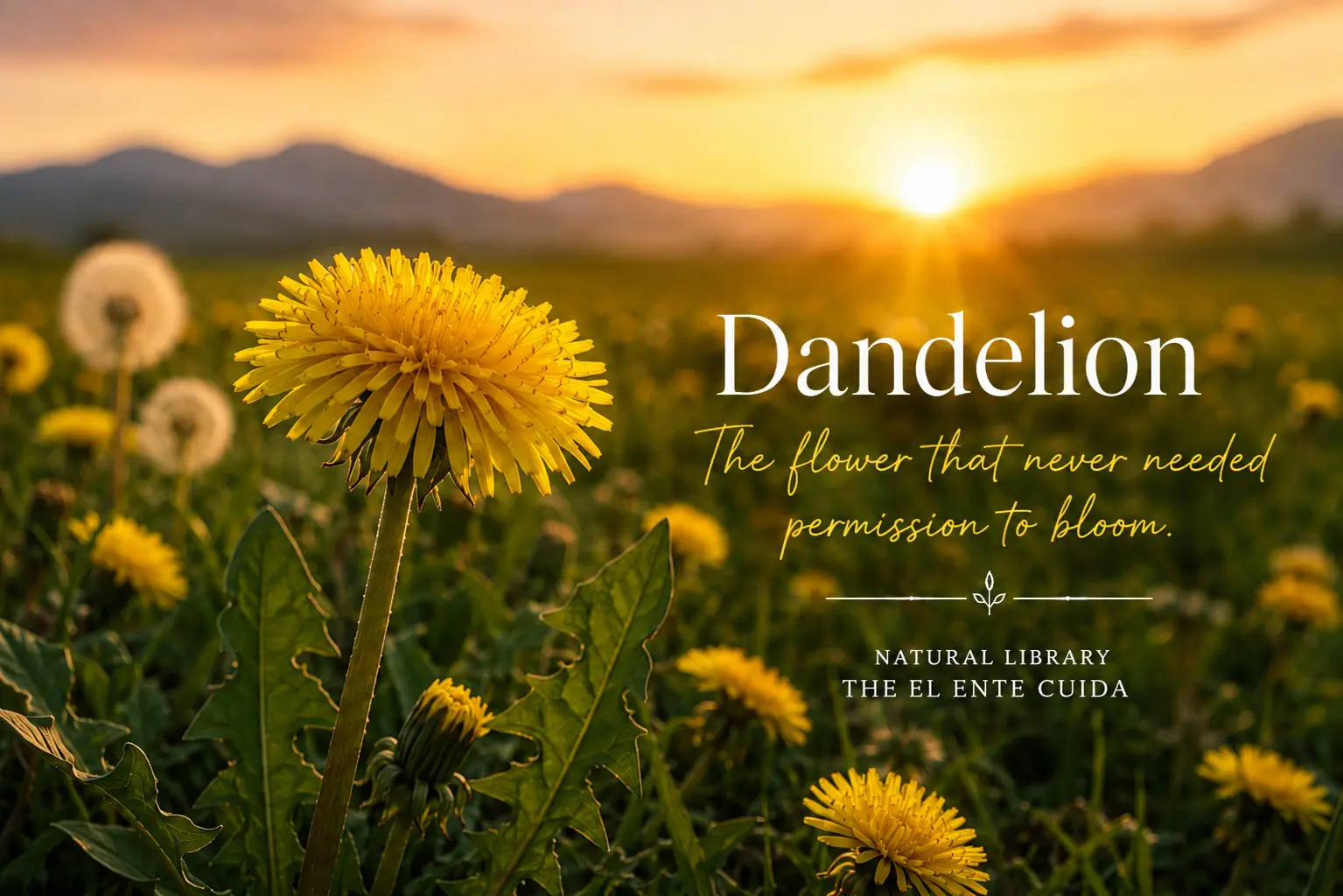
There are flowers that seem to wait for the perfect place to grow: a well-tended garden, fertile soil, and the attention of someone to plant them, water them, and protect them.
And then there are those who seem to ask for nothing.
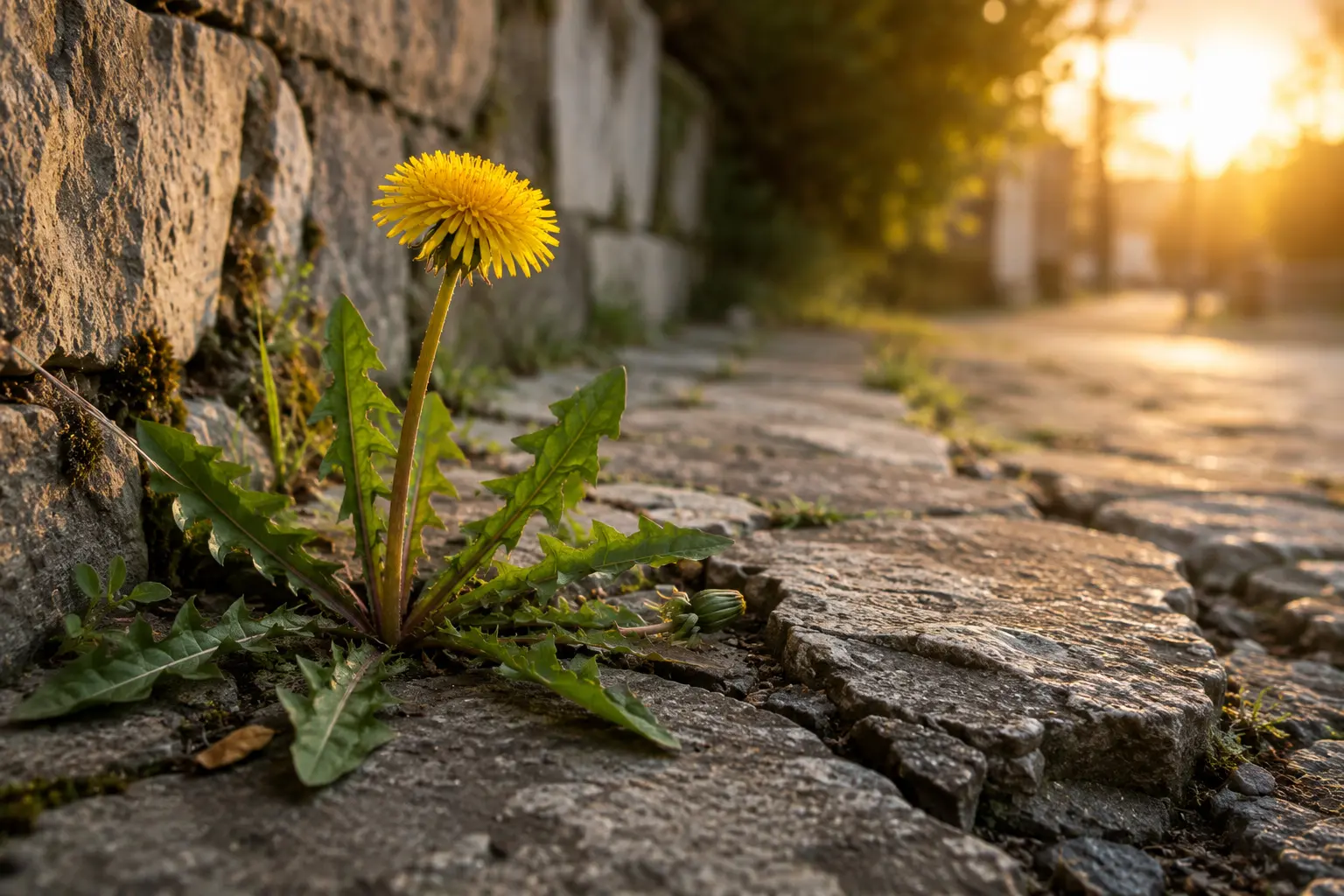
They sprout in the cracks of a sidewalk, beside an old stone wall, or in some forgotten corner of a path. They grow where almost no one expects them, and yet, every spring they reappear, as if to remind us that nature has its own rules and doesn't always need our help to find its way.
Perhaps that's why we've stopped paying attention to them. We call them weeds, we pull them up without thinking twice, and we continue on our way without even asking ourselves what plant was in front of us.
However, few have accompanied humankind for as long as the humble dandelion.
For centuries it has been part of our diet, traditional medicine, and countless folk tales and customs. Farmers, gatherers, herbalists, and families of different generations learned to recognize it and value what nature offered so simply and generously.
It's curious that the more common something is, the less we tend to notice it. We get so used to seeing it that it practically ceases to exist before our eyes. And perhaps this doesn't only happen with plants. We also live surrounded by people, gestures, and small details whose value we forget precisely because they've always been there.
The dandelion invites us to do just the opposite: to pause for a moment, observe, and look with fresh eyes at what we normally overlook. To remember that what is truly valuable doesn't always need to attract attention or grow in the perfect spot.
Because there are flowers that never needed permission to bloom.
And perhaps we shouldn't wait for someone to grant it to us before we start to grow either.
A plant we all know… although not always by name.
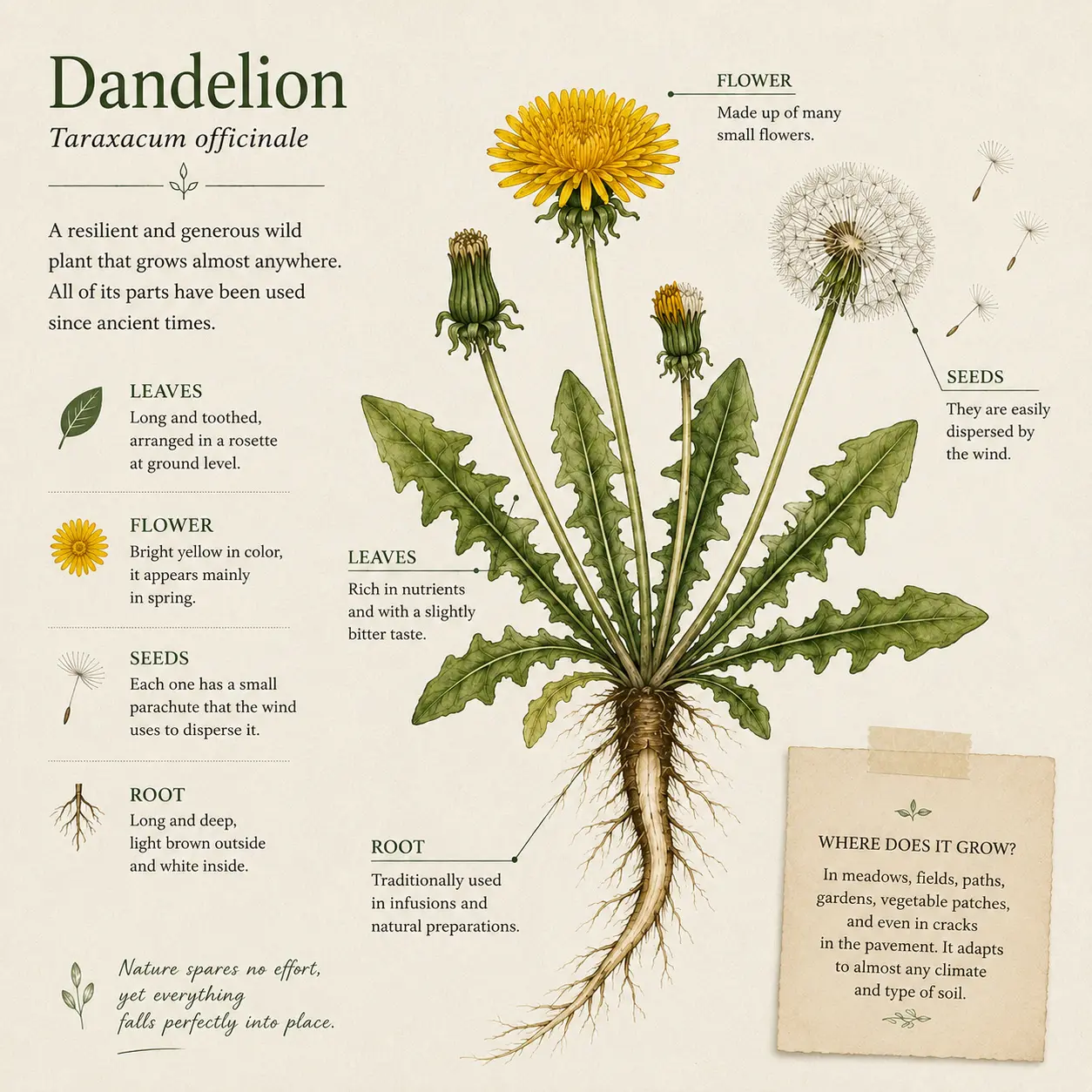
The dandelion (Taraxacum officinaleIt belongs to the Asteraceae family and is one of the most widespread wild plants in the world. It grows spontaneously in meadows, gardens, orchards, and roadsides, and even manages to squeeze through small cracks in the asphalt. This ease of appearing in such diverse places is one of the first clues to its extraordinary adaptability.
Its distinctive yellow flower appears throughout much of spring and summer, but it is probably its subsequent transformation that has remained etched in almost everyone's memory. Over time, the flower gives way to that delicate white sphere made up of countless seeds that many of us blew on as children, watching them scatter on the wind until they disappeared from sight.
Behind that familiar image, however, lies a plant that is much more interesting than its simple appearance might lead us to believe.
Its leaves grow in a rosette very close to the ground, while underground it develops a long, deep root system that allows it to access water and nutrients even when conditions are not particularly favorable. Thanks to this system, it can withstand periods of drought and thrive in places where other species would find it more difficult.
This resilience and adaptability perhaps explains, at least in part, why the dandelion has been so present in human life throughout history. It didn't need specially prepared soil or much care to thrive. Wherever it found a small space and minimal conditions, it also found a way to grow.
Perhaps that's why it's so easy to overlook. We're so used to finding it all around us that we rarely stop to observe it.
But the dandelion has been there for a long time, growing discreetly and taking its place in nature without needing to demand our attention.
An old traveling companion
Long before modern laboratories or scientific treatises on medicinal plants existed, the dandelion already occupied an important place in the daily life of many cultures.
In Europe, its young leaves were traditionally gathered for food, especially at the beginning of spring, when the fields began to awaken after winter. Its characteristic bitter taste, which may seem strange to some palates today, was part of a diet much more closely tied to the seasons and the resources offered by each environment.
Over time, herbalists and apothecaries also began to describe its traditional uses. Gradually, the dandelion found a place within European herbalism and other medicinal traditions, where its leaves, roots, and flowers were used in various ways.
Today we have scientific tools that allow us to study the composition of plants with a precision that those generations could not have imagined. However, it is interesting to note that such a common species has remained linked for centuries to both food and traditional practices related to well-being.
Its story is not that of a rare or hard-to-find plant. Quite the opposite: much of its importance stemmed from its abundance, its ability to adapt, and how easily people could find it in their surroundings.
Much more than a wild plant
After so many centuries of coexistence, it's natural to wonder why the dandelion came to occupy such a prominent place in numerous folk customs. The answer doesn't seem to lie in a single characteristic, but in something much simpler: practically the entire plant could be used.
The leaves, root, and flowers found different uses depending on the region, the time of year, and the customs of each community. In many parts of Europe, for example, the young leaves were harvested in the spring to prepare salads or cooked like any other vegetable. Their slightly bitter taste was not necessarily a drawback; on the contrary, it was one of the characteristics that defined the plant and explained part of its presence in traditional practices.
For generations, that bitterness was associated with foods consumed especially after the winter months. It's important to remember, however, that those interpretations stemmed from traditional knowledge developed long before the existence of modern methods for studying nutrition and human physiology.
The root also came to occupy a special place in the diet. Once dried and roasted, it could be used to prepare a dark, aromatic beverage that at certain times served as an alternative to coffee, especially when coffee was expensive or difficult to obtain. The flowers, meanwhile, were incorporated into various traditional culinary preparations, from drinks and syrups to recipes that still survive today or are being revived by those interested in cooking with wild plants.
Thus, what at first glance might seem like just a small plant growing in any corner ended up becoming part of the diet and customs of different generations. And to better understand why it sparked so much interest, we have to look beyond its history and ask ourselves what it truly contains.
What does a dandelion actually contain?
When we see a dandelion growing by a roadside, it's hard to imagine the complexity hidden within such a seemingly simple plant. Like any plant organism, it produces numerous compounds that play a role in its growth, protection, and ability to adapt to its environment.
Among its components are vitamins and minerals, although their quantity and nutritional relevance depend on the part of the plant consumed and the amount ingested. The leaves, for example, provide various micronutrients, including vitamins A, C, and K, as well as minerals such as potassium, calcium, and iron.
The root has a different composition and contains, among other components,inulin, a type of soluble fiber that can be used as a substrate by certain bacteria in the gut microbiota. This compound also occurs naturally in other vegetables and has sparked considerable interest in the study of the relationship between diet and microbiota.
The dandelion also contains different phenolic compounds and flavonoids, substances naturally present in numerous fruits, vegetables and plants and which are the subject of research, among other reasons, for their antioxidant activity.
These are joined by thesesquiterpene lactonesa group of plant compounds closely related to the dandelion's characteristic bitter taste. This bitterness, which for generations formed part of its culinary identity, therefore has an explanation that we can now begin to understand through the plant's own chemistry.
Knowing these components doesn't automatically mean attributing specific medicinal properties to dandelion. The presence of a substance in a plant and its potential effect on the body are two different things. To understand which benefits are truly supported by scientific evidence, we must go a step further and analyze what research has discovered about it.
Although some of these names may seem complex, the idea behind them is quite simple. Plants have spent millions of years developing substances that allow them to protect themselves, adapt, and survive in very different environments. We, much later, have learned to identify and analyze them, and try to understand what function they perform and what benefits they may have for our health.
What science says
Tradition tells us of a plant that has been prized and used for generations. Science, however, attempts to answer a different question: what do we really know today about the dandelion?
Over the past few decades, numerous studies have been conducted on the plant and some of its compounds. Laboratory research and studies in animal models have explored, among other aspects, its antioxidant activity, its possible relationship with certain inflammatory processes, and the characteristics of some of its bioactive compounds.
The picture is more limited when we look for evidence obtained directly from humans. Although clinical research exists, it is still relatively scarce, and for many of the effects traditionally attributed to dandelion, larger and more rigorous studies are needed before firm conclusions can be drawn.
This distinction is important. A long history of traditional use can offer interesting information and serve as a starting point for research, but it does not, on its own, prove that a plant is effective in preventing or treating certain diseases.
This is precisely where one of the virtues of science lies: observing what we have learned through experience, formulating questions, and putting those ideas to the test. Some will find support, and others will need to be revised or discarded. Respecting nature also means respecting the limits of what we know about it.
How it is usually used
One of the reasons the dandelion has been used by humans for so long is its versatility. Different parts of the plant can be used in various ways, both in traditional cooking and in certain herbal preparations.
The young leaves can be eaten fresh in salads or cooked as a vegetable. The roots have traditionally been used dried to make infusions and, when roasted, to prepare strong-flavored drinks that at times served as an alternative to coffee. The flowers have also found their place in various artisanal recipes, including syrups, preserves, and other culinary preparations.
Currently, we can also find extracts and dietary supplements made with different parts of the dandelion. In these cases, it's important to distinguish between occasionally consuming the plant as food and using concentrated preparations, whose composition and quantity of active ingredients can be very different.
Dietary supplements are not a substitute for a balanced diet and should not be used to treat illnesses without proper guidance. Incorporating plants into our lives can be done in many ways, and the most concentrated preparation is not always the most appropriate.
A plant that barely needs help
If one had to choose a characteristic that particularly defines the dandelion, it would probably be its extraordinary ability to adapt.
It can grow in very different soils and withstand conditions that are not always favorable for other plants. Its deep root system allows it to explore layers of the soil in search of water and nutrients, while its low-lying growth habit helps it to establish itself even in places subject to some environmental pressure.
But perhaps its most recognizable strategy appears when flowering ends. The characteristic white sphere that replaces the yellow flower is made up of numerous seeds, designed to take advantage of air movement. A slight breeze can be enough to carry them away from the original plant and thus begin a new generation.
Behind an image that we have all known since childhood, there is, therefore, an extraordinarily effective survival strategy.
A plant full of little stories
The dandelion isn't known for having the largest flowers or growing in particularly exotic locations. However, few wild plants have managed to occupy such a recognizable place in our collective memory.
It's hard to look at one of its seed spheres without remembering the almost instinctive gesture of bringing it to your lips and blowing on it. Many of us did this as children, making a wish and watching dozens of tiny white dots slowly disappear, carried away by the wind.
That simple gesture has fueled countless stories and folk traditions. In various places, the dandelion became symbolically associated with wishes, hope, change, and new beginnings. These are cultural interpretations, of course, but they also reveal something interesting about our relationship with nature: for centuries we have used what we observe in it to express ideas and emotions that are difficult to explain otherwise.
And what we observed as children also has a fascinating botanical explanation. Each seed possesses a lightweight structure known as a pappus, formed by extremely fine filaments that interact with the air and facilitate its dispersal. Thanks to this, a tiny seed can travel a considerable distance from the parent plant before returning to the soil.
Many will not find a suitable place to germinate. Others will. This enormous capacity to disperse is precisely one of the reasons why the dandelion has managed to spread and colonize such different environments.
Perhaps that's why that white sphere we blew on without thinking was much more than a children's game. We were unknowingly witnessing one of the strategies that allows life to continue searching for new places to begin.
A refuge for life
Although it is often considered a weed in gardens and crops, the dandelion is also part of the ecosystems in which it grows and is related to numerous species.
Their flowers can provide nectar and pollen to various insects, including bees and other pollinators. Their presence can be particularly beneficial during certain times of the season when other flowers are less available, although their importance will always depend on the ecosystem and the other plant species present.
Something else happens underground that we don't usually see. Its taproot penetrates deep into the ground and helps to physically modify the soil as the plant grows. When it finally dies and decomposes, that plant matter is reintegrated into the ecosystem and participates, as with so many other species, in the natural cycles of nutrients.
Sometimes we observe plants solely from the perspective of what they can offer us. However, no species exists in isolation. Each one participates in a much broader network of relationships among plants, animals, microorganisms, soil, water, and climate.
Understanding that network also changes the way we look at a small yellow flower that appears by the roadside.

Use responsibly
Just because a plant is natural does not mean it can be used in any way or that it is free of potential adverse effects.
Dandelion has been part of the diet and various traditional practices for generations, but that does not eliminate the need to act with caution, especially when we talk about extracts, concentrated preparations or food supplements.
People sensitive to plants belonging to the Asteraceae family may experience allergic reactions. Furthermore, certain components of the plant may be unsuitable in some circumstances or interact with certain medications. For this reason, those with any medical condition, undergoing drug treatment, pregnant, or who have any doubts about its use should consult a healthcare professional before using concentrated preparations.
There's another important precaution when it comes to wild plants: knowing exactly what you're picking and where it grew. A plant found by a roadside, in herbicide-treated soil, or in a polluted area shouldn't become an ingredient in your next salad just because you can recognize it.
Approaching nature responsibly involves understanding both its potential and its limitations. In this case, knowledge is also a form of care.
The flower that never needed permission to bloom
After learning about its history, its composition, its uses, and the extraordinary strategy that allows it to survive, perhaps we can look at the dandelion in a different way.
We live in an age where it's easy to wait for perfect conditions before starting anything. We want to feel prepared, have all the resources we need, find the right moment, or receive the approval of those around us. And while we wait, we sometimes forget that much of life happens precisely under imperfect conditions.
The dandelion seems to remind us of this in an extraordinarily simple way. It doesn't choose the garden in which it grows, nor can it know where the seed carried by the wind will end up. It takes advantage of the resources it finds, develops its roots, and, when conditions allow, it blooms.
We don't need to turn a plant into a teacher or look for hidden messages in nature to appreciate the metaphor. We simply need to observe it.
Perhaps growing up isn't always about waiting for the perfect place, but about learning to build something valuable from where we are. Some terrains will be more difficult than others, some moments will be challenging, and some paths won't lead exactly where we imagined.
But none of those things make growth impossible.
That's why, after centuries of considering it food, a traditional remedy, a weed, or simply a flower to play with when we were children, perhaps the dandelion can still give us one last image: that of something small that doesn't need to be extraordinary to find its place.
A simple flower that grows where it can, takes advantage of what it has and, when its time comes, blooms.
🌿 A little self-care for today

The next time you go for a walk, try slowing down a bit. You don't need to seek out spectacular scenery or go far to find nature; often, simply paying attention to those little corners we usually ignore is enough.
You might discover a dandelion between two stones, by the side of a path, or growing somewhere you'd never have thought to plant a flower. If you find one, stop for a few seconds and look at it before moving on.
It may seem like an insignificant gesture, but we live so fast that consciously observing something that has always been in front of us has become almost a small exercise in attention.
Because some of the most interesting things in nature are not found in the tallest trees or the most spectacular flowers.
Sometimes they have been growing up beside us all our lives and we have simply never stopped to really look at them.
🌿 Keep discovering nature
If you enjoyed this story, you’ll find more articles at El Ente Cuida about medicinal plants, simple ways to care for yourself, and everyday habits for a healthier life.
Visit The El Ente Cuida Library
Would you like to join us?
We also share new content several times a week on Instagram, Facebook, Threads, and more.
Follow us at @elentecuida






