
The $55 Anomaly: Assessing Litecoin Intrinsic Value and its 2026 Scalability Roadmap

Infrastructure Integrity — Network Resilience and Monetary Structure
Litecoin (LTC) represents one of the longest continuously operating proof-of-work monetary networks in the digital asset sector. Since its launch in 2011, the protocol has maintained an uninterrupted operational history approaching 15 years of network uptime, a metric that institutional risk models interpret as a proxy for infrastructure reliability and systemic durability.
At the core of this resilience is the Scrypt hashing algorithm, which was intentionally selected to optimize transaction confirmation efficiency while preserving proof-of-work security guarantees. Over time, the network has demonstrated sustained hashrate stability, indicating persistent miner participation and economic alignment with the protocol.
Litecoin as a Hard Money Asset
From a monetary engineering perspective, Litecoin exhibits the defining characteristics of a hard money system:
-
Fixed Maximum Supply: 84 million LTC
-
Deterministic Issuance Schedule: Block subsidy halving approximately every 4 years
-
Decentralized Validation: Distributed mining consensus
-
Predictable Monetary Policy: No discretionary supply expansion
These properties position litecoin as a neutral settlement asset within the emerging global liquidity layer, particularly for cross-border transfers and exchange infrastructure routing.
Infrastructure-Level Strength Indicators
Key indicators commonly referenced in quantitative network assessments include:
-
Network Resilience — sustained operational continuity under market stress
-
Consensus Stability — predictable block production intervals
-
Security Budget — aggregate mining expenditure securing the chain
-
Liquidity Integration — widespread exchange and payment processor support
Collectively, these variables define the structural integrity of a base-layer financial network.
Valuation Inefficiency — The Core Thesis Behind the $55 Price Level
The central thesis of the $55 Anomaly is that Litecoin’s market price reflects a measurable market inefficiency, where valuation has not fully converged with observable network fundamentals.
In classical financial modeling, this phenomenon is associated with mean reversion dynamics, where asset prices eventually realign with intrinsic utility after periods of sentiment-driven divergence.
Fundamental Metrics Driving the Thesis
A quantitative valuation framework for a payment-oriented blockchain typically evaluates:
Network Hashrate
Represents the total computational power securing the network.
Implications:
-
Higher hashrate increases attack cost
-
Sustained growth indicates miner confidence
-
Stability reflects economic equilibrium
Daily Active Addresses
Serves as a proxy for real network usage.
Implications:
-
Measures transactional participation
-
Indicates user engagement density
-
Correlates with demand for settlement capacity
Transaction Volume
Captures value transferred across the network.
Implications:
-
Reflects liquidity velocity
-
Indicates operational relevance
-
Demonstrates settlement utility
When these indicators remain stable or expand while price stagnates, the result is a classic valuation compression event.
Comparative Market Observation
A recurring pattern in digital asset markets involves:
-
High market capitalization tokens with limited throughput
-
Low transaction utilization relative to valuation
-
Narrative-driven price expansion
In contrast, Litecoin demonstrates:
-
Sustained transaction throughput
-
Persistent network activity
-
Established liquidity depth
This divergence supports the hypothesis that the current valuation environment represents a structural mispricing, not a decline in network capability.
Mean Reversion Framework
Under standard financial theory:
Intrinsic Value Growth > Market Price Growth
→ Probability of Mean Reversion Increases
The $55 price level, within this framework, may represent:
A temporary discount to infrastructure value rather than a reflection of declining network relevance.
The MWEB Privacy Standard — Advancing Fungibility and Transaction Confidentiality
The implementation of MimbleWimble Extension Blocks (MWEB) represents a significant architectural evolution in Litecoin’s protocol design. Rather than replacing the base chain, MWEB operates as an opt-in extension that enhances privacy while preserving compatibility with existing infrastructure.
Technical Characteristics of MWEB
Confidential Transaction Amounts
-
Obscures transferred value on-chain
-
Reduces forensic traceability
Improved Fungibility
-
Ensures all units of LTC remain economically interchangeable
-
Prevents discrimination based on transaction history
Blockchain Efficiency
-
Compresses transaction data
-
Reduces storage overhead
-
Enhances scalability potential
Institutional Relevance
For financial entities operating in regulated environments, transaction confidentiality is not a convenience—it is an operational requirement.
MWEB addresses three institutional constraints:
-
Privacy Protection — safeguarding transactional relationships
-
Data Minimization — reducing unnecessary disclosure
-
Operational Scalability — maintaining throughput efficiency
In this context, MWEB positions Litecoin as a privacy-capable settlement layer without compromising network transparency for standard transactions.
Yield Maximization & Accumulation — The Systematic Accumulation Model
Long-term digital asset growth is typically driven by consistent capital deployment rather than intermittent speculation. This principle forms the foundation of Systematic Accumulation, a strategy that leverages network efficiency to optimize portfolio compounding.
Structural Advantages of Low-Fee Networks
Lit coin fee architecture enables frequent asset movement without significant cost friction.
Operational benefits include:
-
Efficient portfolio rebalancing
-
Low-cost liquidity transfers
-
Rapid redeployment into yield environments
Systematic Accumulation Workflow
A disciplined accumulation protocol generally follows a repeatable cycle:
1 — Acquire or Receive LTC
Sources may include:
-
Direct purchase
-
Transactional payments
-
Micro-incentive rewards
2 — Transfer to Yield-Bearing Environments
Examples include:
-
Flexible interest accounts
-
Automated savings protocols
-
Reward-based participation systems
3 — Reinvest Earnings
This establishes a compounding growth loop.
Compounding Mechanics
Portfolio expansion over time is governed by:
Consistency × Duration × Reinvestment Rate
Not:
Market Timing × Price Volatility
Role of Total Value Locked (TVL)
In yield-oriented environments, Total Value Locked (TVL) serves as a key risk indicator.
Higher TVL generally reflects:
-
User confidence
-
Platform liquidity capacity
-
Operational sustainability
Monitoring TVL trends is therefore essential in evaluating long-term yield reliability.
Strategic Risk Assessment — Identifying Verified Participation Channels
The digital asset sector contains both legitimate infrastructure-backed services and high-risk speculative schemes. Differentiating between the two requires systematic due diligence rather than intuition.
Characteristics of Infrastructure-Backed Reward Systems
A credible platform typically demonstrates:
-
Transparent operational model
-
Consistent withdrawal functionality
-
Documented security practices
-
Sustainable yield structure
-
Verifiable liquidity reserves
Warning Indicators of High-Risk Cloud Mining Schemes
Common risk signals include:
-
Guaranteed fixed daily returns
-
Unverifiable mining hardware claims
-
Withdrawal restrictions or delays
-
Excessive referral dependency
-
Unrealistic profitability projections
Verified Participation Checklist
Before committing capital or time, participants should confirm:
-
Platform operational history exceeds multiple market cycles
-
Withdrawal process is reliable and timely
-
Revenue model is clearly defined
-
Security controls are documented
-
User funds remain accessible without lock-in penalties
This framework reduces exposure to operational risk while preserving participation flexibility.
Closing Analysis — The Structural Case for Litecoin
Litecoin occupies a distinct position within the digital asset ecosystem:
It is simultaneously:
-
Mature
-
Liquid
-
Scalable
-
Operationally resilient
While market attention frequently rotates toward emerging narratives, infrastructure networks continue to process transactions, secure value, and maintain liquidity continuity.
In quantitative finance, assets with sustained utility and compressed valuation often exhibit mean reversion behavior once sentiment cycles normalize.
The $55 Anomaly should therefore be interpreted not as a signal of weakness, but as a potential indicator of temporary market inefficiency relative to long-term network fundamentals.
Implementation Pathway — Deploying the Accumulation Protocol
For participants seeking structured exposure to Litecoin within a disciplined framework, the recommended approach is systematic accumulation combined with controlled yield optimization.
Execution typically involves:
-
Establishing a recurring acquisition schedule
-
Maintaining secure custody practices
-
Monitoring network-level indicators
-
Reinvesting incremental returns
To implement this structured accumulation model and participate in automated reward workflows aligned with Litecoin’s low-fee infrastructure, access can be initiated through the specialized entry point below:
LTS
This pathway serves as an operational gateway for individuals implementing a disciplined Litecoin accumulation strategy within a measurable risk-management framework.
Implementation Protocol: Activating the Systematic Accumulation Strategy
Based on the investment thesis outlined above, efficient digital asset management requires minimizing operational friction while maximizing yield. To participate in the Litecoin micro-accumulation protocol, you may utilize the following operational gateway which provides strategic advantages for participants:
-
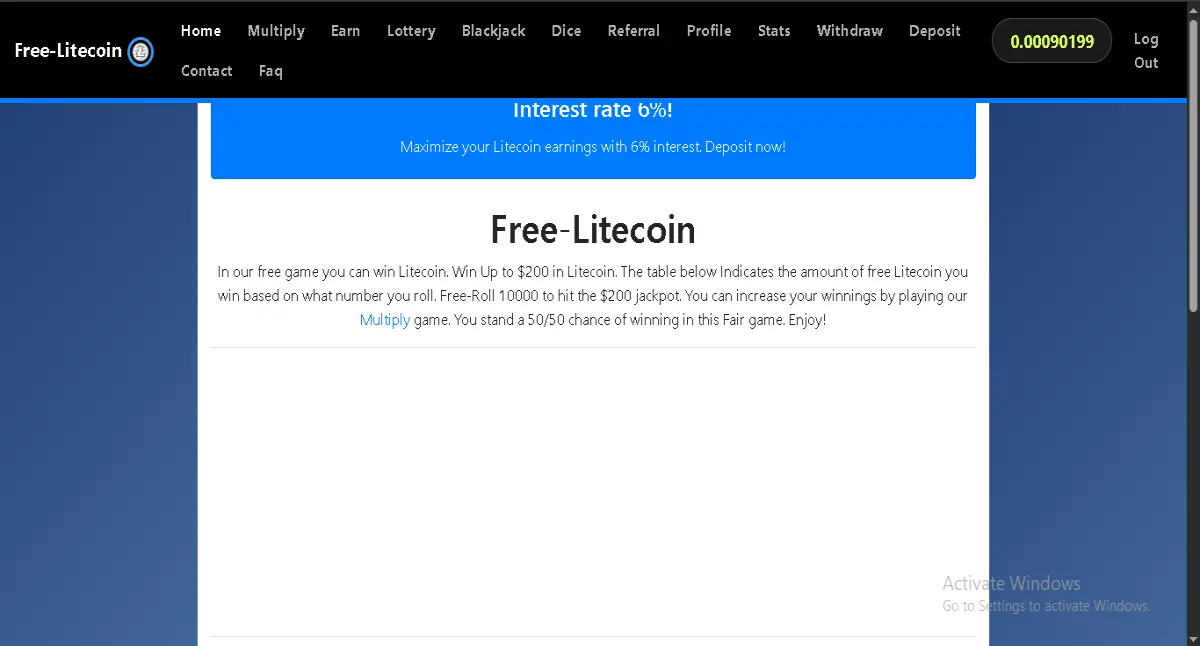
Compounding Yield Generation (Interest): As demonstrated in the platform's technical framework, the system provides an annual interest rate of 6%. This is automatically activated once the minimum balance threshold is met, converting static assets into yield-producing units.
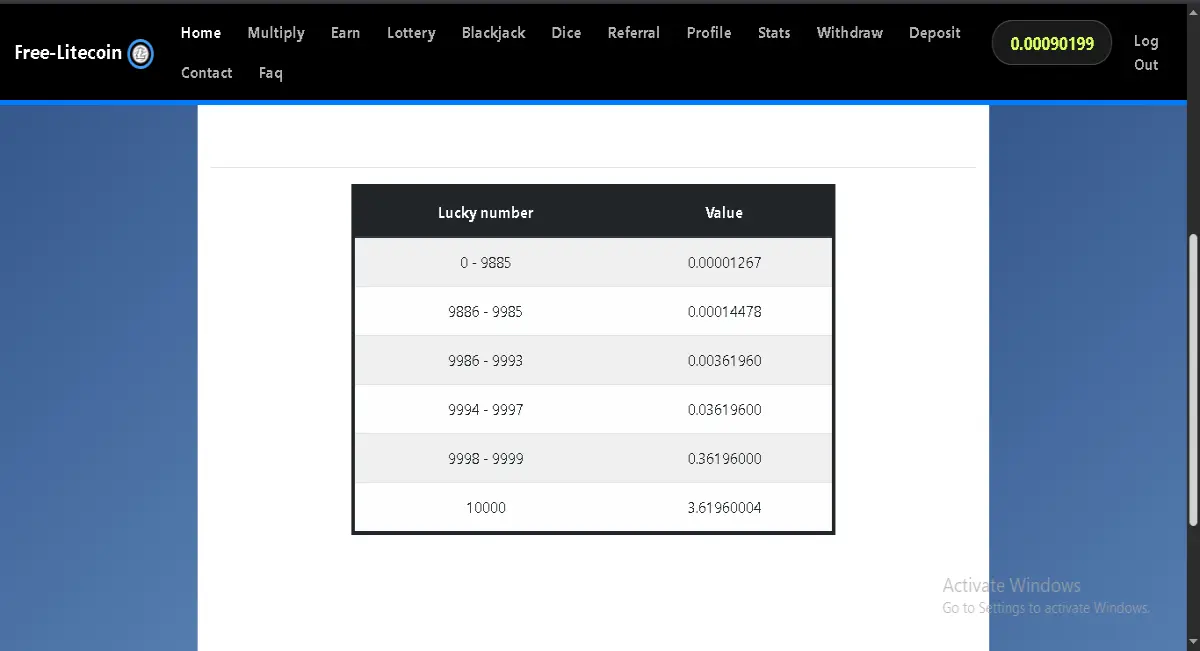
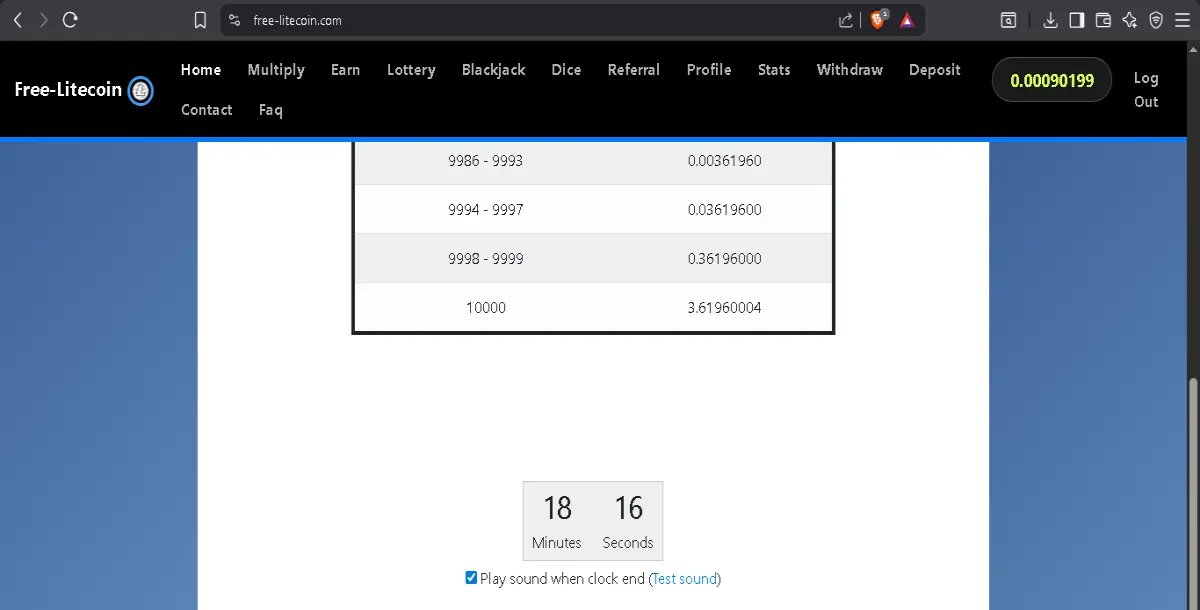
- Micro-Distribution Mechanism (Free-Roll): The platform facilitates periodic LTC acquisitions based on a lucky number algorithm. These rewards scale according to the distribution table, allowing for incremental balance growth directly within your accumulation ledger.
-
Network Growth Factor (Referral): The protocol incorporates a 25% commission incentive derived from referral earnings. This functions as a structural catalyst for portfolio expansion without requiring additional capital expenditure.






