

Most traders obsess over direction.
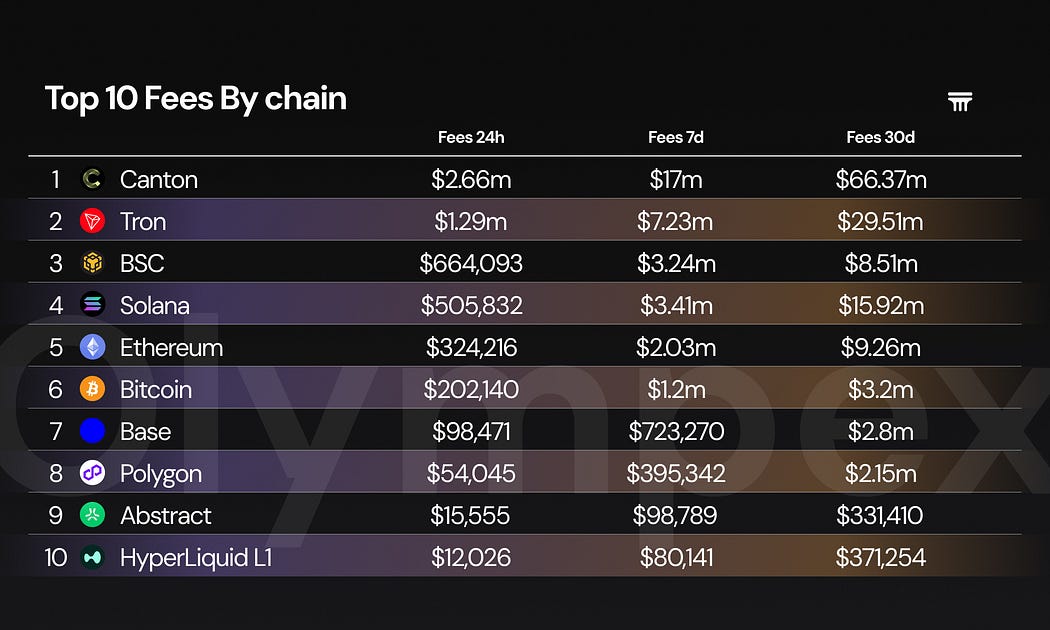
They debate narratives, entries, macro headlines, and whether the next candle confirms their genius or exposes it. But a lot of PnL does not die because the market thesis was wrong. It dies in the plumbing. A trade can be directionally correct and still underperform because value leaks through slippage, fees, poor routing, and weak execution. Onchain, that problem becomes even more obvious because liquidity is fragmented across pools, protocols, and chains.
Slippage, fees, and bad execution are not the same thing
These costs usually get thrown into the same bucket, which is exactly why traders underestimate them.
Slippage is the difference between the price you expected and the price you actually got. Fees are the explicit costs you pay to trade, swap, bridge, or settle. Bad execution is broader. It is what happens when the route itself is inefficient, when the pool is too thin, when your order size is wrong for the available liquidity, or when you take a trade through a venue that was never offering the best path in the first place. Bid ask spread, pool depth, and route quality all matter.
On large CEX pairs, deep order books can reduce price impact. But that convenience comes with custody, venue risk, and opaque internal execution logic. On DEXs, you keep self custody and transparent settlement, which is the better architecture if you actually care about control. The tradeoff is that execution quality depends far more on liquidity conditions, especially when you move beyond majors and into long tail assets. Liquidity pools are the engine of most DEX trading, and thin pools are where slippage starts acting like a tax on bad execution. CEX vs DEX is not just a beginner debate. It is a market structure debate.
Press enter or click to view image in full size
The costs traders ignore because they look small
This is where the leakage becomes dangerous.
A trader sees 0.5% here, 0.8% there, maybe a bit of gas, maybe a bridge fee, maybe one failed transaction that cost “almost nothing,” and mentally files it under irrelevant. But repeated over dozens of trades, those “small” losses compound into a serious drag on performance. This gets worse with smaller cap or newly launched tokens, where lower liquidity can make execution materially worse even if the directional call ends up being right. CoinMarketCap’s own liquidity materials are blunt about this, low liquidity usually means more slippage and worse fills.
That means a strategy does not need to be bad to produce bad results. It only needs to be leaky.
Good trade, bad result
Imagine you buy ETH against USDC after a clean reclaim. Your read is correct. Price moves 6% in your favor.
Looks great on paper.
Now reality. You entered through a shallow route and lost 1.2% in slippage and spread. You paid swap costs and gas on the way in. On exit, volatility widened the gap again. Then you bridged funds back across networks because the next setup was elsewhere. Your “good trade” finished with a result that feels mediocre, not because your market read failed, but because your execution stack quietly shaved the trade on every step.
Now make it worse. Replace ETH with a fresh, low float token that has hype but inconsistent depth. You can be early, right, and still get punished because there simply is not enough liquidity to absorb your order cleanly. In DeFi, that is not rare. It is structural.
Why this happens more often in DeFi
Because DeFi is powerful, but fragmented.
The same swap can have different depth, fees, and price impact depending on the pool, the DEX, the chain, and the route used to execute it. That is exactly why DEX aggregators exist. Their job is not to perform a miracle. Their job is to search across multiple liquidity sources and find the most efficient route for execution. Chainlink defines a DEX aggregator as a protocol that pools liquidity from multiple exchanges to provide the best possible trade execution, while 1inch describes its Pathfinder engine as a routing system that splits and optimizes paths across various DEXs to improve swap outcomes.
That is the lens through which Olympex should be understood.
Olympex is not trying to reinvent the market. It is trying to reduce execution waste inside it. Its aggregation layer compares liquidity across integrated DEXs and networks in real time, then optimizes for the best available route and quote before execution. In other words, the value is not “cheap because yes.” The value is better execution quality through smarter route discovery across fragmented onchain liquidity. That matters because in DeFi, the route is often half the trade.
How to reduce losses without changing your strategy
You do not always need a new system. Sometimes you need less friction.
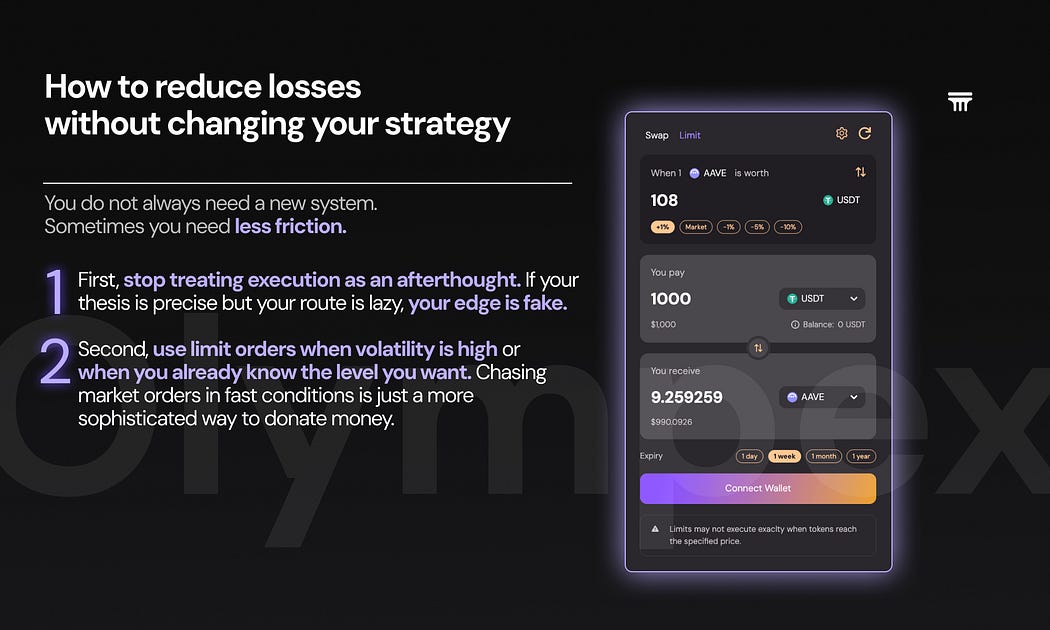
First, stop treating execution as an afterthought. If your thesis is precise but your route is lazy, your edge is fake.
Second, use limit orders when volatility is high or when you already know the level you want. Chasing market orders in fast conditions is just a more sophisticated way to donate money.
Press enter or click to view image in full size
Third, respect liquidity. If the token is thin, your size should know it. Large size in shallow pools is not conviction. It is a self inflicted slip.
Fourth, stop blindly widening slippage tolerance every time a swap struggles. Sometimes that does not solve the problem. It just gives the market permission to fill you worse. Even Uniswap’s own guidance frames slippage tolerance as something to manage carefully, not something to keep cranking upward because you are impatient. Slippage tolerance is a tool, not a coping mechanism.
Fifth, use aggregators and automation where they actually improve execution. If your strategy already works, then the next layer of improvement is reducing how much value evaporates between click and confirmation. Olympex’s edge fits there, in DEX aggregation, cross chain access, limit orders, and systematic tools like DCA, all designed to make execution less dumb.
Final thought
A lot of traders are not losing because they cannot read the market. They are losing because they keep bleeding through invisible friction and calling it bad luck.
In crypto, especially in DeFi, the market does not only test your direction. It tests your execution. And if your execution is sloppy, even a good idea can come home ugly.
You are not always losing money.
Sometimes you are just leaking it.





