
Trading Is a Game of Probabilities: The Numbers Every Trader Should Know
Most traders enter the market asking the wrong question.
They ask: “Will this trade work?”
Professional traders ask: “What is the probability, what is the risk, and is the reward worth it?”
That shift changes everything. Trading is not about certainty. It is about stacking small statistical advantages over time. A support level does not guarantee a bounce. A resistance level does not guarantee rejection. A breakout does not guarantee continuation. But each setup has a probability profile, and when traders understand those probabilities, they stop reacting emotionally and start operating like risk managers.
For Olympex, this is the key message: better infrastructure matters because better execution allows traders to act on probability, not emotion.
Support and Resistance Are Not Magic. They Are Probability Zones
Support and resistance work because markets are driven by positioning, liquidity, memory, and psychology. When many traders see the same level, orders tend to cluster around it. That creates a zone where price may react.
Empirical research on support and resistance found that price has a higher probability of bouncing at discovered support and resistance levels than in shuffled price series, and that levels with more previous bounces are more likely to bounce again. The same research also found that this effect decays over time, meaning old levels lose strength.
In simple trading language:
A fresh support with multiple reactions is stronger than a random line.
A resistance tested several times is more relevant than a single candle high.
A level from a higher timeframe matters more than a level from a 1 minute chart.
A level loses value if price keeps grinding into it without strong reaction.
Investopedia also notes that support and resistance should be treated as zones, not exact numbers, and that longer timeframe levels tend to be more significant than shorter timeframe levels. (Investopedia)
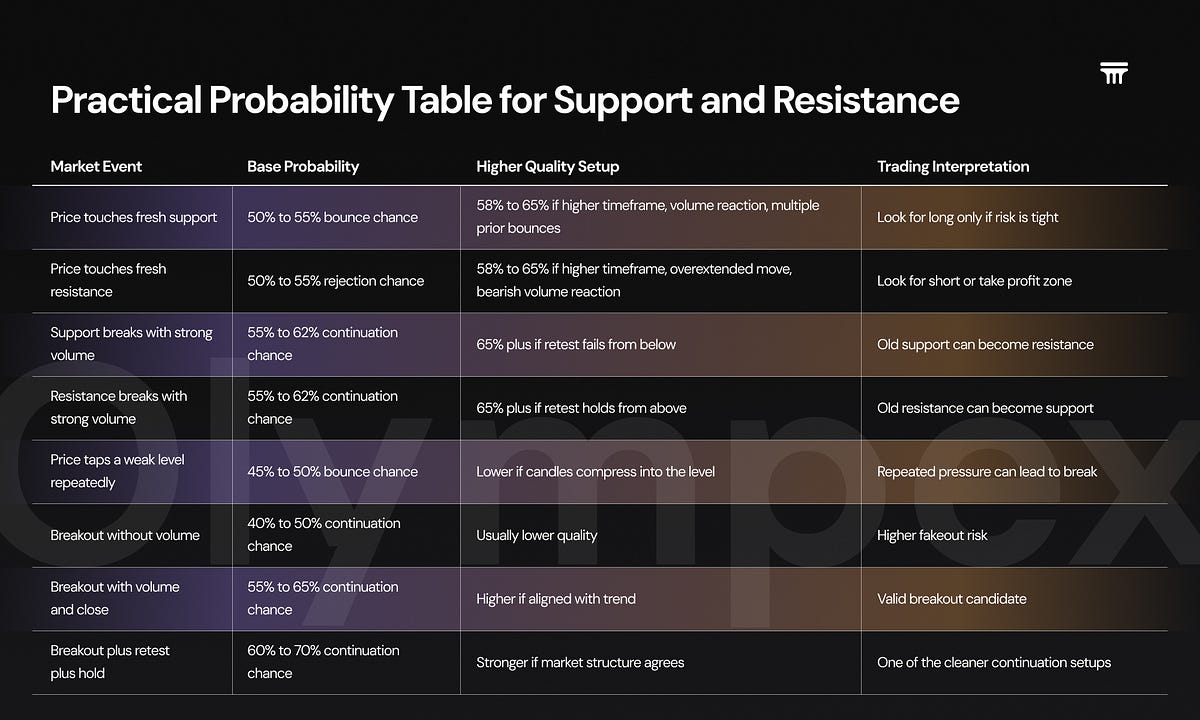
The important part is not the exact number. The important part is the ranking.
A breakout with volume and retest has a better probability than a random breakout.
A support level with reaction and confluence has a better probability than an isolated line.
A level that price keeps attacking loses strength.
Trend Continuation Has Better Odds Than Random Prediction
Markets often trend because information is absorbed gradually. Traders underreact first, then capital flows in later. This is why momentum exists.
A major academic paper on time series momentum found return persistence across equity index, currency, commodity, and bond futures for 58 liquid instruments over 1 to 12 month horizons, with reversal tendencies over longer horizons. (ScienceDirect)
That means the probability of continuation improves when the trader is aligned with the
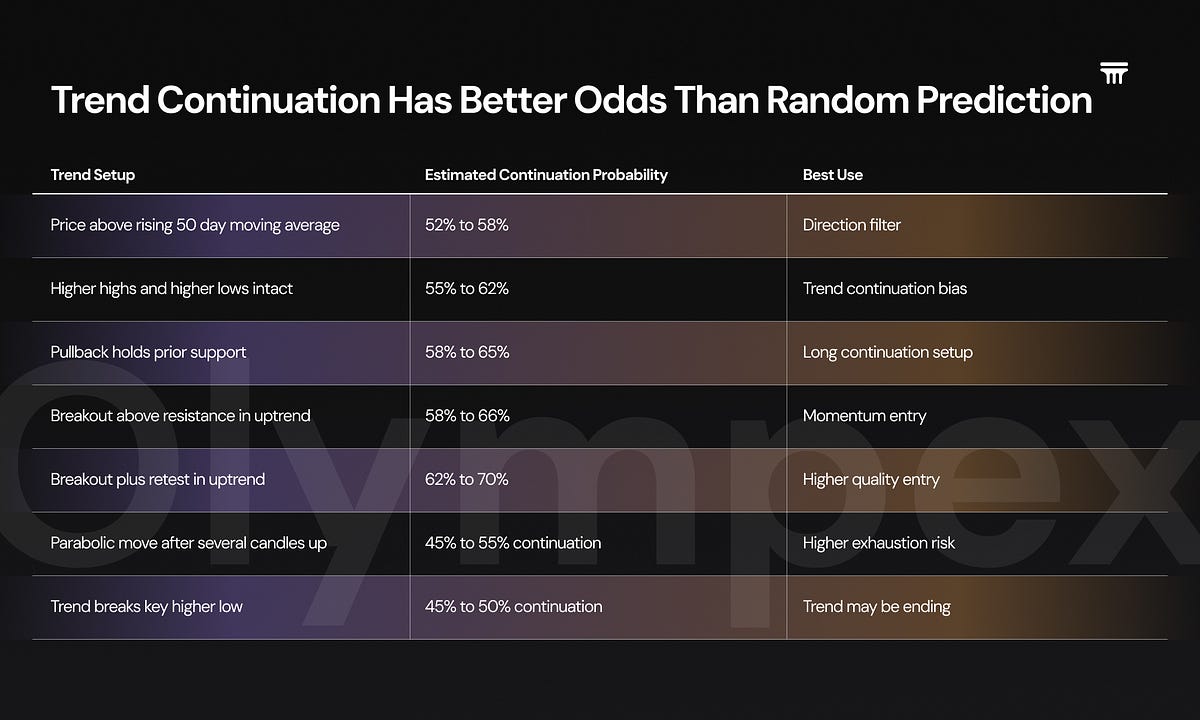
The lesson: trend continuation is not certain, but it often has better odds than trying to catch reversals.
For traders, that means buying strength after a controlled pullback is usually a better probability setup than buying weakness just because price looks cheap.
Crypto Probabilities Are Different From Traditional Markets
Crypto is more reflexive, more volatile, and more liquidity sensitive than traditional markets. That changes the probability map.
Research on crypto markets shows that momentum is an important factor in cryptocurrency returns. Yale research found that crypto market, size, and momentum factors capture cross sectional expected cryptocurrency returns. (Yale Department of Economics) Other research finds that large and liquid coins tend to show weekly momentum, while small and illiquid coins are more prone to short term reversal. (SSRN)
In simple terms:
Large liquid crypto assets can trend better.
Small illiquid coins can reverse faster.
Volume matters more in crypto because liquidity can disappear quickly.
Breakouts without liquidity confirmation are more dangerous.
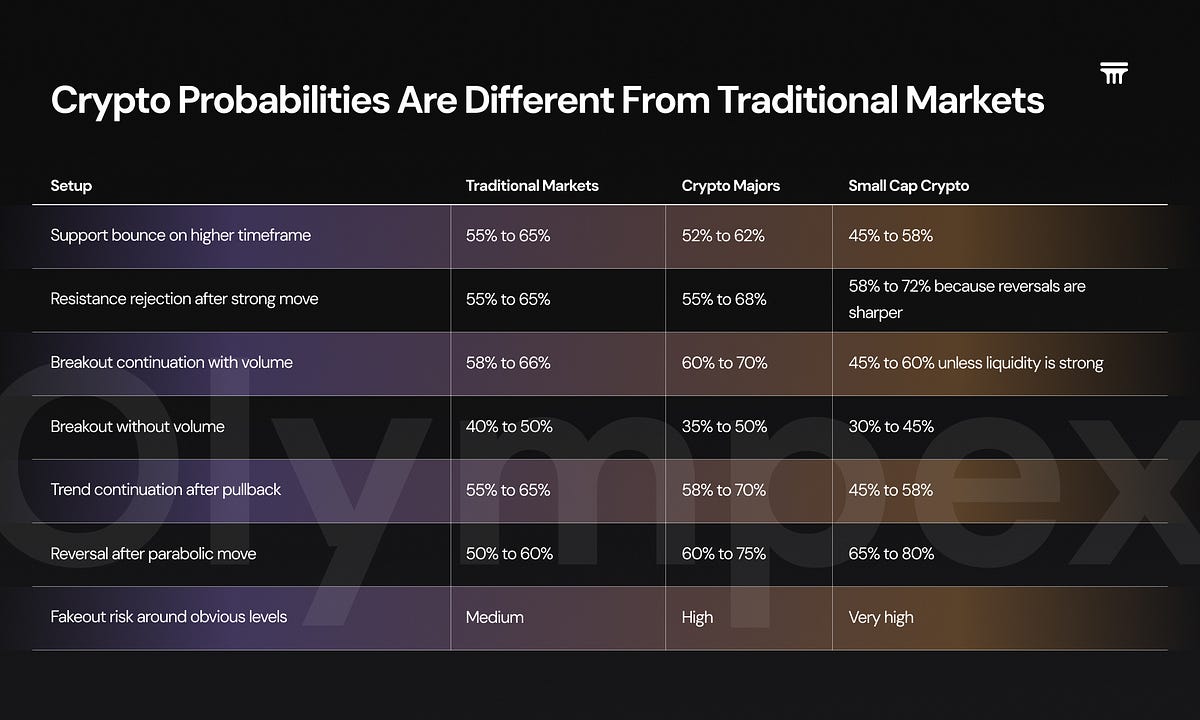
The big difference is liquidity. In traditional markets, large assets usually have deeper order books. In crypto, liquidity fragmentation, funding, leverage, and sentiment can make levels break or reverse much faster.
Probability Alone Is Not Enough. Expected Value Is What Matters
A trader can win only 45% of the time and still make money if the reward is much larger than the risk.
The formula is simple:
Expected Value = Win Probability x Average Win minus Loss Probability x Average Loss
Here is the practical table.
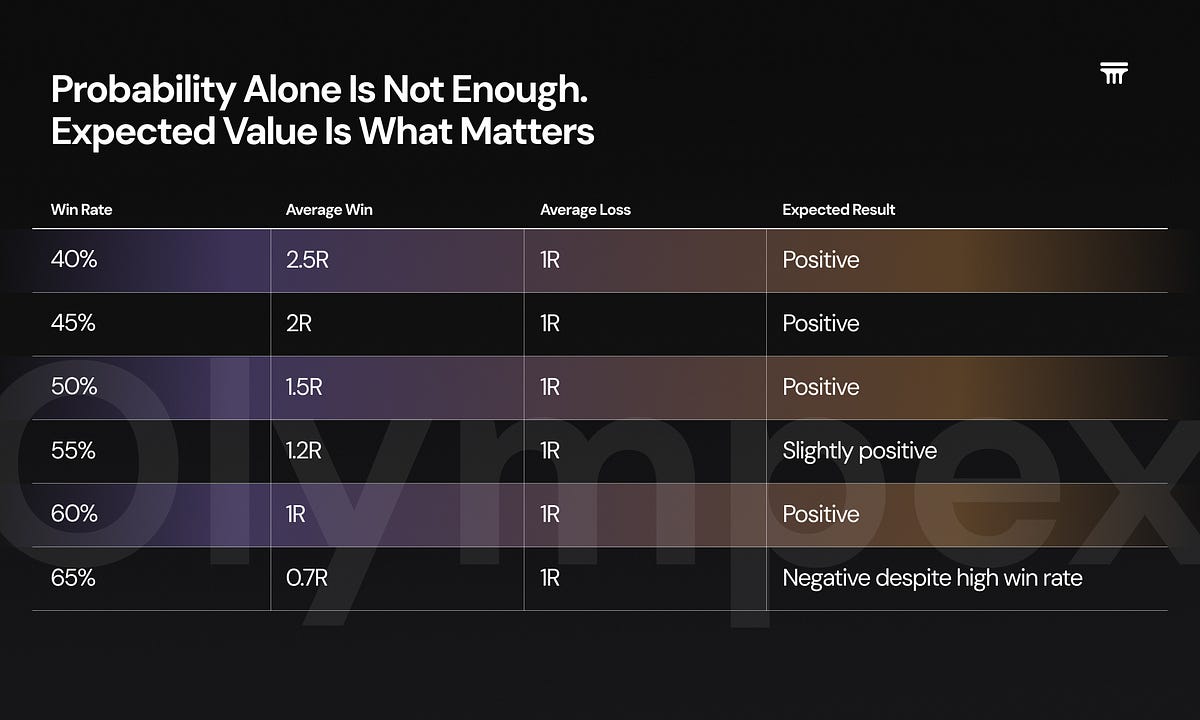
This is why win rate can be misleading.
A trader with a 65% win rate can still lose money if losses are larger than wins.
A trader with a 45% win rate can make money if winners are twice the size of losers.
For Olympex users, the takeaway is simple: the platform should not only help users enter markets. It should help them structure trades where probability and payoff work together.
The Olympex Probability Framework
Before entering a trade, traders can score the setup using five probability filters.
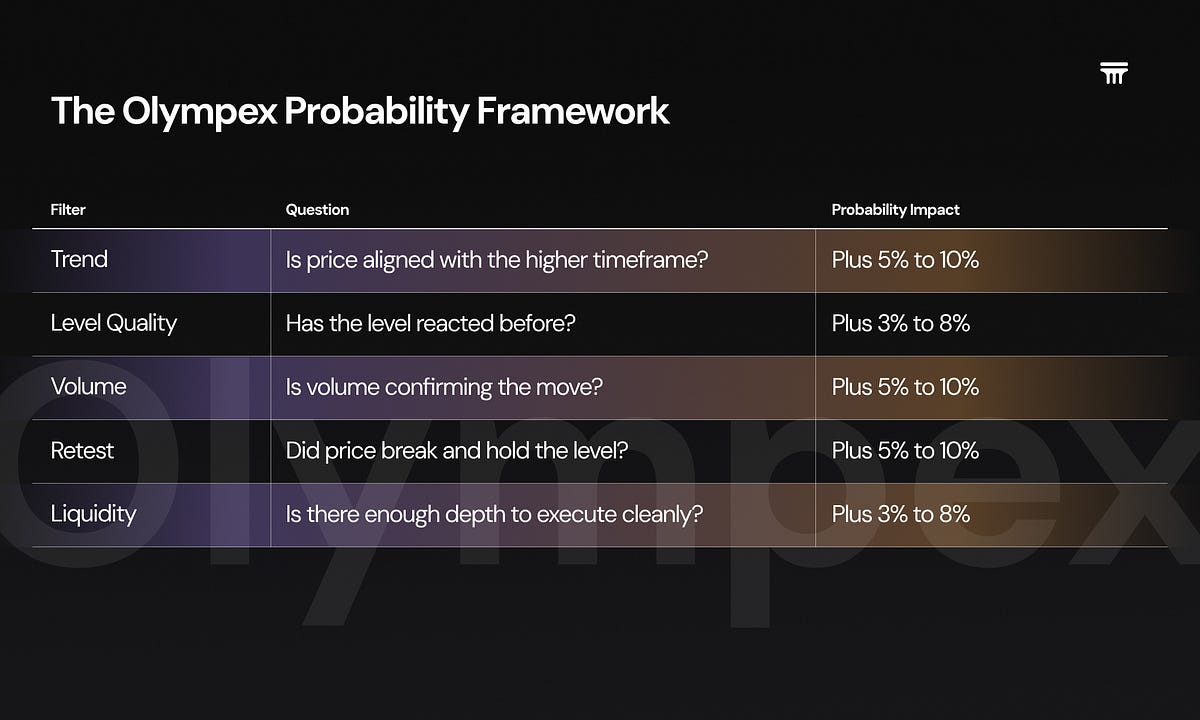
A basic support touch may only be a 52% setup.
But support plus higher timeframe trend, volume reaction, and tight invalidation can become a 60% to 65% quality setup.
That is the difference between guessing and trading.
Practical Trading Rules Based on Probability
Do not trade a support touch blindly. Wait for reaction.
Do not short resistance blindly. Look for rejection, failed breakout, or momentum loss.
Do not chase a breakout without volume. Wait for confirmation.
Do not assume crypto behaves like equities. Liquidity and volatility change the odds.
Do not obsess over win rate. Focus on expected value.
Do not risk the same amount on all setups. Higher probability plus better reward deserves more attention than low probability impulse trades.
Final Takeaway: The Market Does Not Reward Certainty. It Rewards Positive Expected Value.
Trading is not about being right every time.
It is about building a process where the numbers work in your favor.
Support and resistance matter because traders remember levels.
Trends matter because capital flows create persistence.
Volume matters because participation validates movement.
Liquidity matters because execution changes the real result.
For Olympex, this is the core message:
Better trading starts when users stop asking “will this go up?” and start asking “are the probabilities, risk, and reward aligned?”
That is how traders move from emotion to execution.
That is how markets become measurable.
And that is how Olympex helps traders operate with structure instead of impulse.





