
Trading Automation: Without Losing Your Tokens
Introduction
In the fast-paced world of decentralized finance (DeFi), automation has become a critical tool for traders and investors. From auto-compounding vaults to smart order routing, technology allows users to execute strategies with unprecedented efficiency.
However, there’s a fine line between automation that empowers and automation that replaces, often at the cost of transparency, flexibility, and control.
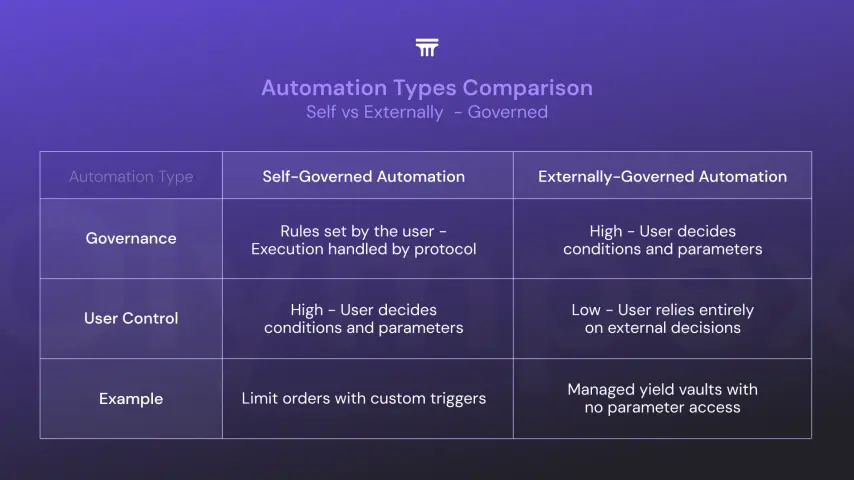
Automation With vs. Without Governance
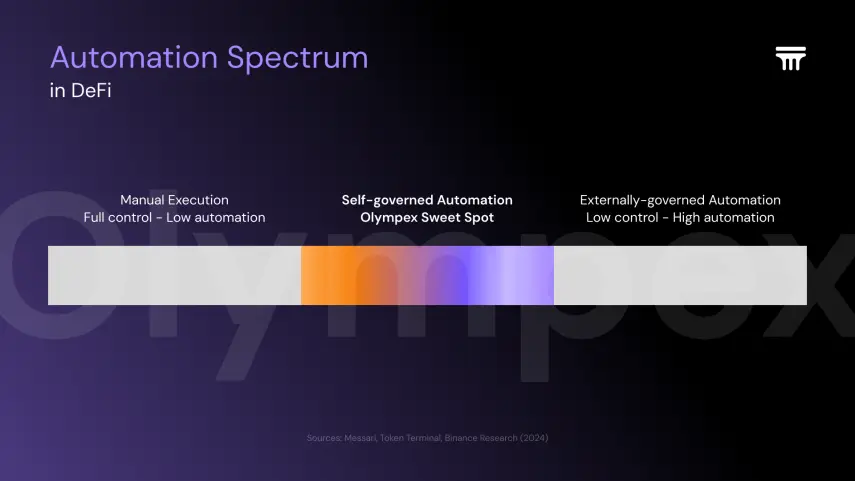
Not all automation is created equal. In DeFi, the governance structure behind a tool often determines whether users maintain control or surrender it entirely.
The Risks of Opaque Vaults and External Bots
While some automation platforms promise high returns, many operate as “black boxes,” giving users little to no visibility into execution logic. Risks include:
- Front-running and poor execution pricing.
- Strategy drift occurs when operators change parameters without notice.
- Security exposure from unverified smart contracts.
Dependence risk: if the operator stops running the strategy, users lose functionality instantly.
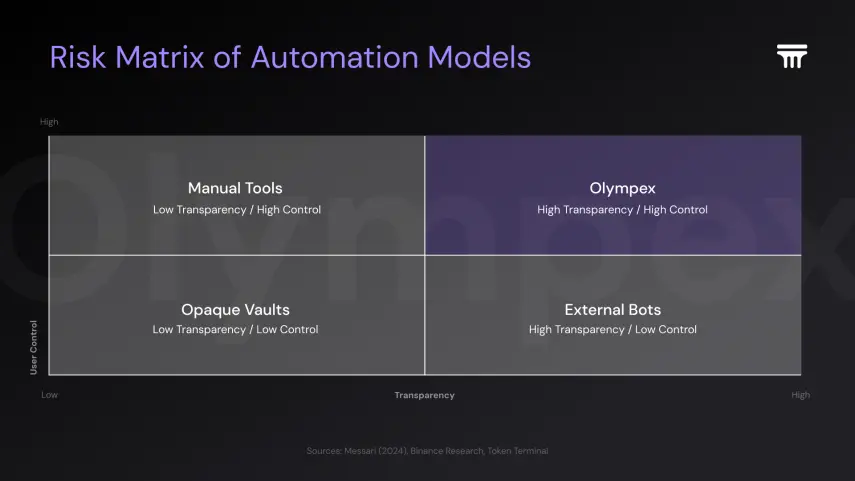
Data Insight: According to Messari and Token Terminal (2024), over 38% of capital locked in opaque DeFi vaults experienced strategy changes without user approval in the last 12 months.
What Is Trading Automation in DeFi?
At its core, trading automation means using algorithms, smart contracts, or bots to execute strategies on your behalf.
- Centralized Automation (CEXs): Uses APIs to connect your account with trading bots. Risks include custodial exposure (funds stored on the exchange) and API key leaks.
- Decentralized Automation (DeFi): Uses non-custodial smart contracts where you maintain control of your assets. Strategies are executed directly on-chain.
Common automation strategies in DeFi include:
- Limit Orders: Pre-set orders that execute only when the market reaches your chosen price.
- Dollar-Cost Averaging (DCA): Automates periodic buys or sells, reducing volatility risk.
- Stop-Loss Orders: Exit positions automatically to cap losses.
- Portfolio Rebalancing: Maintain asset allocations by adjusting holdings regularly.
- Yield Strategies: Automate staking, farming, or compounding rewards across multiple protocols.
In short, trading automation allows you to interact with DeFi markets efficiently and consistently, while freeing you from round-the-clock monitoring.
Why Traders Use Automation
Automation isn’t just about convenience; it solves real problems that every crypto trader faces:
- Markets never close: Unlike stocks or forex, crypto trades 24/7.
- Emotions ruin strategies: Fear and greed often lead to bad timing. Automation removes emotion.
- Manual execution is inefficient: Entering and exiting positions across chains manually is slow and costly.
- Opportunities are fleeting: Some arbitrage or yield opportunities last only minutes. Bots react faster than humans.
For these reasons, professional and retail traders alike increasingly rely on automation to stay competitive in DeFi.
The Hidden Risks of Automated Trading
However, automation also introduces risks that can wipe out your tokens if ignored. Let’s break them down:
1. Smart Contract Risk
Even audited protocols can be exploited. Bugs, faulty logic, or oracle manipulation may result in drained funds. Examples include bZx protocol exploits (2020–2021), where attackers manipulated contract logic to steal millions.
2. Custodial & Permission Risks
If a bot or platform asks for your private key or requires unlimited token approvals, you’re giving them control over your funds. Many rug pulls start with over-permissive contracts.
3. Execution Risk
Automation is only as good as its settings. Common mistakes include:
- Slippage tolerance too high → costly trades.
- Overleveraging → liquidation risk.
- Poor liquidity → low fill rates or failed orders.
4. Market Risk
No algorithm can eliminate volatility. Sudden crashes (e.g., March 2020 “Black Thursday”) caused massive losses even for automated systems, especially those without stop-loss logic.
5. User Overconfidence
Perhaps the most overlooked risk: assuming automation = guaranteed profits. Many traders forget that automation amplifies both good and bad strategies.
How to Automate Without Losing Your Tokens
To use trading automation safely, follow these best practices:
- ✅ Use non-custodial tools — Platforms should never ask for your keys. Stick to smart contracts where you retain custody.
- ✅ Check permissions — Avoid granting unlimited token approvals. Revoke unused permissions regularly (e.g., via revoke.cash).
- ✅ Start small — Test strategies with small amounts before committing serious capital.
- ✅ Set conservative parameters — Reasonable slippage tolerance, modest leverage, and clear stop-loss levels.
- ✅ Diversify tools — Don’t rely on a single bot or strategy. Spread exposure.
- ✅ Stay informed — Follow protocol updates and security audits. Outdated contracts may expose you to risks.
- ✅ Monitor activity — Automation is not “set and forget.” Check dashboards and logs to confirm performance.
By following these steps, you drastically reduce the chance of losing tokens to automation mishaps.
Safer Automation Strategies in DeFi
Not all automation is high-risk. Some strategies are relatively safe when executed correctly:
Limit Orders
- Execute at your target price without chasing the market.
- Advanced protocols add MEV protection and batch settlement to prevent front-running.
Dollar-Cost Averaging (DCA)
- Reduces the impact of volatility.
- Works well for long-term investors looking to build or exit positions gradually.
Portfolio Rebalancing
- Keeps your asset mix aligned with your goals.
- Example: 60% ETH / 40% stablecoins, automatically adjusted as prices shift.
Staking & Yield Compounding
- Automates reward collection and reinvestment.
- Risks exist (inflation, smart contract exploits), but compounding boosts long-term yield.
These strategies focus on discipline and efficiency rather than aggressive speculation.
Real-World Example: Limit Orders Done Right
Limit orders are one of the most common automation tools, but in DeFi they’re notoriously tricky. Many protocols suffer from:
- Front-running by MEV bots
- Low fill rates
- Poor user interfaces
A robust limit order system should include:
- Private transaction paths to prevent front-running.
- Liquidity integration to maximize execution.
- Transparent dashboards showing fill probabilities.
By choosing platforms that address these weaknesses, traders gain automation benefits without unnecessary risks.
Conclusion
Trading automation is one of the most powerful innovations in DeFi, offering consistency, efficiency, and emotion-free execution. But it’s not without risks. Smart contract exploits, poor settings, and custodial mistakes have cost traders millions.
The solution isn’t to avoid automation, it’s to use it wisely. Start small, stay non-custodial, set conservative parameters, and never stop monitoring.
Explore safe automation strategies like limit orders, DCA, and rebalancing with low capital, learn how different protocols manage MEV and liquidity, and build confidence step by step.
In DeFi, knowledge and discipline are your best defense. Automation won’t replace them, but when combined, they can unlock the real potential of decentralized trading. olympex.io





