
There’s Only One Way to Survive a Bear Market
Every few years the crypto market gives off a signal so rare that even people who ignore charts start paying attention. Right now we have one of those signals, and the smart response is not to make a bold prediction. It is to position carefully for a range of outcomes. Here is what is happening, and three concrete ways to act on it using tools you already have.
Where we actually are right now
In mid 2026, the Bitcoin dominance chart printed a monthly death cross, where the shorter moving average of Bitcoin’s share of the total market crossed below the longer one. This is only the third time this has formed since 2017. The two prior instances, in 2016 and 2021, were each followed by long stretches where capital rotated out of Bitcoin and into the rest of the market.
That sounds bullish for altcoins, and it might be. But the data says we are not there yet. Bitcoin dominance has eased to around 58 percent from roughly 60 percent, and Bitcoin itself slipped back under 70,000 dollars in early June. The Altcoin Season Index, which measures whether altcoins are broadly outperforming Bitcoin, sits near the midpoint around 49, well below the 75 reading that would confirm a true rotation. Most analysts want to see dominance break below 55 percent before calling it.
In plain terms: the setup for a rotation is forming, the early signs are real, but nothing is confirmed, and any rotation this cycle looks selective rather than a broad everything rally. That is a market of transition. It is choppy, two sided, and unforgiving to anyone who bets the farm on a single guess.
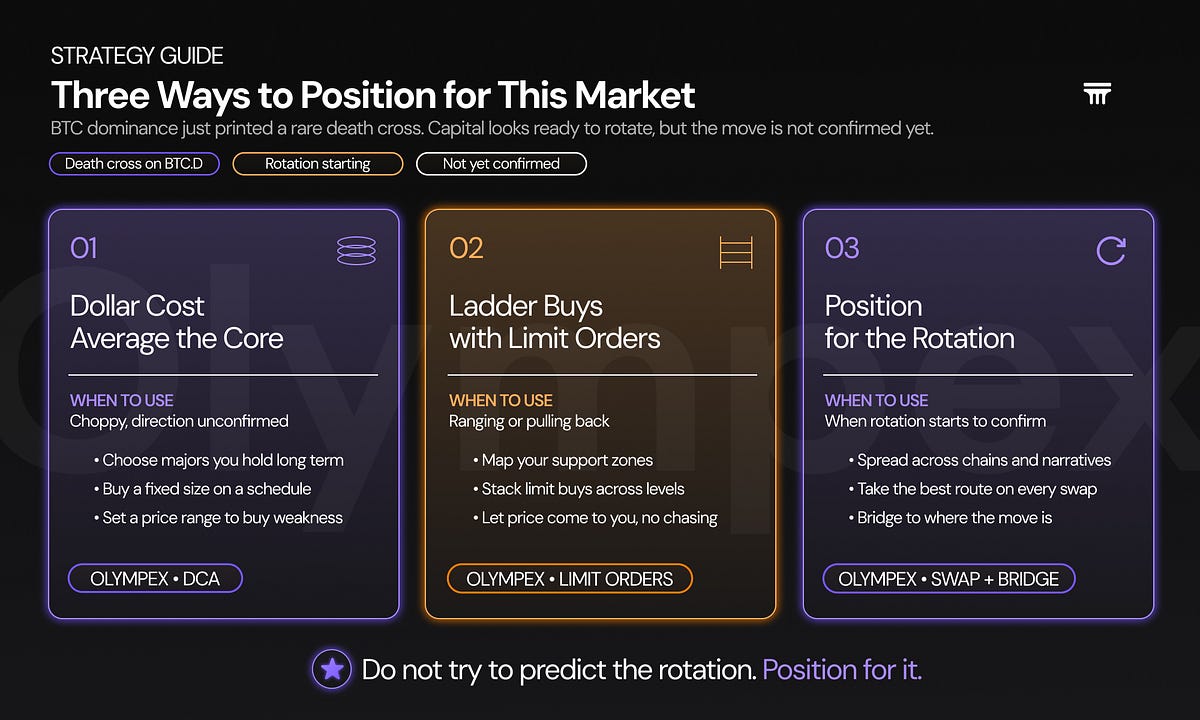
So instead of one big call, here are three strategies for exactly this kind of market. Each one is built to work without perfect timing, and each maps to a feature you can use today.
Strategy 1: Dollar cost average the core
When direction is unconfirmed, the worst thing you can do is wait for the perfect entry that never feels safe. The antidote is dollar cost averaging: buying a fixed amount on a fixed schedule so your average price is built from many entries instead of one nervous decision.
This is the right tool when you have conviction in an asset over the long term but no conviction about next week. You stop trying to call the bottom and let consistency do the work. It also keeps you from the two classic mistakes of a transition market, which are freezing during fear and over committing during a relief bounce.
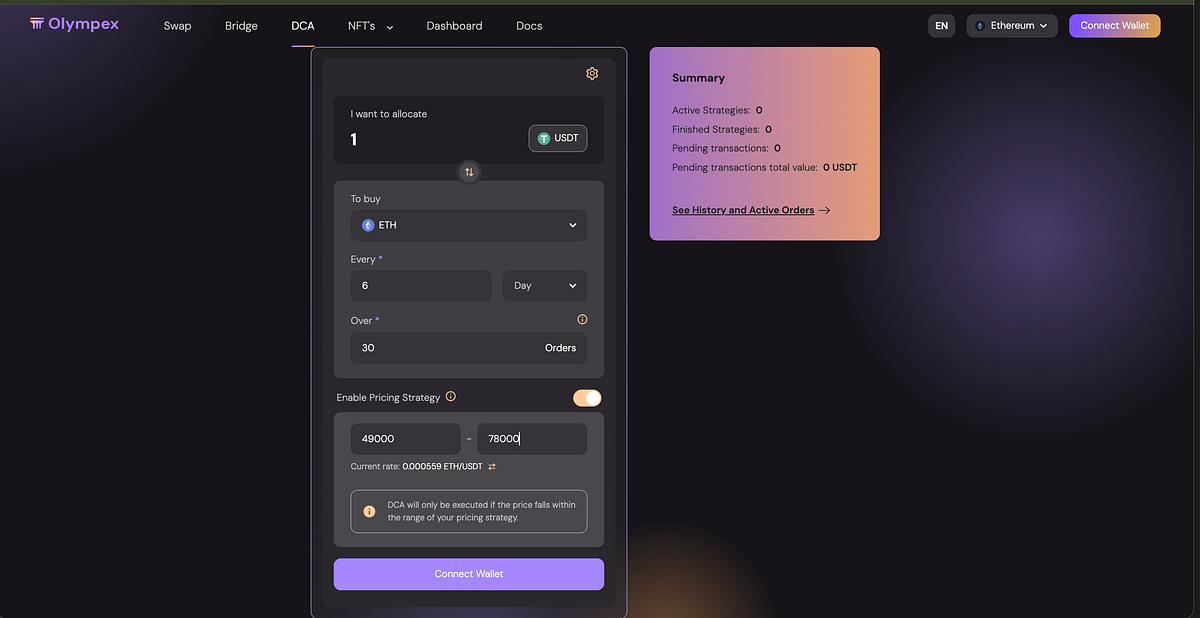
How to run it on Olympex: open the DCA tool, choose the asset you want to accumulate, set the amount and the frequency, and if you want to be more selective, set a price range so the plan only buys on weakness. Then leave it running. When funds are available in your wallet, the scheduled buys execute. When they are not, nothing happens and the plan simply waits. Pair it with basic diversification across a few core assets rather than one, and you have a calm, rules based way to build a position through the noise.
Strategy 2: Ladder your buys with limit orders
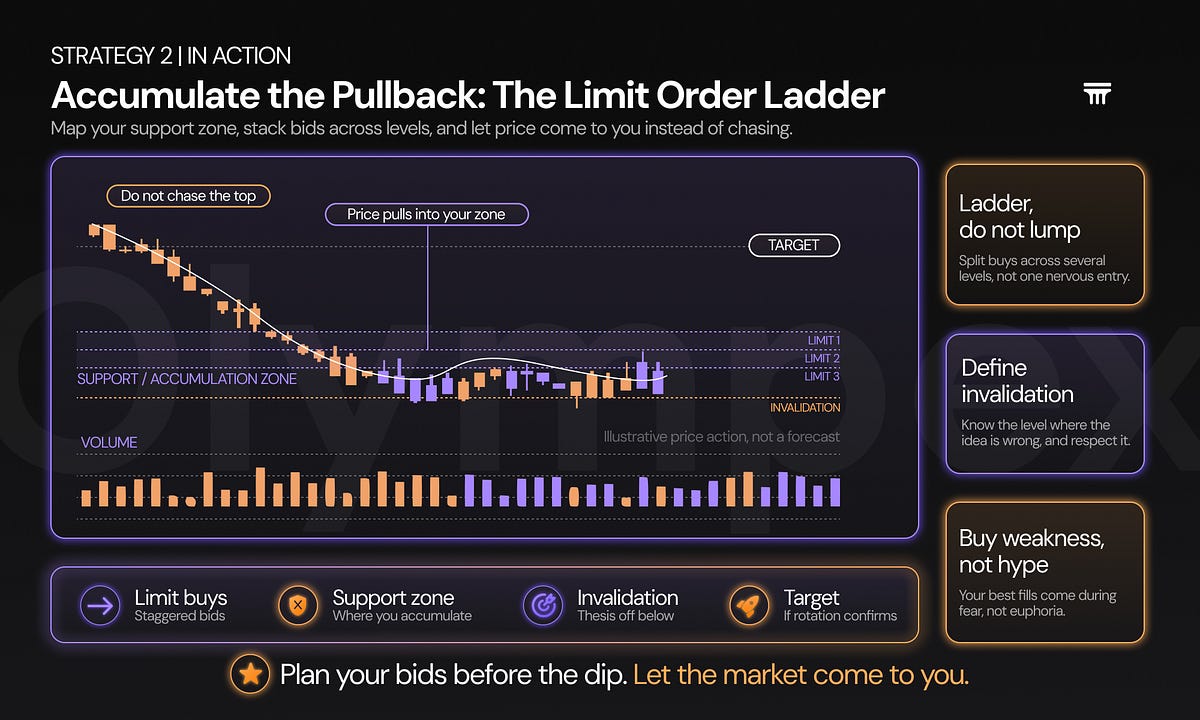
A correcting, range bound market does something useful: it hands you defined levels where price has reacted before. Instead of chasing green candles, you can place your bids in advance and let the market come to you.
This is where limit orders shine. Map the support zones you actually believe in, then stack several limit buys across those levels rather than putting everything at one price. If price dips into your zones, you accumulate at prices you chose with a clear head. If it does not, you were never forced into a bad entry by emotion.
How to run it on Olympex: set limit orders at your mapped levels so your execution is automatic and pre planned. The discipline here is in the preparation, not the reaction. A laddered set of bids turns a scary pullback into a shopping list you wrote when you were calm. The key rule is to size each rung so that even if only the highest one fills, you are comfortable, and if all of them fill, you are not overexposed.
Strategy 3: Position for the rotation across chains
If the death cross plays out the way the last two did, capital will not flow into one token on one chain. In 2026 the rotation looks selective and spread across many narratives and many networks at once. The opportunity, and the difficulty, is that the action is fragmented.
This is the moment a multichain execution layer earns its keep. As signs of rotation strengthen, for example dominance breaking below 55 percent and Ethereum starting to lead, you want to be able to move efficiently to wherever the strength is showing up, without being stranded on a single chain or bleeding value to poor execution.
How to run it on Olympex: use aggregated routing so every swap takes the best available path across liquidity sources, use the cross chain bridge to rotate to the network where the move is happening, and keep everything in view through the multichain dashboard so you are managing one portfolio rather than five disconnected wallets. The point is not to predict which narrative wins. It is to make sure that when you decide, you can act across the whole market quickly and cleanly.
The part most people skip: knowing when you are wrong
A strategy without an invalidation level is just a hope. For this particular setup, the cleanest invalidation is simple: if Bitcoin dominance climbs back above roughly 65 percent, the rotation thesis is on hold, and the strategies that lean toward altcoins should be scaled back. Equally, the rotation is not confirmed until the Altcoin Season Index sustains a move higher, not just a single spike. Decide your levels before you need them.
None of these strategies remove risk. Dollar cost averaging into a falling asset still loses money if the asset never recovers. Limit orders fill into weakness that can keep going. Rotating across chains means more decisions and more ways to be wrong. What these approaches do is replace guessing with structure, which is the single most valuable thing you can bring to an uncertain market.
The takeaway
The death cross on Bitcoin dominance is a genuinely rare signal, and it deserves attention. But attention is not the same as certainty. The market is telling you that change is likely, not that it has arrived. The traders who do well from here will not be the ones who called the exact top of dominance. They will be the ones who built a plan that works across several outcomes and executed it without drama.
Do not try to predict the rotation. Position for it, define where you are wrong, and let your setup do the work.





