
For decades, the S&P 500 has been seen as the gold standard of diversification.
The idea is simple. By investing in the 500 largest companies in the United States, you gain broad exposure to the market. You are not betting on a single company or sector. You are investing in the economy as a whole.
But today, that assumption deserves a closer look.
A Market Driven by a Few
Press enter or click to view image in full size
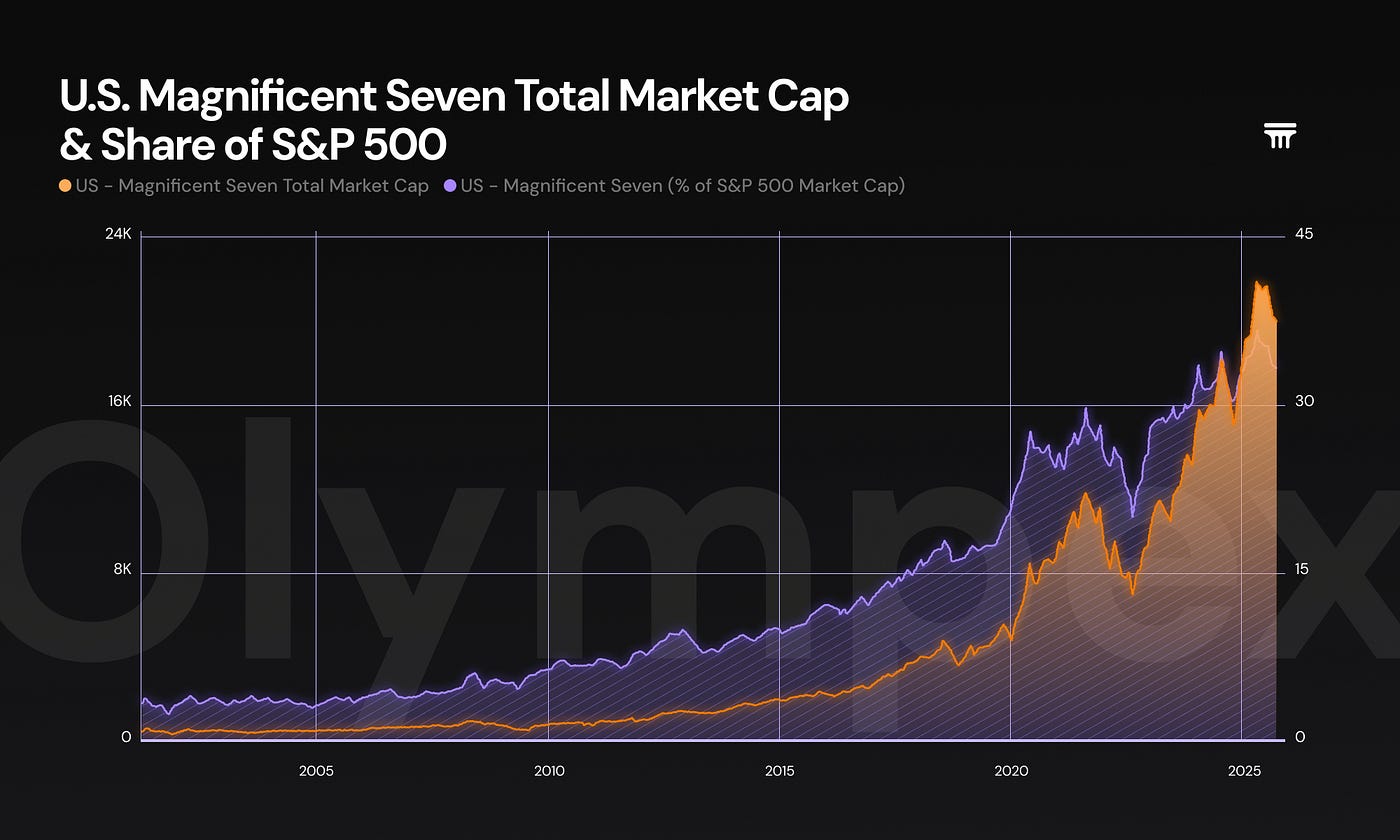
The first chart shows how a small group of companies, often referred to as the Magnificent Seven, has grown to dominate the S&P 500.
Their total market capitalization has increased significantly over time. More importantly, their share of the index has also expanded.
This means that a growing portion of the market’s performance is being driven by a very limited number of companies.
What appears to be a broad index is increasingly concentrated.
A Historically Unusual Situation
Press enter or click to view image in full size
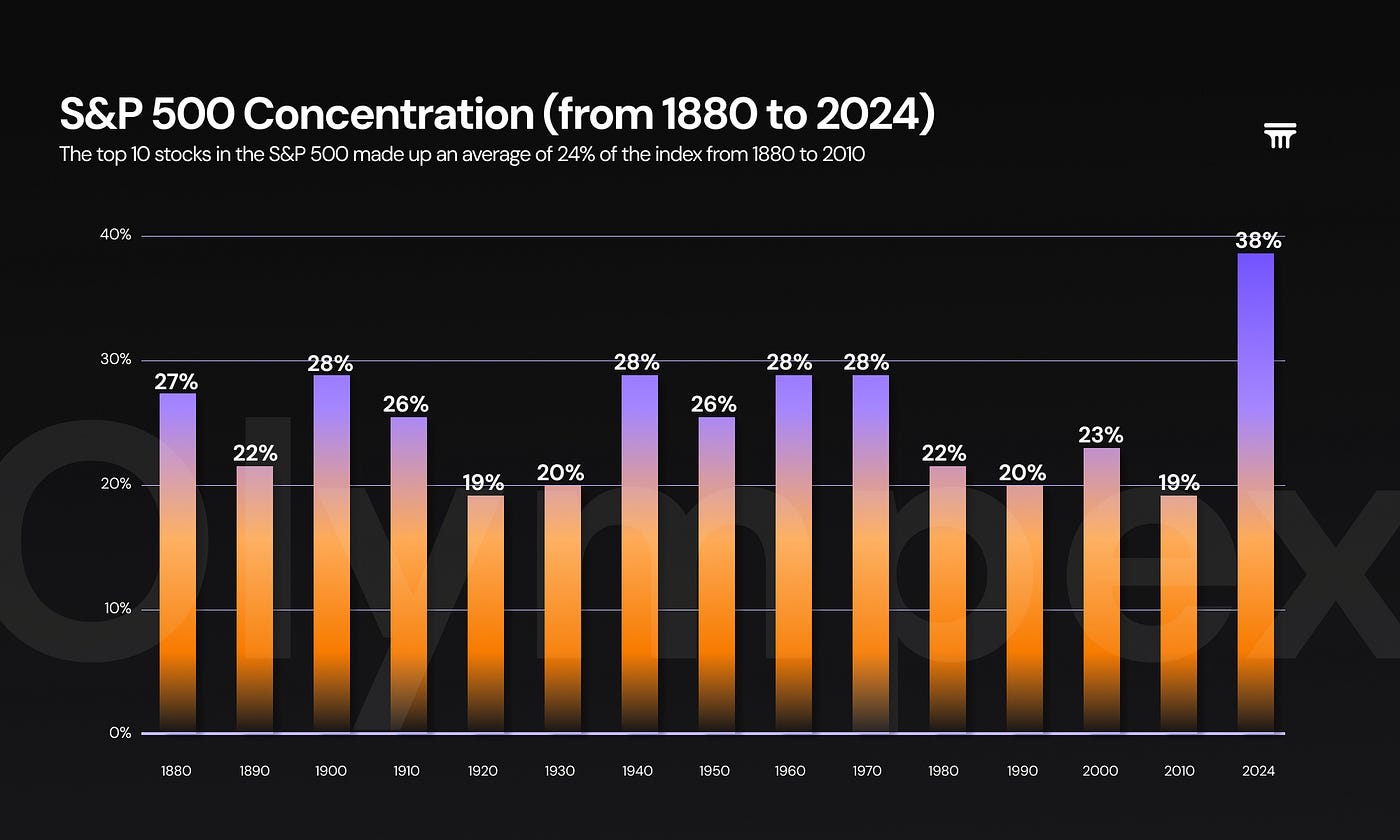
Market concentration is not new, but the current levels are.
For most of modern financial history, the top ten companies in the S&P 500 represented around 24 percent of the index. Today, that number is closer to 38 percent.
This puts the current market structure near historical extremes.
The implication is simple. The index is no longer evenly distributed across hundreds of companies. It is heavily weighted toward a small group at the top.
Not All Growth Is Equal
Press enter or click to view image in full size
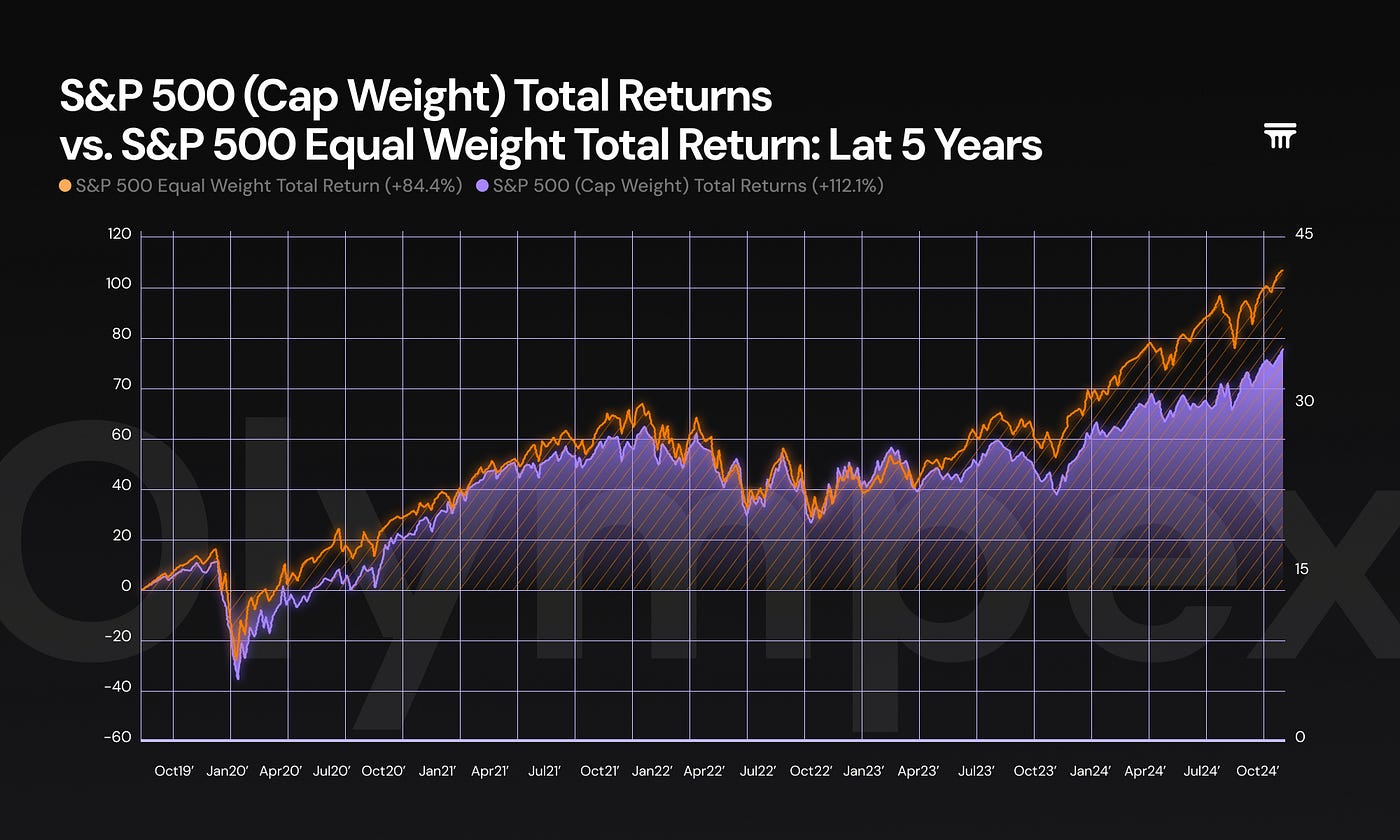
This third chart is where the insight becomes undeniable.
It compares two versions of the S&P 500. One is weighted by market capitalization, which is how the index is traditionally constructed. The other gives equal weight to every company.
The result is clear. The cap weighted index has outperformed.
However, this outperformance does not come from the entire market rising together. It comes primarily from the largest companies.
If every company contributed equally, the returns would be lower.
This reveals something important. Investors are not fully exposed to the market. They are exposed to the biggest players within it.
The Illusion of Diversification
At first glance, holding the S&P 500 feels like diversification.
In reality, the exposure is concentrated. Risk is tied to a handful of companies. Performance depends on a narrow segment of the market.
This creates what can be described as diversification in form, but not in substance.
The portfolio looks diversified, but behaves as if it is not.
Rethinking Portfolio Construction
In today’s environment, diversification requires more than simply holding multiple stocks.
It requires exposure to different types of assets that respond differently to market conditions.
Growth assets such as equities play one role. Protective assets such as gold play another. Liquidity, often represented by stablecoins, introduces flexibility. Opportunistic strategies allow capital to adapt when conditions change.
The combination of these elements creates a more resilient structure.
A Shift in Perspective
The issue is not that the S&P 500 is flawed.
The issue is assuming that it is sufficient on its own.
Markets have evolved. Concentration has increased. Opportunities now exist across multiple asset classes and infrastructures.
As a result, investors need tools that allow them to move efficiently between these opportunities and manage their portfolios without unnecessary friction.
Final Thoughts
Investing is no longer just about choosing assets.
It is about understanding how those assets are structured, how they interact, and what kind of exposure they truly provide.
In a highly concentrated market, real diversification becomes a strategic decision, not a default outcome.
Stay Ahead
If you want to better understand how to build flexible portfolios, manage liquidity, and access new financial infrastructure, join our Telegram.
Stay informed. Stay adaptable.





