

Safe or a Trap? It’s Your Money.
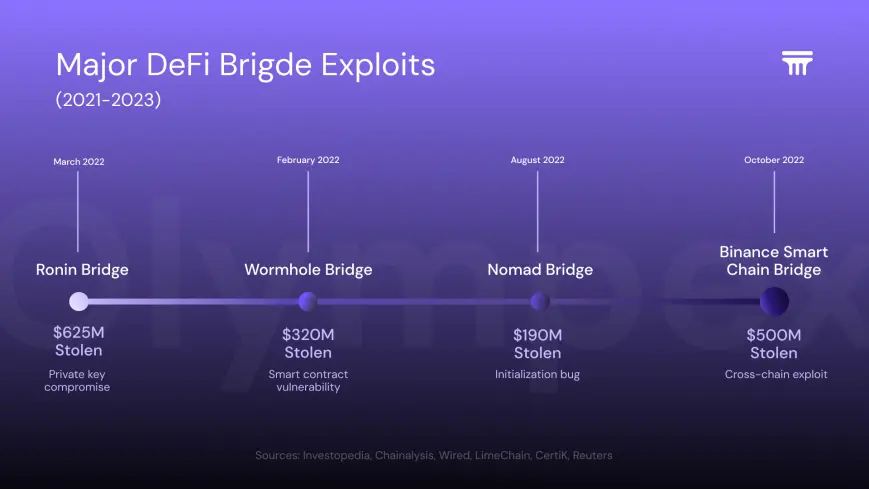
Cross-chain bridges are among the most critical and vulnerable pieces of infrastructure in DeFi. By enabling assets and data to move between blockchains, they unlock interoperability, but also concentrate enormous risk. Over the past three years, more than $2.5 billion has been lost to bridge exploits, making them one of the prime targets for attackers [Chainalysis, 2023].
This post reviews what went wrong in notorious incidents, what solutions the industry developed in response, and how Olympex integrates these lessons into a security-first bridge architecture.
The Anatomy of Bridge Exploits
Ronin Bridge (2022 — $625M lost)
Attackers compromised validator keys, controlling enough nodes to approve fraudulent withdrawals.
Lesson: validator decentralization and key management are single points of failure.
Wormhole (2022 — $320M lost)
A smart contract bug allowed attackers to mint wrapped ETH without collateral.
Lesson: unaudited contracts and missing on-chain verification mechanisms create critical vulnerabilities.
Nomad (2022 — $190M lost)
A faulty initialization in smart contracts allowed anyone to spoof transactions. Once discovered, it triggered a copycat free-for-all.
Lesson: Contract misconfiguration is as dangerous as malicious code.
Emerging Security Practices
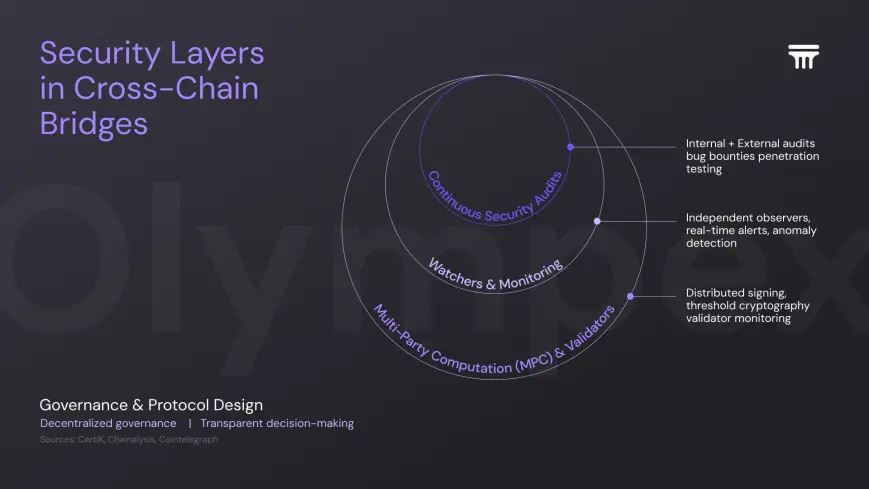
To address these risks, several layers of defense have become industry standards:
- Continuous Audits & Formal Verification
Third-party audits (CertiK, Trail of Bits, Quantstamp) and the adoption of formal verification reduce undetected contract errors. - Multi-Party Computation (MPC) & Threshold Signatures
Instead of relying on a single key, MPC distributes signing authority across independent parties, mitigating key compromise risk. - Watcher Networks / Guardian Sets
Independent “watchers” monitor bridge activity and can halt suspicious transactions.
Layered Security Architecture
Combining contract-level safety, off-chain monitoring, and governance-based fail-safes creates redundancy against diverse attack vectors.
Technology Leaders and Their Approaches
- LayerZero
Uses Ultra Light Nodes and an independent “oracles + relayers” model to verify transactions across chains. - Wormhole
Migrated to a guardian-based consensus with 19 validators, plus enhanced contract monitoring. - Axelar
Implements delegated proof-of-stake and MPC-based signing for improved decentralization.
Olympex: Security by Design
At Olympex, our cross-chain bridge integrates lessons from past exploits while adding structural safeguards:
- MPC-Based Signing with no single point of key compromise.
- Independent Watchers are able to flag and pause abnormal flows in real time.
- Continuous On-Chain Monitoring with automated alerts.
- Security in Layers: smart contract audits, governance oversight, and redundancy across validator sets.
Future-Proofing: exploring zk-proof based validation to remove reliance on external relayers.
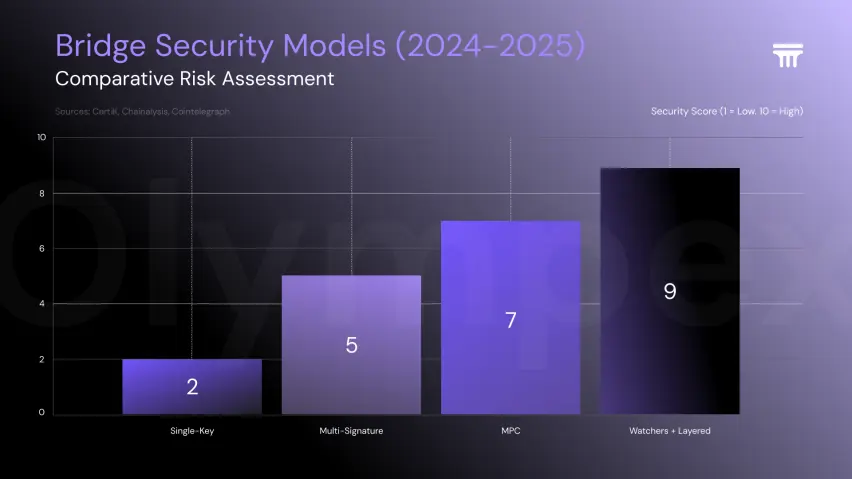
By combining these elements, Olympex offers a bridge that is not only functional but designed to withstand the evolving threat landscape in DeFi.
Conclusion
Not all bridges are created equal. History shows us that weaknesses in key management, smart contract integrity, or validator decentralization can be catastrophic. Secure bridges must be built on multiple layers of defense, from cryptographic safeguards to governance and monitoring.
Cross-chain bridges are the backbone of a multi-chain DeFi ecosystem, but history has proven that they are also its most fragile link. Billions lost to exploits remind us that innovation without security is nothing more than a trap waiting to spring.
The industry has matured, learning painful lessons and evolving toward layered defenses, continuous audits, and advanced cryptographic tools. Yet, for users, the decision remains simple: where you choose to move your assets defines whether you’re unlocking opportunity or exposing yourself to unnecessary risk.
At Olympex, security isn’t an afterthought; it’s the foundation. By combining MPC signing, independent watchers, continuous monitoring, and a multi-layered defense architecture, Olympex is building a bridge that puts user protection first.
In the end, your money deserves more than promises; it deserves proof. The choice is yours: will you take the safer path forward?





