
Real-World Assets Need Better Rails
Why tokenized RWAs make more sense through a DEX aggregator like Olympex
Draft blog for Olympex, prepared for editorial and design adaptation. Data referenced as of May 2026. Not financial advice.
Executive summary
Real-world assets, or RWAs, are becoming one of the most important bridges between traditional finance and crypto. Treasury bills, money market funds, tokenized gold, private credit, equities, ETFs, bonds and other instruments are starting to move on-chain. The opportunity is not only about listing traditional assets as tokens. The real shift is that financial assets can become programmable, globally accessible, composable and usable inside DeFi strategies.
For traders and investors, the key question is no longer only whether RWAs will grow. The better question is: where should users access them? A centralized exchange can offer simplicity, but a DEX aggregator can offer a different kind of advantage: non-custodial access, route comparison, cross-chain execution and better quote discovery across fragmented liquidity.
The market signal: RWAs are no longer a theoretical use case
The RWA sector has moved from narrative to production. According to RWA.xyz, tokenized real-world assets already represent tens of billions of dollars in distributed value, with hundreds of thousands of asset holders and activity across dozens of networks. CoinGecko reported that tokenized RWAs grew 256.7% over the fifteen months ending March 31, 2026, from $5.42 billion to $19.32 billion, excluding stablecoins. MetaMask also reported that tokenized US Treasuries and money market products had become one of the strongest categories, with roughly $12.98 billion in market size by April 2026.
This matters because tokenization is not just another crypto sector trying to invent demand from scratch. It connects blockchain infrastructure to assets that already have demand in the traditional economy: cash equivalents, government debt, equities, commodities, private credit and eventually real estate, funds and structured products.
Press enter or click to view image in full size
CEX access vs DEX aggregator access
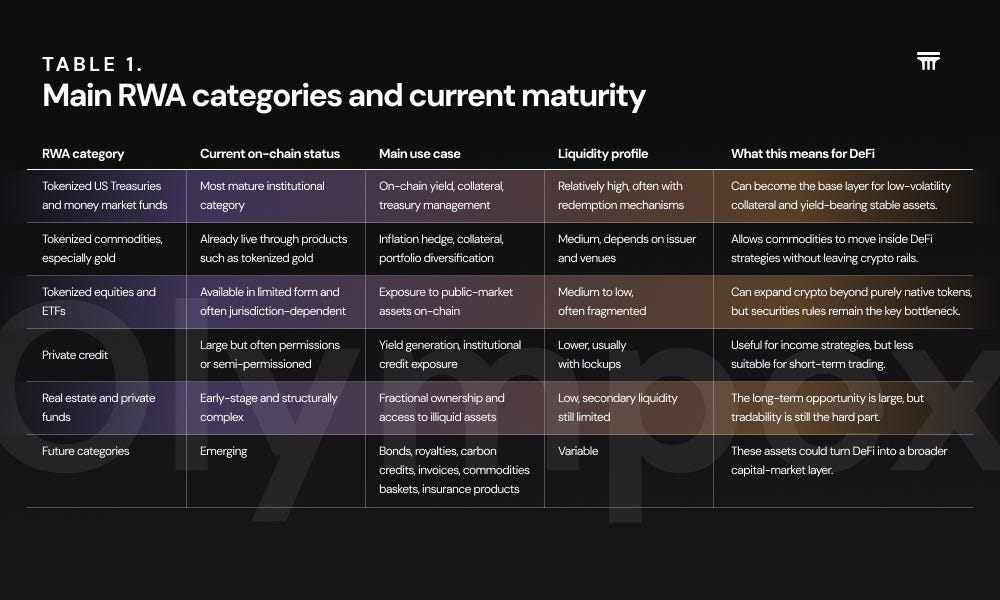
Centralized exchanges can be useful for onboarding, fiat rails and simple buying flows. But they also recreate many of the same constraints that crypto was supposed to reduce: custody, account risk, platform-specific listings, opaque execution and limited access depending on geography or compliance requirements.
A DEX aggregator approaches the problem differently. Instead of forcing the user into one exchange order book, it compares liquidity sources and routes across integrated protocols. For RWAs, this becomes especially relevant because tokenized assets are fragmented by network, issuer, liquidity pool, compliance design and trading venue.
Press enter or click to view image in full size
Why Smart Routing matters more for RWAs than for simple crypto swaps
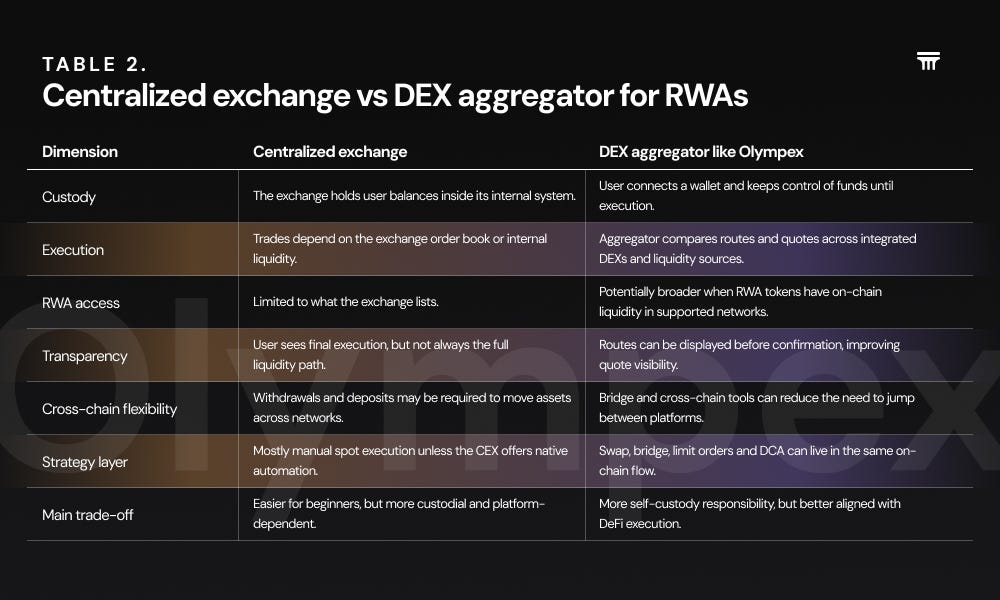
In a highly liquid token pair, poor routing can still hurt execution. In RWAs, poor routing can hurt even more because liquidity can be thinner, more fragmented and spread across different networks or pools. A tokenized Treasury product, a tokenized gold instrument or a tokenized stock representation may not have the same depth everywhere. In that environment, best execution depends on finding the route that produces the best available quote, not simply clicking the first visible pool.
This is where a DEX aggregator becomes strategically relevant. Olympex is designed to retrieve quotes from an extensive catalog of integrated DEXs, search and optimize trading routes, and inform the user of the available prices before execution. In plain terms, Smart Routing is not a magic promise of lower network fees. Its real value is route selection, price discovery and better execution across fragmented liquidity.
Press enter or click to view image in full size
Which RWAs are available today, and which could come next?
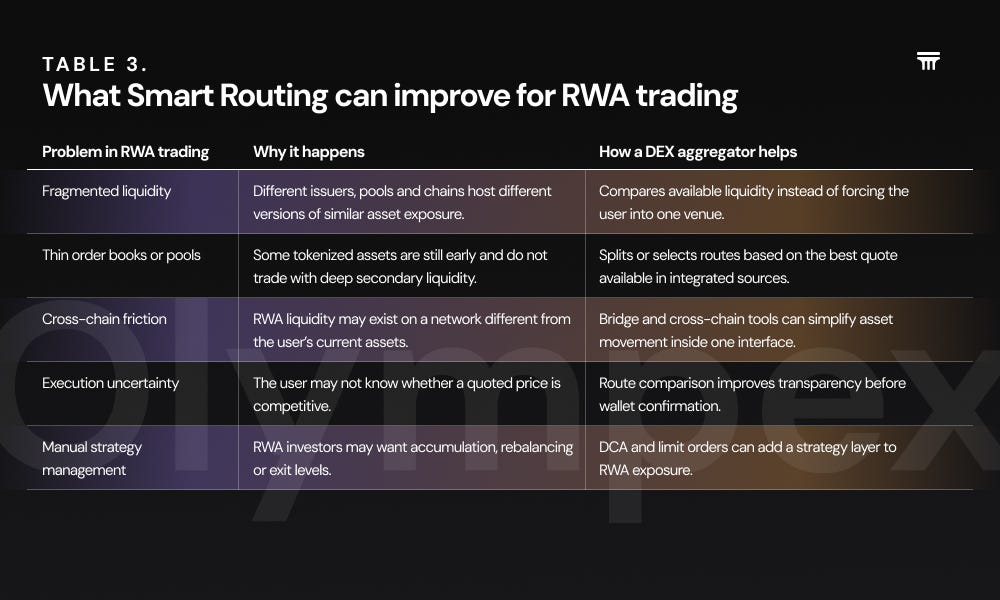
The current RWA market is not one single category. It is a stack of very different products. Some are already liquid and practical for DeFi use. Others are technically tokenized but still limited by regulation, issuer controls, lockups or thin secondary markets.
Available or already developing
• Tokenized US Treasuries and money market funds, used for on-chain yield, collateral and treasury management.
• Tokenized gold and commodities, useful as on-chain hedges and collateral-like assets.
• Tokenized equities and ETFs, available in limited jurisdictions and usually with more compliance restrictions.
• Private credit products, attractive for yield but often less liquid and more permissioned.
• Stablecoins, which are not always classified as RWAs in the strictest sense, but remain the largest example of real-world value represented on-chain.
Likely next wave
• Tokenized corporate bonds and municipal bonds.
• Tokenized index products and diversified asset baskets.
• Real estate income products and fractional ownership structures.
• Carbon credits, energy credits and commodity-linked products.
• Private equity, venture funds, royalties and structured yield products.
Which blockchains are pushing RWA adoption?
Ethereum remains the dominant institutional settlement environment for tokenized assets, especially Treasuries and money market products. But the RWA map is becoming increasingly multi-chain. Stellar, Solana, Polygon, Avalanche, Arbitrum, Base and BNB Chain are all appearing in RWA conversations depending on the asset class, issuer and distribution strategy. This matters because the future of RWAs will not be one chain with one venue. It will be a fragmented market that needs aggregation, routing and cross-chain execution.
Network or ecosystem
Press enter or click to view image in full size
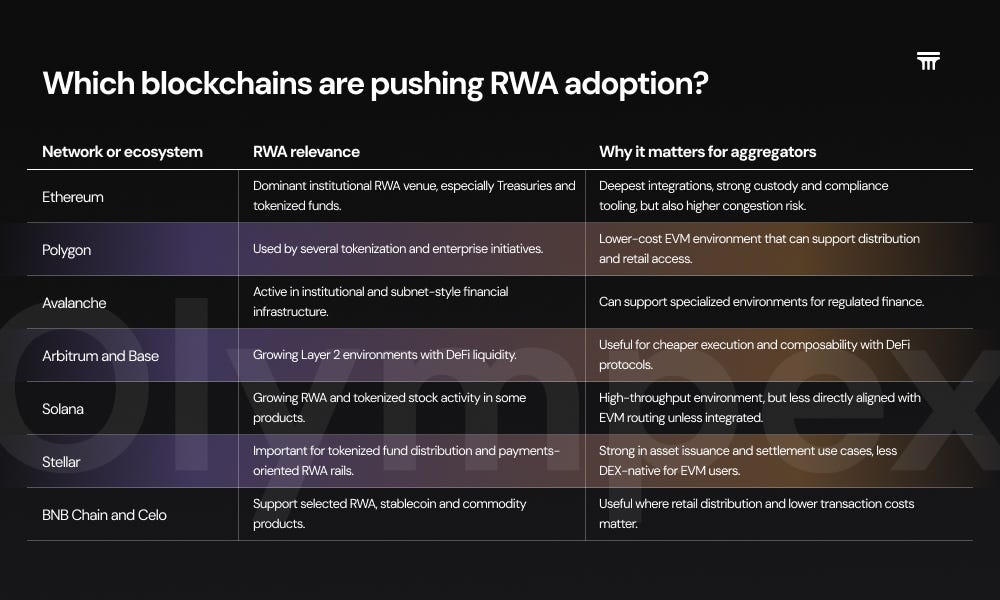
Source note: RWA.xyz tracks RWA activity across 35 networks, and MetaMask reports that Ethereum hosts the majority of tokenized Treasury value while Stellar, Solana, Polygon, Avalanche, Arbitrum, Base and BNB Chain also support Treasury products.
Why RWAs can expand the crypto market
RWAs can change the role of crypto from a market centered only on native tokens to a broader execution layer for global assets. This does not mean every traditional asset should be tokenized tomorrow. It means the rails are becoming more useful.
For DeFi, RWAs can bring more collateral, more yield sources, more stable instruments and more reasons for institutions to interact with on-chain infrastructure. For traders, they can create a more complete market environment: crypto-native volatility, tokenized cash equivalents, commodities, equities and eventually income-generating assets inside one execution stack.
This is the same logic that made ETFs powerful in traditional markets. ETFs did not invent stocks, bonds or commodities. They improved packaging, distribution and access. Tokenization can do something similar, but with programmable settlement, wallet-based ownership and composability across DeFi.
Market comparison: traditional assets, Bitcoin and altcoins
One reason RWAs matter is that crypto users increasingly want access to more than native crypto beta. Bitcoin can outperform in some cycle windows, but public equities and AI-led mega-cap stocks have also delivered massive returns. Meanwhile, altcoins can produce extreme upside in selected windows and painful underperformance in others. A broader on-chain asset universe gives users more ways to allocate capital instead of being trapped in one narrative.
Press enter or click to view image in full size
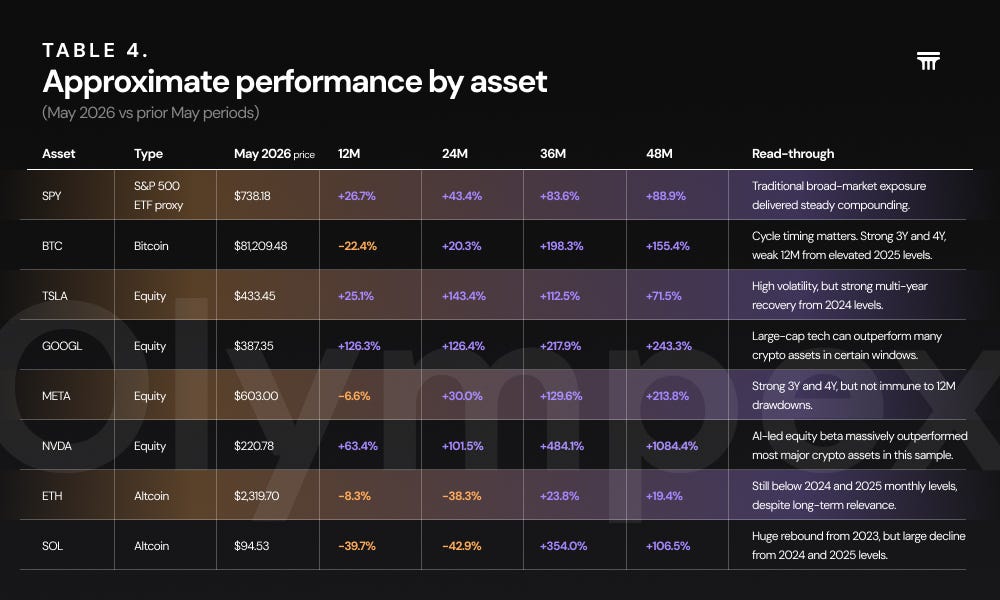
Methodology: return = May 2026 adjusted monthly price divided by adjusted monthly price for May 2025, May 2024, May 2023 and May 2022, minus one. Data is rounded and intended for strategic comparison, not trading decisions.
What the performance table actually says
The point is not that tokenized stocks are always better than crypto, or that Bitcoin is always better than equities. That would be lazy analysis. The real point is that different assets dominate different windows. Bitcoin dominated the 3-year comparison. Nvidia dominated the 4-year comparison. Solana had a massive 3-year rebound but was still deeply negative over 12 and 24 months. ETH remained structurally important, but underperformed in this sample.
For users, this creates a simple strategic argument: if global assets can move on-chain, DeFi becomes less dependent on one asset class. Traders can rotate between crypto-native assets, tokenized cash equivalents, equities, commodities and yield products without leaving the broader Web3 execution layer.
Where Olympex fits into the RWA thesis
Olympex is not just competing to be another trading screen. Its strongest positioning is as an execution layer that can unify tools across fragmented DeFi markets. The platform combines DEX aggregation, bridge and cross-chain functionality, limit orders, DCA automation and a multichain dashboard inside one interface. That matters because RWAs will not scale through isolated tools. They will scale through infrastructure that helps users discover routes, compare quotes, move assets across chains and build strategies around them.
As more RWAs become liquid on-chain, the user problem will become familiar: too many assets, too many chains, too many pools, too many venues and too much execution friction. A DEX aggregator can turn that fragmentation into a more usable market. And in a sector where liquidity is still uneven, that usability can become a real edge.
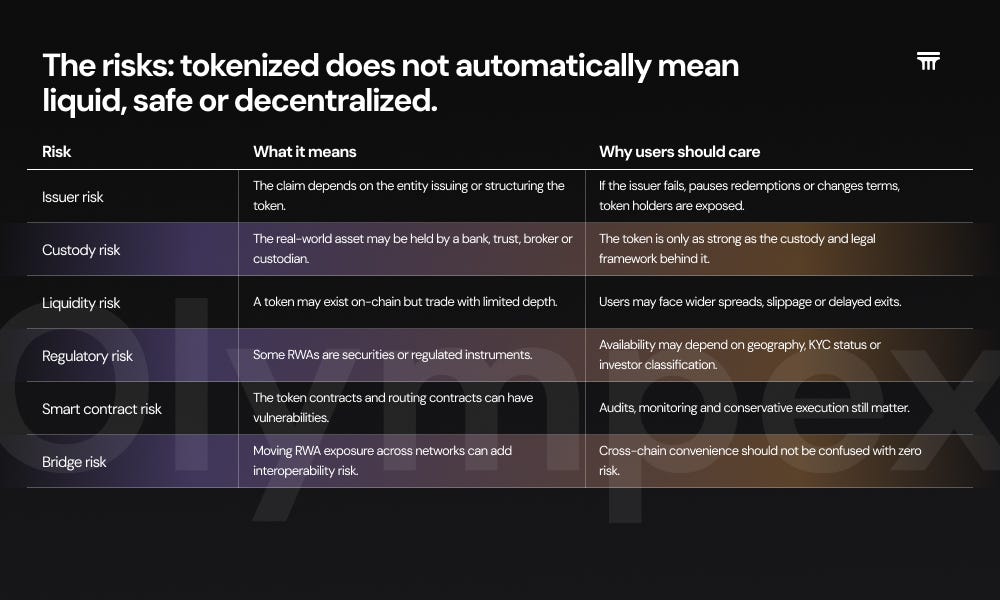
The risks: tokenized does not automatically mean liquid, safe or decentralized
The RWA narrative is strong, but it should not be oversold. Tokenized assets carry additional risks that users need to understand. A token can be on-chain while the underlying asset is still held by a custodian, governed by legal contracts, subject to redemption windows or restricted by compliance rules. In other words, the blockchain token is only one part of the stack.
Press enter or click to view image in full size
Conclusion: RWAs need execution, not just tokenization
The next phase of tokenized real-world assets will not be won only by the platforms that tokenize the most assets. It will be won by the infrastructure that makes those assets usable. Tokenization creates the representation. Liquidity makes it tradable. Routing makes it efficient. Strategy tools make it useful.
That is why DEX aggregation matters. A centralized exchange may list selected RWA products, but a DEX aggregator can become the layer that connects users to the best available on-chain opportunities across liquidity sources and networks. If RWAs are going to bring traditional assets into crypto, execution quality will become one of the main battlegrounds.
For Olympex, the opportunity is clear: position the platform as a multichain execution layer where users can access, compare and trade tokenized opportunities without surrendering custody or jumping across disconnected tools. RWAs can bring more value into DeFi. Aggregation can make that value usable.





