

Mastering Bridges for Bigger Gains
Bridging between blockchains is more than just a technical necessity; it is the backbone of the vision that makes DeFi truly borderless. In theory, bridges should function as invisible highways, seamlessly connecting assets, applications, and liquidity across ecosystems. But in practice, most users quickly realize that the road is far from smooth. What should feel like a fluid experience often turns into a fragmented and frustrating journey.
The issues are not just about missing “nice-to-have” features. They cut deeper, striking at the heart of the three elements that define the value of any bridge: liquidity, latency, and user experience (UX). When liquidity is fractured across multiple silos, traders pay higher spreads and suffer from slippage. When latency slows down execution, strategies that depend on speed collapse. And when UX is poorly designed, even technically sound bridges feel unusable to anyone outside of a niche group of experts.
These bottlenecks don’t just create inefficiencies; they actively undermine DeFi’s promise. Instead of enabling freedom, they lock users into second-best choices: settling for higher costs, slower transfers, or incomplete functionality. And for institutions or professional traders looking to integrate DeFi into their operations, these flaws are often deal-breakers.
Yet the horizon is changing. A new generation of infrastructure is beginning to rethink bridges not as isolated pipes, but as living systems built with smart routing, unified liquidity, and intuitive design at their core. By removing the traditional pain points, they unlock not only better performance, but also a smoother, more empowering user journey.
In this article, we dive into the three fundamental challenges: liquidity, latency, and UX, analyzing their real-world impact on traders and protocols, and we show how an integrated approach can transform bridging from a technical burden into a genuine growth engine for DeFi.
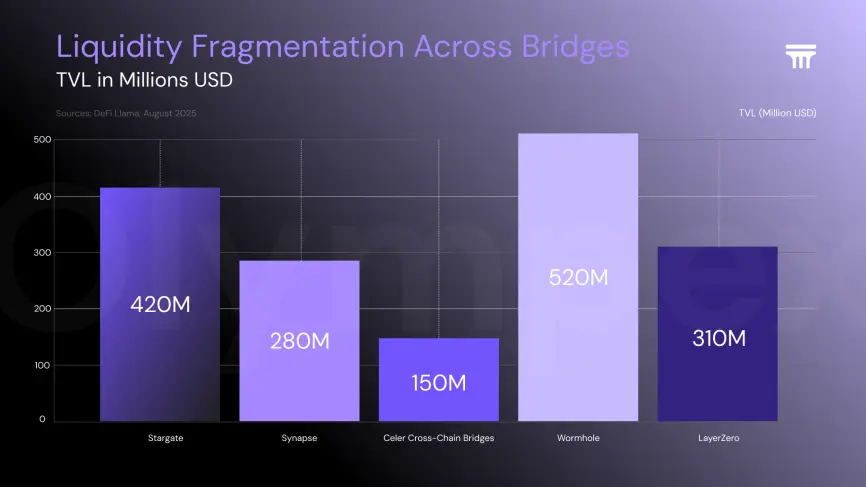
Fragmented Liquidity
What it is: Liquidity is spread thin across multiple chains and pools, creating inefficiencies and slippage.
Why it matters: When liquidity is fragmented, large trades become costly or opaque due to slippage and depth constraints.
Example protocols:
- Stargate: aggregates cross-chain liquidity but faces slippage in low-liquidity pairs.
- Synapse: faces challenges moving assets quickly between under-utilized chains.
Celer (cBridge): relies on multiple liquidity pools, increasing fragmentation risk.
Impact on users: Limits strategy precision for arbitrage and automated trading.
Sources: DefiLlama, Dune Analytics, Token Terminal data.
Latency & Cross-Chain Delays
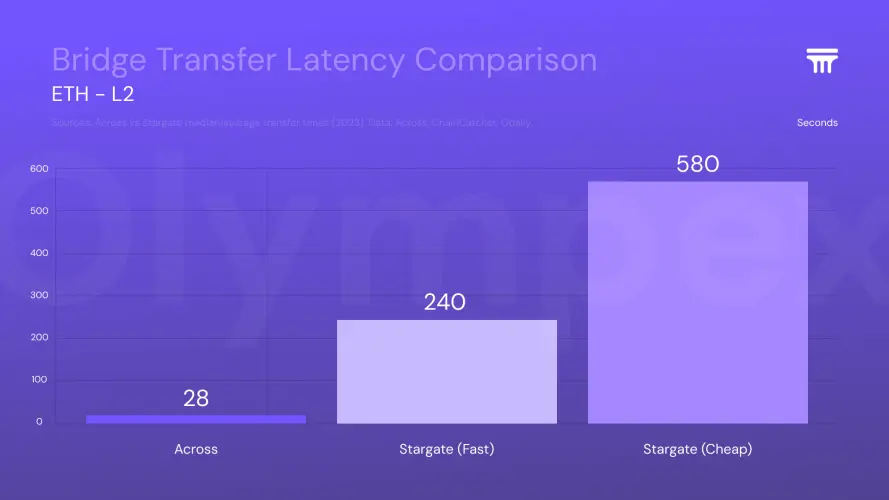
What it is: The time gap between initiating a transfer and confirmation on destination chain.
Why it matters: Latency disrupts algorithmic and flash trading strategies that require fast state updates.
Case in point: Bridges using central relayers or batch settlement (e.g., Synapse) can delay finalization by minutes.
Impact: Automated strategies (like DCA or limit orders) may execute at unfavorable prices due to latency.
Sources: DeFiLlama bridges docs, Chainlink Labs latency reports.
Disjointed UX
What it is: Complex workflows, inconsistent interfaces, and fragmented user feedback.
Why it matters: Confusing design and delays deter users.
Examples:
- Many bridges require manual steps across chains, wallet confirmations, and confusing fields.
- Mobile wallets often struggle with cross-chain interactions.
Impact: Traders may abandon transfer mid-process, or duplicate chains incorrectly.
Sources: Cointelegraph articles, user surveys on bridge pain points.
Extra Angles to Enhance the Post
- Security vs. UX trade-offs: Bridges with low latency often compromise on decentralization (e.g., Synapse relies on centralized relayers).
- Gas inefficiencies across networks: Highlight how high gas on certain chains can compound UX challenges.
- Developer-support friction: Building on bridges that rely on fragmented liquidity increases integration complexity.
- Cross-chain state consistency: Not just fast transfers, but also accurate cross-chain state is needed for advanced use cases (like liquid staking).
Integrated Solution
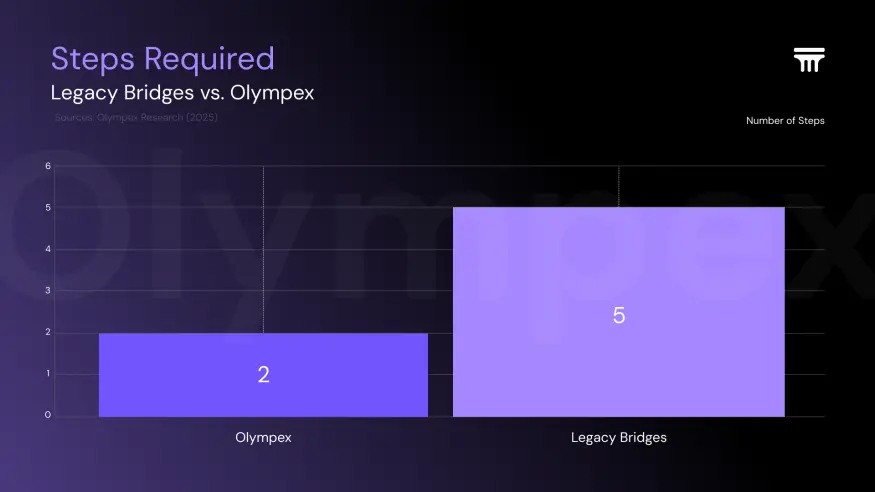
Olympex bridges the gap: liquidity, latency, and UX are addressed as a cohesive system:
- Unified Liquidity Layer: Smart-routing engine sources cross-chain liquidity depth optimally via Aggregators, AMMs, and vaults.
- Low-Latency Mechanism: Near-real-time messaging and confirmations across chains, using Ultra Light Nodes and relayer redundancy.
- User-centric UX: One-step cross-chain swaps with previews, execution status, and recovery options. Mobile-first responsive interface.
Developer-Ready API: Simplifies auto strategies and DEX integrations with consistent interfaces across chains.
Sources: Olympex internal design docs, UX audit comparisons, and tested bridges metrics.
Conclusion: The Future of Bridges Is More Than Just Transfers
For too long, bridges were treated as siloed pipelines, mere conduits to move tokens from one chain to another. That model no longer works. In today’s Web3, where speed, composability, and user trust define the winners, a bridge must be more than a technical shortcut: it must be the invisible infrastructure of liquidity and strategy.
1. From Transport to Infrastructure
A bridge can no longer be judged only by whether funds “arrive on the other side.” The new standard demands seamless execution, reduced risk, and frictionless onboarding for users who are not engineers but investors, builders, and communities. In this sense, a bridge is no longer a tunnel; it is a foundation upon which dApps, DeFi strategies, and cross-chain economies can scale.
2. Liquidity Is King
Bridging is not valuable unless it brings usable liquidity where it’s needed most. That means dynamic routing, deep pools, and integrations that avoid fragmentation. Liquidity without accessibility is wasted capital; accessibility without liquidity is an empty promise. The bridge of the future must optimize both simultaneously.
3. Speed as a Trust Factor
In blockchain, speed is more than convenience; it is psychological trust. Delays in bridging create doubt; doubt slows adoption. Users today expect the certainty of instant settlement, or they move on. Smart infrastructure bridges like Olympex deliver this by reducing confirmation bottlenecks and optimizing cross-chain logic.
4. Usability as the Onboarding Key
The biggest roadblock for newcomers has never been “where” to bridge, but “how.” Confusing steps, multiple wallets, and long waiting times all kill adoption. By designing bridges as user-first gateways, clear, intuitive, and secure, we are not just moving tokens; we are moving people into ecosystems.
5. Beyond Transfers: Strategy and Growth
The next generation of bridges does not just connect chains; it connects opportunities. A trader who bridges through Olympex doesn’t just move USDT from Ethereum to Polygon; they unlock farming, staking, hedging, and arbitrage strategies that would be impossible in isolation. The bridge becomes a strategic tool, not just a pipe.
Olympex’s Vision
At Olympex, bridging is not a service, but an experience. Our smart infrastructure removes bottlenecks, accelerates settlement, and integrates liquidity layers so that users are not limited to “moving capital” but are empowered to deploy capital intelligently.
We see bridges as the onboarding ramp for the next million users — not just crypto-native developers, but traditional investors, creators, and communities ready to tap into Web3. That is why we build with the philosophy of simplicity, scalability, and strategic empowerment.
Final Reflection: The Bridge as a Catalyst
The future of blockchain is multichain. The question is not whether we will bridge, but how we will bridge. Those who treat it as a technical afterthought will fade into irrelevance. Those who build it as an experience, a strategy, and a trust layer will lead the next cycle of adoption.
Olympex is not redefining bridges for the sake of innovation; it’s redefining them because the next wave of growth depends on it.
In this new era, a bridge is no longer a tunnel between blockchains. It is the blueprint for liquidity, the catalyst for onboarding, and the gateway to strategy.
And with Olympex, that future is already here.





